The Venetian Master of Light and Drama
In the vibrant, water-bound splendor of eighteenth-century Venice, few artists captured the theatrical essence of the late Baroque and Rococo periods as fluently as Giovanni Battista Pittoni. Born on June 6, 1687, Pittoni emerged from a city that was itself a stage for grand spectacle, bringing to his canvas a sense of movement and luminosity that would define an era. While his early life was rooted in the traditions of his native Venice, his artistic soul was shaped by a profound connection to the masters who preceded him. Trained under the guidance of his uncle, Francesco Pittoni, he inherited a foundational understanding of the Venetian school, yet he possessed a unique vision that allowed him to transcend mere imitation.
The development of Pittoni’s style was an exquisite evolution of light and emotion. He drew deep inspiration from the dramatic chiaroscuro of Caravaggio and the textured depth of Rembrandt, yet he filtered these heavy influences through a distinctly Venetian lens. As his career progressed, his work began to reflect the lighter, more airy sensibilities of the Rococo, characterized by a shimmering palette and an elegant, almost weightless grace. His brushwork became increasingly fluid, capable of conveying both the divine majesty of a religious apparition and the delicate intimacy of a mythological encounter. This ability to navigate between the profound and the playful made him a central figure in the transition from the heavy drama of the Baroque to the refined elegance of the Rococo.
A Legacy of Theatricality and Grace
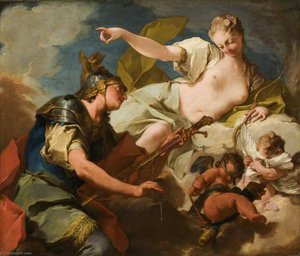
Pittoni’s oeuvre is a breathtaking collection of religious and mythological narratives, each designed to captivate the viewer through dynamic composition and expressive figures. His paintings often feel like frozen moments from a grand opera, where every gesture is imbued with meaning and every shadow tells a story. Whether depicting the serene sanctity of The Nativity or the heroic tension in Venus Giving Armour to Aeneas, his work possesses an unmistakable theatricality. He had a remarkable talent for utilizing light not merely as a tool for visibility, but as a spiritual protagonist, bathing his subjects in an ethereal glow that suggests the presence of the divine.
Beyond the confines of individual canvases, Pittoni’s influence extended to the very architecture of Venetian prestige. His mastery of large-scale composition earned him prestigious commissions for the ceilings and walls of grand palaces and churches across Italy. His work in the Palazzo Labia and various Milanese residences showcased his ability to transform structural spaces into immersive mythological worlds. This period of prolific creation solidified his reputation as a leading painter of his generation, capable of decorating the most significant civic and religious institutions with unparalleled sophistication.
Institutional Impact and Historical Significance
The historical importance of Giovanni Battista Pittoni extends far beyond the aesthetic beauty of his paintings; he was a cornerstone of the Venetian artistic community. His commitment to the formalization of art education led him to become one of the founding members of the Academy of Fine Arts, Venice. His leadership within this institution—eventually serving as its second president following the legendary Tiepolo—demonstrates the immense respect he commanded among his peers and the lasting impact he had on the training of future generations of Italian artists.
Though he was known to receive significant commissions from abroad, particularly from Germany, Pittoni remained deeply tied to the Venetian landscape. He was a painter who found greatness within the borders of his home, enriching the local culture with a style that was both internationally relevant and intimately Venetian. Today, his works serve as vital windows into the 18th century, embodying the transition of European art from the intense emotionality of the Baroque to the luminous, decorative splendor of the Rococo. His legacy lives on in the museums of the world, where his canvases continue to enchant viewers with their timeless elegance and dramatic brilliance.
Soru & Cevap
Giovanni Battista Pittoni eserlerinin kronolojik bir zaman çizelgesi var mı?
Sanatçının Eser Kronolojisi sayfası, Giovanni Battista Pittoni eserlerini yıl yıl, tarihe göre sıralanmış bir şekilde sunar.
Giovanni Battista Pittoni eserlerinin 3D sanal turu mevcut mu?
Giovanni Battista Pittoni sanatçısının 3B Müze, sanatçının eserlerini sanal bir üç boyutlu galeride sergileyen bir sayfadır.
Giovanni Battista Pittoni adlı sanatçının eserleri hangi duyguları yansıtıyor?
Sanatçının Ruh Haline Göre Oda sayfası, Giovanni Battista Pittoni eserlerini atmosferlerine göre düzenlenmiş bir şekilde sunuyor.
Giovanni Battista Pittoni adlı sanatçının eserlerine tekniklerine göre göz atabilir miyim?
Giovanni Battista Pittoni tarafından belirli bir teknikte üretilmiş tüm eserleri bulmak için sanatçının Tüm Teknikler sayfasını kullanabilirsiniz.
Giovanni Battista Pittoni hangi takma adlar veya alternatif isimlerle tanınmaktadır?
Giovanni Battista Pittoni aynı zamanda Giambattista Pittoni olarak da bilinir.
Giovanni Battista Pittoni en çok hangi renkleri kullandı?
Giovanni Battista Pittoni'in bu web sitesi üzerinde listelenen eserlerindeki renk kullanımı, sanatçının Palet Genomu sayfasından incelenebilir.
Giovanni Battista Pittoni sanatçısının eserlerine renklere göre ayrılmış şekilde nereden ulaşabilirim?
Renk İndeksi sayfası, Giovanni Battista Pittoni adlı sanatçının eserlerini renklere göre düzenler.
Giovanni Battista Pittoni sanatçısının konulara göre haritalanmış eserleri nerede bulunuyor?
Giovanni Battista Pittoni'in eserleri, sanatçının Konu Atlası sayfasında konuya göre keşfedilebilir.