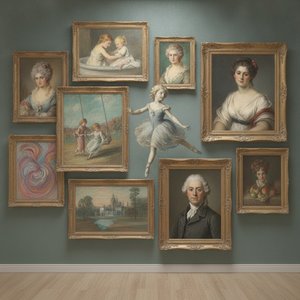
The Ethereal Grace of Gaston Bouy
In the vibrant, shifting landscape of late nineteenth-century France, few artists captured the delicate intersection of intimacy and elegance quite like Henri-Gaston-Jules-Louis Bouy. Known to the art world simply as Gaston Bouy, he emerged from the outskirts of Paris, specifically Bois-Colombes, to become a master of the pastel medium. His life, spanning from 1866 to 1943, coincided with a transformative era in European aesthetics, where the rigid structures of academic realism began to yield to the flowing, organic rhythms of Art Nouveau and the luminous experimentation of Impressionism.
Bouy’s artistic journey was rooted in the rigorous traditions of French excellence. His formal education at the prestigious Académie Julian and the École des des Beaux-Arts provided him with a formidable technical foundation. During these formative years, he breathed in the atmosphere of a Paris teeming with creative revolution, absorbing the subtle lessons of masters such as Auguste Renoir and Camille Pissarro. From them, he inherited a profound sensitivity to the ephemeral qualities of light and the ability to translate atmospheric nuances onto a surface, though he would eventually steer his talent toward a more specialized and soft-edged expression.
A Mastery of Light and Pastel
While many of his contemporaries sought the permanence and weight of oil on canvas, Bouy found his true voice in the ephemeral dust of pastels. This choice of medium was central to his identity as an artist. Unlike the heavy, slow-drying nature of oils, pastels offered him a sense of immediacy and a unique luminosity that allowed for unparalleled tonal gradations. He possessed a rare ability to layer delicate strokes of pigment, meticulously blending colors to create surfaces that seemed to glow from within. This technique bestowed his portraits with an ethereal, almost dreamlike quality, making the skin of his subjects appear translucent and their presence hauntingly serene.
His primary subject matter—the female form—became a vehicle for exploring the ideals of beauty prevalent in the Belle Époque. Through his meticulous observation, Bouy did not merely paint faces; he captured the subtle nuances of emotion, the gentle curve of a neck, and the quiet dignity of a gaze. His work embodies the very essence of Art Nouveau, characterized by:
- Organic Fluidity: A seamless integration of subject and atmosphere through flowing lines.
- Luminous Textures: The use of pastel to achieve a soft, velvety skin tone and radiant light.
- Idealized Beauty: A focus on grace, elegance, and the romanticized feminine spirit.
Legacy and the Art of the Poster
Beyond the intimate confines of portraiture, Bouy’s talent extended into the burgeoning world of commercial art and lithography, where his aesthetic could reach a much broader public. One of his most enduring achievements remains the 1897 poster "Chocolat Delacre." This work serves as a magnificent specimen of Art Nouveau design, blending the allure of luxury with a graceful female figure to create an image that was both a commercial triumph and a piece of high art. It demonstrated his ability to marry sophisticated fine art techniques with the bold, graphic requirements of the poster medium.
The historical significance of Gaston Bouy lies in his role as a bridge between the classical training of the Beaux-Arts and the modern, sensory-focused movements of the turn of the century. He remains a celebrated figure for those who seek the poetic side of French art—a painter who could transform simple pigment into a breathing, luminous testament to elegance. His work continues to resonate as a window into a lost era of refinement, reminding us of a time when art sought to capture the very soul of beauty through the softest touch of a pastel stroke.
Soru ve Cevaplar
Gaston Bouy eserlerinin kronolojik bir zaman çizelgesi var mı?
Gaston Bouy’in eserlerini kronolojik sırayla sanatçının Eser Kronolojisi sayfasında inceleyebilirsiniz.
Gaston Bouy sanatçısının renklere göre ayrılmış eserlerine nereden ulaşabilirim?
Renk Spektrumu sayfası, Gaston Bouy adlı sanatçının eserlerini renklere göre düzenler.
Gaston Bouy’in eserlerini tekniğe göre gruplandırılmış halde nerede bulabilirim?
Gaston Bouy eserlerine, sanatçının Tüm Teknikler sayfasından tekniklerine göre ayrılmış şekilde göz atabilirsiniz.