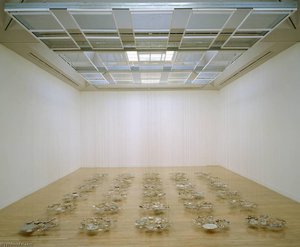
A Life Sculpted by Fragments: The World of Cornelia Parker
Cornelia Parker, born in Cheshire, England, in 1956, is an artist whose work doesn’t simply occupy space—it interrogates it. Her pieces are often born from acts of dramatic intervention, a controlled unleashing of forces that dismantle and then reassemble our perceptions of order and chaos. To understand Parker's art is to delve into a world where destruction isn’t finality, but rather a catalyst for transformation, a means of unearthing hidden narratives within the mundane and the monumental alike. Her upbringing, steeped in the echoes of 20th-century conflict – her mother a nurse during WWII, her grandfather a veteran of the Somme – subtly informs this preoccupation with fragmentation and remembrance, though Parker herself often resists direct biographical readings of her work. She received her formal training at Gloucestershire College of Art and Design, Wolverhampton Polytechnic, and ultimately earned an MFA from the University of Reading in 1982, later receiving honorary doctorates from several universities recognizing her significant contributions to the art world.
The Alchemy of Destruction and Rebirth
Parker’s artistic journey began with a resistance to easy categorization, particularly the label of “feminist artist,” though feminist ideologies subtly permeate much of her work through explorations of power dynamics and societal structures. However, it was her unique approach to materials and processes that truly set her apart. She doesn't build *up* so much as she takes things *apart*, subjecting objects to extreme forces – explosions, crushing, burning – before meticulously reconstructing them in ways that challenge our understanding of both creation and annihilation. This isn’t about nihilism; it’s a deeply inquisitive process, an attempt to reveal the latent energy contained within everyday items, or to expose the hidden histories embedded within structures. Cold Dark Matter: An Exploded View (1991), arguably her most iconic work, exemplifies this perfectly. A garden shed, blown apart by the British Army and suspended in mid-air, frozen in a moment of violent dispersal, becomes a haunting meditation on contained energy, the aftermath of trauma, and the beauty found within disintegration. The piece isn’t about the destruction *of* the shed, but rather the revelation of its potential energy, its internal architecture laid bare. This fascination with transformation extends to works like Mass (Colder Darker Matter) (1997), a deeply moving installation comprised of the charred remains of a church destroyed by lightning, and Anti-Mass (2005), utilizing charcoal from a church lost to arson. These pieces aren’t simply displays of ruin; they are powerful evocations of loss, spirituality, and the enduring impact of forces beyond our control.
Beyond the Explosion: Expanding Conceptual Boundaries
Parker's artistic range extends far beyond explosive interventions. Works like Thirty Pieces of Silver, a collection of silver-plated objects salvaged from flea markets and then crushed by a steamroller, demonstrate her ability to imbue seemingly mundane items with profound symbolic weight. The title itself alludes to Judas’ betrayal, adding layers of religious and historical resonance to the act of destruction. Similarly, The Maybe (1995), created in collaboration with Tilda Swinton, was a performance piece that blurred the lines between art, life, and celebrity, inviting viewers to contemplate the weight of history and the fragility of identity. She has also engaged directly with canonical artworks, wrapping Rodin’s The Kiss in miles of string, forcing us to reconsider its form and meaning through a veil of delicate constraint. This willingness to challenge established norms and engage with art historical precedents demonstrates Parker's intellectual rigor and her commitment to pushing the boundaries of contemporary sculpture and installation.
Recognition and Enduring Legacy
Cornelia Parker’s innovative approach has garnered significant recognition throughout her career. Her 1997 nomination for the Turner Prize cemented her position as a leading figure in British contemporary art, and she has since held prestigious academic appointments, including Honorary Professor at the University of Manchester and Visiting Fellow at Lady Margaret Hall, Oxford. Her work has been exhibited internationally in major museums and galleries, with notable solo shows at the Institute of Contemporary Art, Boston (2000), MCA Sydney (2019) and a comprehensive survey exhibition at Tate Britain (2022). Parker’s influence extends beyond her own artistic production; she has inspired a generation of artists to explore themes of destruction, transformation, and cultural memory in new and innovative ways. Her work challenges us to reconsider our relationship with the material world, to see beauty in unexpected places, and to recognize the enduring power of objects to hold and transmit stories across time. She continues to create compelling and thought-provoking artwork, solidifying her legacy as one of Britain’s most important contemporary artists – an artist who finds poetry in wreckage, and meaning in the spaces between creation and destruction.
WahooArt.com Editör Ekibi Tarafından
Sanat Bilgisi Testi
Her soru için yalnızca bir doğru cevap bulunmaktadır.
Soru 1:
Cornelia Parker is best known for her work exploring which of the following themes?
Soru 2:
What is 'Cold Dark Matter: An Exploded View'?
Soru 3:
Parker was shortlisted for which prestigious art prize in 1997?
Soru 4:
Parker's mother had a unique background related to which historical event?
Soru 5:
What is a recurring element in Parker's artistic process?
Master the nuances of three-dimensional art with our expert guide. Explore sculptural history, from Phidias to Neoclassicism, and learn to evaluate materiality, form, and technique like a true connoisseur. Elevate your collection with profound insights into the world of sculpture.
Discover the enduring allure of bronze sculptures at WahooArt.com. From classical lost-wax casting to modern metal masterpieces, explore museum-quality artworks designed to elevate luxury interiors. Expert curation, authenticity guaranteed, and worldwide shipping for discerning collectors.
Merhaba! Bir sanat eseri seçmenize, siparişinizi takip etmenize veya garanti sorularınızı yanıtlamanıza yardımcı olabilirim. Size nasıl yardımcı olabilirim?