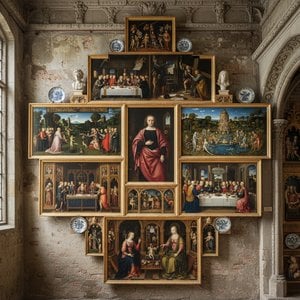
The Ethereal Frost: The Life and Legacy of César van Loo
César van Loo, born Jules César Denis van Loo in the vibrant heart of Paris in 1743, remains one of the most evocative voices of the late eighteenth-century French school. While his lineage connected him to a prestigious dynasty of Flemish-descended painters, he possessed an artistic soul that sought to transcend the mere imitation of his predecessors. Though he was the heir to a tradition of portraiture and decorative excellence, van Loo carved out a singular niche in the art world, moving away from the polished faces of the aristocracy to capture the silent, breathing majesty of the natural world. His journey was one of profound transformation, evolving from a student of the Rococo splendor into a master of atmospheric realism and winter landscapes. The foundations of his technique were laid under the watchful eyes of two titans of French art: François Boucher and Jean-Honoré Fragonard. From these masters, he inherited a sophisticated command of disegno and colore, learning to manipulate light and pigment to create scenes of grace and movement. His early works shimmered with the delicate ornamentation and pastel palettes characteristic of the Rococo era, yet even in these formative years, a deeper sensitivity was emerging. He was not merely interested in the decorative; he was captivated by how light interacted with texture, and how the subtle shifts in atmosphere could evoke a sense of profound solitude or quiet wonder.A Mastery of Atmosphere and Winter Landscapes
As his career matured, van Loo’s focus shifted toward the sublime, particularly through his celebrated winter landscapes. It was in these frozen vistas that he truly found his voice, moving beyond idealized scenery to embrace a meticulous, almost tactile realism. He possessed an uncanny ability to render the weight of fallen snow, the crystalline structure of frost, and the way a pale, wintry sun casts long, blue-tinted shadows across a desolate plain. His canvases became windows into a world of quietude, where the biting chill of the air is almost palpable to the viewer. His landscapes often served as meditations on time and the cyclical nature of existence. A recurring motif in his work was the inclusion of ancient ruins, partially swallowed by the snow or reclaimed by the elements. These crumbling structures acted as poignant symbols of decay and regeneration, juxtaposing the permanence of stone with the fleeting, seasonal shifts of the landscape. Through this technique, van Loo bridged the gap between the classical ideals of his training and the burgeoning Romantic interest in the emotional power of nature.Historical Significance and Artistic Triumph
The zenith of his professional recognition was marked by prestigious appointments and a lasting presence in the great collections of Europe. His appointment as Directeur Général signaled his standing within the French artistic establishment, yet he never lost the observational intimacy that defined his personal style. His work continues to be studied for its technical brilliance and its ability to convey complex emotional states through purely environmental means. The enduring legacy of César van Loo can be summarized by several key contributions to the history of painting:- Innovation in Genre: He elevated the winter landscape from a secondary decorative element to a profound medium for psychological and atmospheric expression.
- Technical Synthesis: He successfully blended the delicate coloristic traditions of the Rococo with a rigorous, realistic approach to natural light and texture.
- Symbolic Depth: Through his use of ruins and seasonal transitions, he introduced layers of intellectual meaning regarding mortality and the sublime into landscape painting.
- Artistic Independence: By choosing to sign his works simply as "Cesar van Loo," he asserted a distinct identity separate from his famous father and uncle, establishing himself as a pioneer in his own right.
Soru & Cevap
César Van Loo sanatçısının doğum yeri olan şehir ve ülke neresidir?
César Van Loo, Italy sınırları içerisindeki Paris şehrinde doğmuştur.
César Van Loo adlı sanatçının eserlerini renklere göre sıralayabilir miyim?
César Van Loo'in eserlerini, sanatçının Renk İndeksi sayfasında renklere göre keşfedebilirsiniz.
César Van Loo adlı sanatçının eserlerini bir 3D galeride nerede görebilirim?
Sanal bir ziyaret mümkün: César Van Loo sanatçısının 3B Müze sayfası, sanatçının eserlerini üç boyutlu bir galeride sunuyor.