Early Life, Family and Training
Born in Mons, Belgium, on 8 December 1886, Anto Carte was the son of a master joiner and cabinet-maker. This lineage of craftsmanship left a lasting impression on the young boy, who would later credit his father for his appreciation of fine work and the inherent beauty of quality materials. His early years were shaped by this disciplined environment, where the precision of a craftsman met the budding curiosity of a child. By the age of eleven, having left secondary school, he enrolled at the Académie de Mons to begin his formal education. It was here that his natural talent for drawing first began to emerge under the guidance of his teachers.
The path of his training was not a simple one, for necessity often dictated the rhythm of his studies. At the age of fourteen, he entered the studio of the figurative painter Frans Depooter. To support himself while pursuing his calling, he spent time working as an apprentice for a neighbor, François Depooter, who was an interior painter and decorator. This period of labor in building painting and decorating allowed him to master many different techniques and brought him into contact with various skilled craftsmen. Such practical experience provided a solid grounding that would support his later artistic pursuits.
As his ambitions grew, so too did the scope of his education. He continued his studies at the Royal Academy of Fine Arts in Brussels and eventually traveled to Paris to further refine his skill. Through these academies and the hands-on experience of his apprenticeship, Anto Carte developed a profound understanding of his medium, moving from the practicalities of decoration to the complexities of fine art.
Artistic Style and Technique
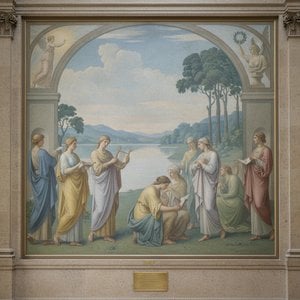
The early years of his creative life were marked by a deep fascination with the Symbolist tradition. He drew significant inspiration from the works of Pierre Puvis de Chavannes, seeking to capture a sense of the poetic and the fantastic within his compositions. This early period saw him exploring themes that leaned toward the mystical, often imbuing his subjects with an otherworldly atmosphere. As he matured, his vision underwent a profound transformation. Following the Great War, his hand moved away from those initial Symbolist inclinations, finding a new language in Flemish Expressionism. This shift brought him into the orbit of the painters of the Sint-Martens-Latem group, most notably the influence of Gustave Van de Woestijne, which helped shape his evolving aesthetic.
His technical approach was as deliberate as his stylistic shifts. He possessed a particular method for manipulating his medium, often using a knife to scratch through different layers of paint. This physical intervention was not merely a gesture of texture, but a calculated way to increase the luminosity of the surface, allowing light to catch the broken edges of the pigment. Such a technique lent a unique depth to his canvases, where the interplay of light and color felt deeply integrated into the very substance of the paint. Whether he was depicting the quietude of a landscape or the weight of a human figure, his work maintained a certain atmospheric tension.
- The Heat
- Peasant and his Horse
- The blind musicians
Exhibitions and International Recognition
The artist first stepped into the light of public scrutiny in 1917, when he presented a collection of illustrations inspired by the literary works of Emile Verhaeren. This early encounter with the public marked the beginning of a career that would soon cross borders. By 1923, his presence was felt in Paris, where he exhibited alongside the Flemish Expressionists at the Salon d'Automne. This period of his life saw his reputation growing beyond the familiar landscapes of his Belgian home, as his unique vision began to find an audience in the great art capitals of Europe.
His reach extended far across the Atlantic, leading to a significant moment of recognition in the United States. In 1924, he was invited to a solo exhibition at the Carnegie Institute in Pittsburgh. The reception in America was nothing short of extraordinary; every single one of the sixty paintings he brought to the exhibition was sold. This success in Pittsburgh solidified his standing as an artist of international consequence, proving that his depictions of human struggle and character resonated deeply with viewers far from his native Mons.
Even as the years passed, the legacy of his work continued to be revisited by those who sought to understand his contribution to Belgian art. The Museum of Mons honored his life's work with major retrospective exhibitions, first in 1949 and again much later in 1995. These gatherings allowed new generations to look closely at the man who had once captivated the collectors of Pittsburgh.
Commissions and Public Works
Beyond the confines of the easel, the artist sought to bring his vision into the very fabric of civic and spiritual life. His hand moved from the intimate scale of canvas to the grander demands of architecture and public utility. In 1927, he was entrusted with the creation of stained glass windows for a new building at the University of Mons-Hainaut, allowing his light and color to filter through the halls of learning. This ability to translate his aesthetic into functional, public spaces was a recurring theme in his later years, as he found himself designing many posters that graced the streets.
His influence even extended to the most practical of daily objects, reaching into the pockets of the citizenry through his design of a 50 Belgian Francs banknote. This intersection of fine art and national identity demonstrated a versatility that few of his contemporaries could claim. He was equally at home in the sacred silence of religious spaces, where he left a lasting mark through his frescoes in the chapel of Orval. His devotion to the medium of glass continued late into his life, as seen in the windows he created for the National Basilica of the Sacred Heart in Koeketberg in 1952.
Teaching and Artistic Groups
The artist sought to foster a sense of community among his peers, leading him to help establish the Groupe Nervia in 1928. He founded this collective alongside Louis Buisseret and Leon Eeckman, creating a space where shared artistic visions could find a voice. This endeavor reflected his desire to connect with others who shared his dedication to the craft and the spirit of their time.
His influence extended into the halls of formal education, where he shaped the minds of the next generation of painters. From 1932 onwards, he held a professorship at the La Cambre school. During this same period, he also shared his knowledge at the Académie Royale des Beaux-Arts in Brussels. Through these roles, he passed on the technical discipline and the expressive sensibilities he had cultivated throughout his own long career.
Soru ve Cevaplar
Anto Carte sanatçısına ait katalogda kaç adet eser bulunuyor?
Tüm Sanat Eserleri sayfasında Anto Carte imzalı 1 sanat eseri eseri inceleyebilirsiniz.
Anto Carte tarafından üretilen tüm eserleri nasıl görebilirim?
bu web sitesi üzerindeki Anto Carte imzalı tüm eserlere sanatçının Tüm Sanat Eserleri sayfasından göz atabilirsiniz.
Anto Carte hangi dönem sanatçısıdır?
Anto Carte, Modern döneminde eserlerini vermiştir. Bu dönem, sanatçının çalışmalarını tarihsel bir bağlama oturtur.
Anto Carte adlı sanatçının eserlerine tekniklerine göre göz atabilir miyim?
Tüm Teknikler sayfası, Anto Carte eserlerini tekniğe göre gruplandırır.