A Dance of Perception: Exploring Victor Vasarely’s “Versakk”
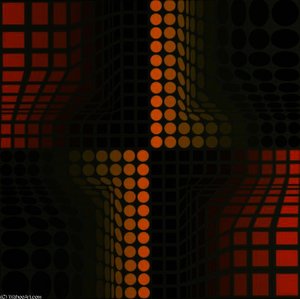
Victor Vasarely's "Versakk" is not merely a painting; it’s an invitation, a carefully constructed illusion that challenges our very perception of space and form. Created by the Hungarian artist, a key figure in the development of Op Art – Optical Art – this work embodies the movement’s core principle: to stimulate visual excitement through controlled patterns and geometric abstraction. The image itself is dominated by a vibrant blue circle, its surface meticulously rendered with a network of smaller dots that create an almost hypnotic effect. Within this central blue field are strategically placed red and white circles, their positions deliberately arranged to generate a dynamic interplay of color and shape. This isn't accidental; Vasarely painstakingly engineered these visual relationships to exploit the way our eyes and brain process information, resulting in a captivating optical illusion.
The Genesis of Op Art: Bauhaus Roots and Kinetic Vision
Understanding “Versakk” requires acknowledging its place within the broader context of 20th-century art. Vasarely’s artistic journey began with an unexpected detour – initially pursuing medical studies before embracing painting in 1927. This shift was profoundly influenced by his enrollment at Sándor Bortnyik’s ‘Műhely,’ a workshop deeply rooted in the principles of functional design and geometric abstraction championed by the Bauhaus movement. The Bauhaus, with its emphasis on reducing form to its essential elements – line, shape, and color – provided Vasarely with a crucial framework for his artistic explorations. He wasn't simply interested in representing reality; he sought to create art that actively engaged the viewer’s visual system, anticipating the rise of kinetic art and exploring how perception itself could be manipulated through controlled optical effects. The meticulous construction of “Versakk” reflects this rigorous approach, a testament to Vasarely’s dedication to scientific precision applied to artistic creation.
Technique and Materiality: Oil on Canvas – A Rich Texture
“Versakk” is executed in oil paint on canvas, a choice that contributes significantly to the artwork's impact. The artist’s skillful application of the medium creates a rich texture and depth, enhancing the illusionary qualities of the piece. The use of multiple layers of color, combined with the subtle variations in brushstroke, allows light to play across the surface, further intensifying the optical effects. Vasarely’s technique is characterized by its precision and control – each circle, each dot, carefully placed to maximize their visual impact. This attention to detail elevates “Versakk” beyond a simple decorative image; it's a testament to the artist's mastery of oil painting and his ability to harness its properties to create a truly immersive visual experience.
Symbolism and Emotional Resonance: A Visual Puzzle
While ostensibly abstract, "Versakk" invites contemplation about order and chaos. The concentric circles evoke notions of movement, dynamism, and perhaps even the underlying structure of the universe. Vasarely’s work isn't about depicting a specific scene or object; it’s about exploring the fundamental principles of visual perception. The piece generates a sense of controlled excitement, a feeling of being drawn into a complex visual puzzle. This inherent ambiguity allows viewers to project their own interpretations and emotions onto the artwork, making “Versakk” a profoundly personal experience. It's a reminder that art can be both intellectually stimulating and emotionally resonant, challenging our assumptions about reality and inviting us to reconsider how we see the world.
Soru ve Cevaplar
"Versakk" reprodüksiyonu evin hangi bölümünde şık durur?
"Versakk" reprodüksiyonu bir Living Room için oldukça uygundur.
Victor Vasarely imzalı "Versakk" benzeri sanat eserlerini nerede bulabilirim?
Victor Vasarely imzalı "Versakk" eserine benzer çalışmalar, eserin Benzerleri sayfasında bir araya getirilmiştir.
"Versakk" eserinde teknik ve üslup nasıl birleşiyor?
"Versakk" adlı eserde, Oil On Canvas tekniği Op Art akımıyla buluşuyor.



 Önizle
 El Yapımı Tablo Satın Al
 Gönder
 Paylaş
 Detaylar
 Rehber

 Dosyayı İndir
 Benzerleri
 X-Işını
 Slayt Gösterisi
 İstatistikler

 Devamını Oku






































 Cam seçeneği yalnızca 110 cm altındaki boyutlar için mevcuttur.