Bu sayfada sergilenen eser telif hakkı yasasıyla korunmaktadır; bu da yasal olarak eserin birebir kopyasını oluşturamayacağımız veya satamayacağımız anlamına gelir. Bu koruma, aşağıdakiler gibi uluslararası anlaşmalar kapsamında uygulanmaktadır: Bern Sözleşmesi ve aşağıdakiler de dahil olmak üzere ulusal yasalarca belirlenen ABD Telif Hakkı Kanunu - 17. Başlık.
Bu yöntem, koruma altındaki sanat eserinin kopyalanmasını veya çoğaltılmasını içermediği için telif hakkı düzenlemelerine tam uyum sağlar. Bunun yerine, yaratıcı bir yeniden yorumlamadır; orijinalinden etkilenen ancak onunla aynı olmayan yeni bir tablodur.
Hızlı üretim ve esnek bitiş seçenekleriyle müze kalitesinde giclée veya kanvas baskı. ( El Yapımı Tablo Satın Al Dijital Görsele Geç)





























Eserin orijinal oranlarıyla uyumlu, önceden belirlenmiş boyutlarımız arasından seçim yapın.

Çerçevenize veya duvarınıza uygun olması için ihtiyacınız olan genişlik ve yüksekliği yazın. Bir baskı yalnızca kesilebilir, görselden daha büyük hale getirilemez; bu nedenle farklı bir formdaki boyut seçimi, görselin bir kısmının kaybına neden olur. Herhangi bir baskı yapmadan önce onaylamanız için size bir dijital taslak gönderiyoruz. Bu sayfada gösterilen resim gerçek kesimi göstermez — bunu yalnızca taslak gösterir.
Dünya Çapında Teslimat (); standart 4/5 hafta yerine 2 haftada. (8 Kasım)
Syry
Reproduksiyon Boyutu
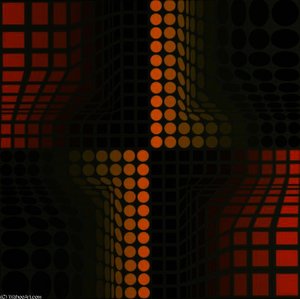
Victor Vasarely's "Syry" is not merely a painting; it’s an invitation – an invitation to question the very nature of visual perception. This vibrant artwork, dominated by a colossal sphere encircled by a constellation of smaller circles, embodies the core tenets of Op Art and represents a pivotal moment in 20th-century art history. Created by a man initially destined for a medical career, Vasarely’s journey reflects a profound fascination with geometry and its ability to manipulate our senses. Born Károly Vaszary in 1906 in Pécs, Croatia – then part of Austria-Hungary – his early life foreshadowed little of the groundbreaking artistic path he would ultimately forge. His initial studies in medicine were abruptly abandoned in favor of a pursuit far more captivating: the exploration of visual form and its impact on human perception.
Vasarely’s artistic evolution was inextricably linked to the intellectual currents of his time. His enrollment at Sándor Bortnyik’s “Műhely” workshop, profoundly influenced by the Bauhaus movement, proved instrumental. This environment fostered a deep understanding of functional design and geometric abstraction – principles that would become the bedrock of his signature style. The Bauhaus emphasis on reducing form to its essential elements—primarily lines, shapes, and colors—directly informed Vasarely’s approach. He wasn't interested in depicting recognizable objects; instead, he sought to create visual experiences that directly stimulated the viewer’s eye and challenged their assumptions about space and depth. “Syry,” with its meticulously arranged circles, is a quintessential example of this pursuit.
The creation of "Syry" exemplifies Vasarely's mastery of Op Art techniques. The large sphere, rendered in bold, contrasting colors – likely utilizing layering and glazing—appears to float within a dynamic field of smaller circles. These circles aren’t simply decorative elements; they are carefully calibrated to create an optical illusion. Through precise placement and color variations, Vasarely generates a sense of movement and depth that seems to defy the two-dimensional surface of the canvas. The technique relies heavily on the viewer's eye actively processing the visual information, creating a dynamic and shifting perception. Vasarely’s meticulous attention to detail ensures that the artwork is not static but rather an active participant in the viewing experience.
"Syry" transcends mere optical illusion; it carries symbolic weight. The sphere itself can be interpreted as representing wholeness, unity, or even the cosmos – a fundamental building block of existence. The surrounding circles evoke a sense of infinite expansion, mirroring the boundless possibilities of perception. Vasarely’s work isn't about creating beautiful images in the traditional sense; it’s about provoking thought and stimulating emotional responses through the manipulation of visual elements. The artwork’s vibrant colors and dynamic composition generate a feeling of excitement, energy, and perhaps even a slight disorientation – a deliberate effect designed to engage the viewer on a visceral level. It's a testament to Vasarely's belief that art could be both intellectually stimulating and emotionally resonant.
"Syry", Victor Vasarely kariyerinin Op Art dönemine aittir. Bu sınıflandırma, eseri sanatçının gelişim süreciyle ilişkilendirir.
Op Art akımı içerisinde, "Syry" eseri Iconic düzeyinde bir popülerliğe sahiptir.
"Syry" eserinde, Dark renkler Calm bir duyguya eşlik ediyor.

1906 - 1997 , Hırvatistan

Explore the profound spiritual depth of geometric abstraction. From Malevich's Suprematism to modern masters, our expert guide reveals how pure form and color command presence in fine art collections.

Explore the profound evolution of Neo-Abstract art. Discover how bold geometric forms, vibrant chromatic depth, and tactile textures redefine modern expression for the discerning collector seeking sophisticated, high-impact masterpieces for contemporary interiors.

Discover the profound beauty of abstract art. Our expert guide explores geometric abstraction, Op Art, and Expressionism, offering connoisseurs deep insights into collecting and curating powerful, non-representational masterpieces for sophisticated interiors.
 Gerçek Boyutta Önizle
 Paylaş
 Paylaş
 Detayları Gör
 Rehber

 İndir
İndir
 Benzer ürünler
 X-Işını
 Slayt Gösterisi
 Soru & Cevap
 İstatistikler

 Tümünü Gör









 Cam seçeneği yalnızca 110 cm altındaki boyutlar için mevcuttur.