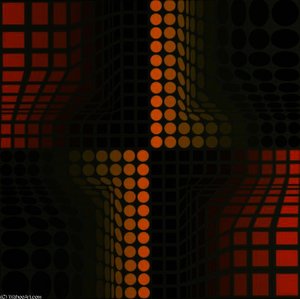
SIR-RIS: A Geometric Dance of Perception by Victor Vasarely
Victor Vasarely’s ‘SIR-RIS,’ a captivating sculpture rendered in meticulous black and white, stands as a cornerstone of Op Art – a movement that fundamentally challenged our understanding of visual perception. This isn't merely a representation of form; it’s an invitation to actively participate in the illusion, a testament to Vasarely’s mastery of manipulating space and light through geometric precision. The photograph captures ‘SIR-RIS’ in all its arresting complexity: a stylized cube, seemingly fractured by intersecting lines that generate a dynamic, almost dizzying effect. The stark contrast between the sculpture's intricate pattern and the clean white pedestal immediately draws the eye, emphasizing the artwork’s deliberate disruption of conventional visual experience.
Deconstructing Illusion: Vasarely’s Op Art Technique
Vasarely’s approach was rooted in a rigorous exploration of mathematical principles and their application to artistic creation. ‘SIR-RIS’ exemplifies this perfectly. The sculpture's design relies heavily on parallel lines that curve and intersect, creating a powerful sense of movement and distortion. These aren’t random arrangements; they are precisely calculated to exploit the way our eyes perceive depth and distance. The use of black and white amplifies this effect, eliminating color as a distraction and forcing the viewer to focus solely on the interplay of lines and shapes. The polished metal surface, likely chosen for its reflective qualities, further enhances this illusion, creating an almost three-dimensional experience within the two-dimensional image.
A Legacy of Kinetic Art and Modern Design
Born in 1906 in Pécs, Croatia (then part of Austria-Hungary), Victor Vasarely’s journey began far from the world of abstract art. Initially studying medicine, he was drawn to visual expression, a path solidified by his enrollment in Sándor Bortnyik's workshop – a hub for Bauhaus-influenced design. This formative experience instilled within him a fascination with functional geometry and its potential to create dynamic visual experiences. ‘SIR-RIS’ is a direct descendant of this lineage, echoing the principles of Op Art—a movement that sought to stimulate the eye through optical illusions. Vasarely's work anticipated many developments in kinetic art and influenced generations of designers and artists who explored the relationship between perception and form. The sculpture’s creation involved careful planning and execution, likely utilizing templates or precise tools to ensure the accuracy of the repeating pattern – a testament to the artist’s dedication to his craft.
Symbolism and the City of Tomorrow
Beyond its purely visual impact, ‘SIR-RIS’ reflects Vasarely's broader vision for the future. His work often explored themes of urban development and technological advancement, envisioning a world shaped by geometric order and rational design. The sculpture can be interpreted as a representation of a structured, yet dynamic, cityscape – a “city of tomorrow” where form and function are inextricably linked. The deliberate fragmentation and distortion suggest a critical engagement with the complexities of modern life, prompting viewers to question their own perceptions and assumptions about reality. Vasarely’s legacy extends beyond artistic innovation; it represents a profound exploration of how we experience and interpret the world around us.
Soru ve Cevaplar
Victor Vasarely imzalı "SIR-RIS" eserinin bir baskısını nereden satın alabilirim?
"SIR-RIS", pamuklu kanvas veya arşivlik kanvas kağıt üzerine yüksek kaliteli sanat baskısı olarak temin edilebilir. Siparişlerinizi bu sayfa üzerinden, dilediğiniz boyutta verebilirsiniz.
"SIR-RIS" adlı eser, Victor Vasarely'in külliyatında nerede konumlanıyor?
"SIR-RIS", Victor Vasarely'in diğer eserleriyle birlikte Op Art üslubunu ve işlenen temaları paylaşmaktadır: bauhaus influence, geometric exploration, visual perception, kinetic dynamism, op art legacy.
Victor Vasarely imzalı "SIR-RIS" eserini odamda görmek için artırılmış gerçekliği kullanabilir miyim?
Uyumlu bir cihazda artırılmış gerçekliği kullanarak, eserin AR Önizleme sayfası aracılığıyla Victor Vasarely imzalı "SIR-RIS" adlı çalışmayı kendi duvarınızda önizleyebilirsiniz.
Victor Vasarely imzalı "SIR-RIS", aranan Op Art eserleri arasında mı?
Op Art akımı içerisinde, "SIR-RIS" eseri Iconic düzeyinde bir popülerliğe sahiptir.
Victor Vasarely imzalı "SIR-RIS" eserinin duygusu nasıl tanımlanıyor?
Victor Vasarely imzalı "SIR-RIS", ruh hali açısından Calm olarak tanımlanmaktadır. Bu sınıflandırma, eserin bir mekana uyum sağlamasına yardımcı olabilir.
"SIR-RIS" eserinde teknik ve üslup nasıl birleşiyor?
"SIR-RIS", Acrylic On Canvas tekniğiyle Op Art üslubunda hazırlanmıştır.
"SIR-RIS" eserinin Op Art üslubuna hangi duygusal ton eşlik ediyor?
"SIR-RIS", Op Art akımı içerisinde Reflective bir duygusal ton taşımaktadır.
"SIR-RIS" adlı eserin Op Art akımının arkasındaki ulusal köken nedir?
"SIR-RIS", Hırvatistan doğumlu Victor Vasarely tarafından Op Art akımı içerisinde yaratılmıştır. Sanatçının kökeni, eseri Op Art akımının Hırvatistanli sanatçılar tarafından uygulanan biçimine bağlamaktadır."



 Önizle
 El Yapımı Tablo Satın Al
 Gönder
 Paylaş
 Detaylar
 Rehber

 Dosyayı İndir
 Benzerleri
 X-Işını
 Slayt Gösterisi
 İstatistikler


 Devamını Oku






































 Cam seçeneği yalnızca 110 cm altındaki boyutlar için mevcuttur.