Sanatçılarımız tarafından sipariş üzerine hazırlanan; istediğiniz boyut ve çerçevede, tuval üzerine el boyaması yağlı boya. ( Baskı satın al Görsel satın al)





























Eserin orijinal oranlarıyla uyumlu, önceden belirlenmiş boyutlarımız arasından seçim yapın.

Belirli bir çerçeveye veya alana uyması için kendi boyutlarınızı girebilirsiniz. Seçtiğiniz boyut orijinal görüntünün oranlarıyla eşleşmiyorsa, sanat eserini kırparak veya ek el boyaması öğelerle resmi uzatarak ayarlayacağız. Üretim başlamadan önce onayınız için dijital bir taslak gönderilecektir.
Lütfen ekrandaki önizlemenin gerçek kırpmayı veya uzatmayı yansıtmadığını unutmayın. Nihai kompozisyonu yalnızca hazırlanan taslak doğru şekilde gösterecektir.
Özel boyutlar mevcut olsa da, orijinal oranları korumak adına önceden tanımlanmış listeden bir boyut seçmenizi öneririz.
Dünya Çapında Teslimat (); standart 5 hafta yerine 3/4 haftada. (7 Eylül). Kaliteden ödün verilmez.


Quasor-Paal-2
Reproduksiyon Boyutu
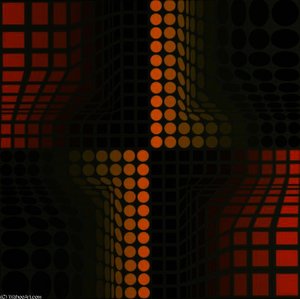
Victor Vasarely's "Quasor-paal-2," created in 1970, stands as a cornerstone of Op Art—Optical Art—a movement that revolutionized visual perception during the mid-20th century. More than just an aesthetically pleasing image, it’s a meticulously crafted exploration into how our eyes interpret patterns and colors, challenging conventional notions of representation.
Vasarely’s artistic journey began at Sándor Bortnyik’s Műhely, a school deeply rooted in the principles of Bauhaus design—a German movement advocating for functional art and geometric abstraction. This formative experience instilled in him a belief that art could communicate ideas directly through visual elements, bypassing narrative storytelling.
"Műhely" championed the use of orthogonal grids and repetitive patterns as tools for creating harmonious compositions, concepts that profoundly impacted Vasarely’s artistic vision. He sought to create artworks that evoked sensations of movement and depth without relying on traditional perspective—a radical departure from prevailing artistic conventions.
"Quasor-paal-2" exemplifies the core tenets of Op Art, capitalizing on perceptual phenomena like retinal distortion and Phi (the golden ratio). Vasarely meticulously designed the composition to exploit these illusions, prompting viewers’ eyes to perceive movement where none exists. The seemingly static squares and circles generate a captivating visual experience—a deliberate provocation of our sensory perceptions.
The artist's intention wasn’t merely to produce visually stimulating art; it was to investigate how the human brain processes information. By manipulating color and pattern, Vasarely aimed to demonstrate that perception is subjective and influenced by mathematical ratios—a groundbreaking contribution to both visual art and cognitive science.
Victor Vasarely's "Quasor-paal-2" continues to resonate with audiences today, securing its place as a seminal work within the history of modern art. Its geometric simplicity belies a complex intellectual framework—a testament to Vasarely’s unwavering commitment to exploring the fundamental principles governing visual experience.
His pioneering approach to abstraction paved the way for subsequent artists and designers who sought to harness optical illusions as expressive tools. “Quasor-Paal-2” remains a captivating reminder that beauty can reside in mathematical precision—a timeless masterpiece embodying the spirit of innovation and intellectual curiosity.

1906 - 1997 , Hırvatistan

Explore the mesmerizing world of Victor Vasarely. Discover how his Bauhaus-inspired Op Art masters the science of perception through geometric abstraction and vibrant color. A sophisticated guide for discerning art collectors seeking to understand the legacy of optical illusion.

Embark on a visual journey through the mesmerizing world of Op Art. Discover the masters of optical illusion, explore geometric abstraction, and learn how to curate high-impact kinetic works for your private collection with expert guidance from art professionals.

Explore the profound world of optical art and masterpieces that redefine perception. From Vasarely’s geometric illusions to Farndon’s sensory reality, discover how legendary works challenge the eye and transform the viewer's experience through sophisticated abstraction.

Explore the profound spiritual depth of geometric abstraction. From Malevich's Suprematism to modern masters, our expert guide reveals how pure form and color command presence in fine art collections.

Discover the profound beauty of abstract art. Our expert guide explores geometric abstraction, Op Art, and Expressionism, offering connoisseurs deep insights into collecting and curating powerful, non-representational masterpieces for sophisticated interiors.

 Önizleme yap
 Paylaş
 Paylaş
 Detayları Gör

 İndir
İndir
 Benzerlerini gör
 X-Işını
 Slayt Gösterisi
 Tümünü Gör







 Cam seçeneği yalnızca 110 cm altındaki boyutlar için mevcuttur.