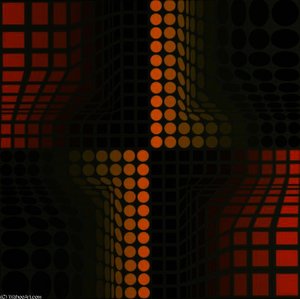
A Universe in Squares: Exploring Victor Vasarely’s ‘Quasar’
Victor Vasarely's 'Quasar' is not merely a painting; it’s an invitation into the very fabric of perception, a testament to the revolutionary impact of Op Art and the burgeoning field of kinetic art. Created by a mind initially drawn to medicine but ultimately captivated by the visual world, this piece embodies Vasarely’s lifelong dedication to dissecting and reconstructing our understanding of space and movement. The artwork's deceptively simple arrangement – a vibrant blue background punctuated by precisely calibrated squares – belies a profound intellectual and artistic endeavor. It represents a pivotal moment in 20th-century art, reflecting the era’s fascination with scientific advancements, particularly Einstein’s theories of relativity, and their influence on artistic expression.
The Genesis of Optical Illusions
Born Károly Vaszary in 1906 in Pécs, Croatia – then part of Austria-Hungary – Vasarely's journey began with a formal education in medicine. However, his artistic inclinations soon took hold, leading him to the Podolini-Volkmann Academy and, crucially, Sándor Bortnyik’s ‘Műhely’ workshop. This environment, deeply rooted in the principles of Bauhaus functional design and geometric abstraction, provided the fertile ground for Vasarely's unique vision to flourish. The influence is immediately apparent in 'Quasar': the meticulously arranged squares aren’t randomly placed; they are precisely calculated to create an optical illusion, a deliberate manipulation of the viewer’s perception of depth and movement. This technique, central to Op Art, aimed to evoke a sense of dynamism and vibration within the artwork itself.
Technique and Composition: A Symphony of Blue
- Geometric Precision: Each square in ‘Quasar’ is rendered with an almost obsessive attention to detail. The variations in size and position are not accidental; they are the result of rigorous mathematical calculations designed to maximize the illusion of movement.
- Color Theory: Vasarely masterfully employs color theory, utilizing a striking contrast between the deep blue background and the varying shades within the squares. This creates a sense of visual tension and draws the eye across the composition, further enhancing the optical effect.
- Spatial Illusion: The arrangement of the squares generates an illusion of three-dimensional space, creating the impression that they are receding into the distance or expanding outwards. This is achieved through careful manipulation of scale and perspective.
Symbolism and Emotional Impact – A Window to the Universe
'Quasar' transcends a simple geometric exercise; it’s a visual representation of cosmic phenomena, echoing the scientific fascination with quasars – incredibly luminous objects at the edge of the observable universe. The dynamic arrangement of squares can be interpreted as a metaphor for the energy and movement inherent in these celestial bodies. More broadly, the artwork speaks to humanity's innate desire to understand the vastness and complexity of the cosmos. The piece evokes feelings of wonder, curiosity, and perhaps even a sense of awe at the power and beauty of the universe. It’s a reminder that art can be both intellectually stimulating and profoundly moving.



 Önizleme yap
 Baskı Moduna Geç
 Paylaş
 Paylaş
 Detayları Gör

 İndir
İndir
 Benzerlerini gör
 X-Işını
 Slayt Gösterisi
 İstatistikler

 Tümünü Gör






































 Cam seçeneği yalnızca 110 cm altındaki boyutlar için mevcuttur.