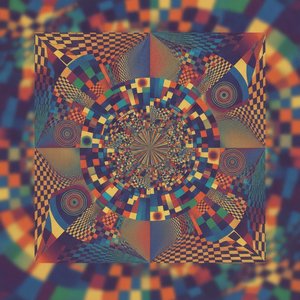
A Symphony of Geometric Perception: Exploring Victor Vasarely’s *ORION-MC*
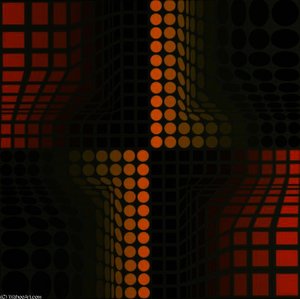
Victor Vasarely's ORION-MC is not merely a painting; it’s an invitation to experience the world through a radically altered lens. This captivating work, rendered in a vibrant palette of red, yellow, green, blue, purple, orange, and black, exemplifies the core tenets of Op Art – Optical Art – pioneered by Vasarely himself. Born Károly Vaszary in 1906 in Pécs, Croatia, his artistic trajectory began with an unexpected detour into medicine before he decisively embraced the power of visual perception. This decision, fueled by his studies at the Podolini-Volkmann Academy and profoundly shaped by Sándor Bortnyik’s “Műhely” workshop – a breeding ground for Bauhaus principles – established him as a key figure in challenging our fundamental understanding of how we see.
- The Essence of Op Art: Vasarely's work, like ORION-MC, sought to stimulate the viewer’s visual system through controlled optical illusions. The meticulously arranged circles aren’t simply decorative; they actively engage with our perception of depth, movement, and space.
- Geometric Abstraction: Rejecting representational imagery, Vasarely focused on pure geometric forms – in this case, circles – to explore the relationship between form and perception. This approach was revolutionary for its time, anticipating developments in minimalist art and computer graphics.
- A Legacy of Innovation: ORION-MC stands as a testament to Vasarely’s relentless experimentation with color, scale, and arrangement, solidifying his place as one of the most influential artists of the 20th century.
Decoding the Visual Language
The composition of *ORION-MC* is deceptively simple yet profoundly complex. The numerous circles, varying in size and position, create a dynamic visual field that seems to shift and shimmer before your eyes. This effect isn’t accidental; Vasarely meticulously controlled every element to manipulate the viewer's perception. The artist’s skillful use of color intensifies this optical illusion, creating a sense of movement and depth that draws the eye across the canvas. The black elements provide grounding and contrast, further emphasizing the vibrancy of the other colors. It is a carefully constructed visual puzzle designed to challenge our assumptions about reality.
Historical Context & Influences
Vasarely’s work emerged during a period of significant artistic and technological change. The rise of industrialization, coupled with advancements in photography and printing, led to a questioning of traditional modes of representation. The Bauhaus movement's emphasis on functional design and geometric abstraction provided a crucial intellectual framework for Vasarely’s explorations. His work can be seen as a direct response to these influences, translating abstract principles into a visually arresting aesthetic. The influence of kinetic art, with its focus on creating illusions of movement, is also evident in *ORION-MC*.
Symbolism and Emotional Impact
While ostensibly an abstract composition, *ORION-MC* evokes a sense of the cosmos – fittingly named “Orion,” one of the most recognizable constellations. The circles can be interpreted as representing stars or planets, suggesting a connection to the vastness of space and the underlying order of the universe. Beyond this symbolic layer, the painting’s impact lies in its ability to evoke a sense of wonder and contemplation. It invites viewers to slow down, observe carefully, and appreciate the beauty of geometric forms – a timeless invitation to explore the fascinating relationship between art and perception.



 Önizleme yap
 Baskı Moduna Geç
 Paylaş
 Paylaş
 Detayları Gör
 Rehber

 İndir
İndir
 Benzerlerini gör
 X-Işını
 Slayt Gösterisi
 İstatistikler

 Tümünü Gör






































 Cam seçeneği yalnızca 110 cm altındaki boyutlar için mevcuttur.