Bu sayfada sergilenen eser telif hakkı yasasıyla korunmaktadır; bu da yasal olarak eserin birebir kopyasını oluşturamayacağımız veya satamayacağımız anlamına gelir. Bu koruma, aşağıdakiler gibi uluslararası anlaşmalar kapsamında uygulanmaktadır: Bern Sözleşmesi ve aşağıdakiler de dahil olmak üzere ulusal yasalarca belirlenen ABD Telif Hakkı Kanunu - 17. Başlık.
Bu yöntem, koruma altındaki sanat eserinin kopyalanmasını veya çoğaltılmasını içermediği için telif hakkı düzenlemelerine tam uyum sağlar. Bunun yerine, yaratıcı bir yeniden yorumlamadır; orijinalinden etkilenen ancak onunla aynı olmayan yeni bir tablodur.
Hızlı üretim ve esnek bitiş seçenekleriyle müze kalitesinde giclée veya kanvas baskı. ( El Yapımı Tablo Satın Al Dijital Görsele Geç)





























Eserin orijinal oranlarıyla uyumlu, önceden belirlenmiş boyutlarımız arasından seçim yapın.

Çerçevenize veya duvarınıza uygun olması için ihtiyacınız olan genişlik ve yüksekliği yazın. Bir baskı yalnızca kesilebilir, görselden daha büyük hale getirilemez; bu nedenle farklı bir formdaki boyut seçimi, görselin bir kısmının kaybına neden olur. Herhangi bir baskı yapmadan önce onaylamanız için size bir dijital taslak gönderiyoruz. Bu sayfada gösterilen resim gerçek kesimi göstermez — bunu yalnızca taslak gösterir.
Dünya Çapında Teslimat (); standart 4/5 hafta yerine 2 haftada. (10 Kasım)
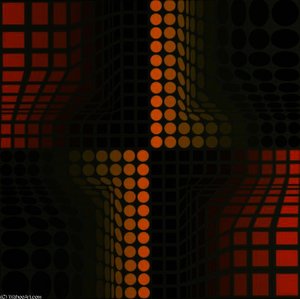
Nobel II
Reproduksiyon Boyutu
Victor Vasarely (1906-1997) stands as an undisputed titan of Op art, a movement that irrevocably altered the landscape of 20th-century visual culture. Born Károly Vásárhelyi in Pécs, Hungary – then part of Austria-Hungary – his artistic journey began with aspirations for medicine but swiftly pivoted towards the vibrant realm of painting in 1927, enrolling at Sándor Bortnyik’s influential workshop in Budapest.
This formative period instilled within him a profound understanding of geometric abstraction and functional design principles, concepts deeply rooted in the Bauhaus ethos. However, it was his enrollment at Bortnyik's school that truly ignited his creative spark, propelling him toward the groundbreaking exploration of perception and form that would define his artistic legacy.
Vasarely’s breakthrough came with “Zebra,” created in 1937 – a seminal work recognized as one of the earliest manifestations of Op art. This mesmerizing piece immediately captivated audiences with its illusionistic qualities, demonstrating how visual perception could be manipulated to generate strikingly vibrant and dynamic images.
The artist’s systematic approach to creating these optical illusions involved meticulously crafted screens—a technique he championed throughout his career—allowing for precise control over color and texture. Vasarely's canvases are characterized by repeating geometric patterns, often circles and squares, arranged in complex configurations that defy conventional spatial representation.
More than just aesthetically pleasing, Vasarely’s work embodies a broader philosophical ambition: to democratize visual experience. He sought to liberate art from the constraints of traditional realism, presenting instead an intellectually stimulating challenge to viewers' senses and fostering contemplation about the fundamental nature of reality itself. His enduring influence can be seen in countless contemporary designs and artworks—a testament to his visionary contribution to modern artistic expression.
“Nobel IV,” executed in 1983, exemplifies Vasarely’s signature style perfectly. This screenprint showcases a captivating interplay of red and black circles within a larger circular framework – a visual motif that recurs throughout his oeuvre. The artwork's simplicity belies its profound impact, inviting viewers to consider the transformative power of geometric abstraction.
Vasarely’s legacy extends beyond individual artworks; he fundamentally reshaped artistic discourse, establishing Op art as a cornerstone of experimental art and inspiring generations of artists to embrace unconventional visual languages. His unwavering dedication to exploring the boundaries of perception continues to resonate today, securing his place as one of the most significant figures in 20th-century art history.
"Nobel II" eserinin renk paleti, Belirgin Renk Varlığı düzeyinde bir doygunluğa sahiptir.
Victor Vasarely imzalı "Nobel II" eserinin bir baskısını edinmek için, sadece Sanat Baskısı sayfasından sipariş verebilirsiniz: pamuklu kanvas veya arşivlik kanvas kağıt üzerine yüksek kaliteli sanat baskısı.
Victor Vasarely'in eserleri arasında yer alan "Nobel II", geometric abstraction, bauhaus influence, visual perception, kinetic exploration, vasarely legacy temalarıyla birlikte Op Art üslubunda konumlanmaktadır.

1906 - 1997 , Hırvatistan

Explore the profound evolution of Neo-Abstract art. Discover how bold geometric forms, vibrant chromatic depth, and tactile textures redefine modern expression for the discerning collector seeking sophisticated, high-impact masterpieces for contemporary interiors.

Explore the profound spiritual depth of geometric abstraction. From Malevich's Suprematism to modern masters, our expert guide reveals how pure form and color command presence in fine art collections.

Discover the profound beauty of abstract art. Our expert guide explores geometric abstraction, Op Art, and Expressionism, offering connoisseurs deep insights into collecting and curating powerful, non-representational masterpieces for sophisticated interiors.
Explore the mesmerizing world of Victor Vasarely. Discover how his Bauhaus-inspired Op Art masters the science of perception through geometric abstraction and vibrant color. A sophisticated guide for discerning art collectors seeking to understand the legacy of optical illusion.
 Gerçek Boyutta Önizle
 Paylaş
 Paylaş
 Detayları Gör
 Rehber

 İndir
İndir
 Benzer ürünler
 X-Işını
 Slayt Gösterisi
 Soru & Cevap
 İstatistikler

 Tümünü Gör









 Cam seçeneği yalnızca 110 cm altındaki boyutlar için mevcuttur.