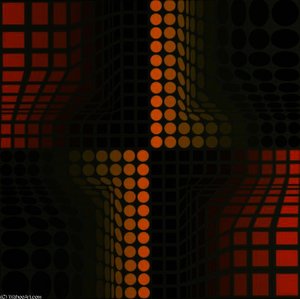
Lava: A Geometric Symphony of Color
Victor Vasarely’s “Lava” isn't merely a painting; it’s an invitation into a realm where visual perception bends and dances, mirroring the mesmerizing flow of molten rock. Created in 1963, this piece embodies the essence of Op Art – Optical Art – a movement that sought to challenge our senses and explore how we perceive color and form through illusion. Vasarely meticulously crafted this artwork using acrylic paint on canvas, applying a technique known as “poligraphy,” which involved printing multiple layers of pigment onto the surface in precise geometric patterns. This method ensured exceptional color vibrancy and textural depth, creating an effect that resembles the undulating heat haze above volcanic landscapes.
- Style: Geometric Abstraction
- Technique: Poligraphy – Multiple Layers of Pigment Printing
- Medium: Acrylic Paint on Canvas
The artwork’s visual impact is immediately arresting. Dominating the canvas is a large central sphere, encircled by smaller spheres and interconnected geometric shapes—squares, triangles, circles—that radiate outwards in concentric bands. These forms aren't randomly arranged; they adhere to Vasarely’s rigorously defined system of mathematical principles, reflecting his fascination with crystallography and fractal geometry. This systematic approach wasn’t simply aesthetic; it was intended to demonstrate that visual experience could be governed by underlying mathematical structures.
Historical Context: Op Art flourished in the mid-1960s, coinciding with a period of significant artistic experimentation and intellectual curiosity. Artists like Vasarely rejected representational art, prioritizing instead the exploration of perceptual phenomena—the way our eyes perceive color, movement, and depth. The movement gained traction during the Cold War era, partly fueled by anxieties about technological advancement and partly driven by a desire to push the boundaries of artistic expression.
Symbolism: While Vasarely himself resisted assigning explicit symbolic meaning to his work, “Lava” undeniably evokes associations with primal forces—fire, energy, transformation. The swirling patterns mimic the turbulent movement of magma beneath the Earth’s surface, symbolizing dynamism and instability. However, crucially, Vasarely insisted that these forms were devoid of emotional content; they aimed solely for visual stimulation and intellectual engagement. He believed that art should provoke thought rather than elicit feeling.
Emotional Impact: Despite its lack of overt emotion, “Lava” possesses a captivating allure. The vibrant colors—reds, blues, greens, yellows—create an immersive experience that stimulates the eye and captivates the imagination. The intricate geometric patterns generate a subtle optical illusion, subtly shifting as viewers move across the canvas. This effect is designed to destabilize our assumptions about reality, prompting us to reconsider how we perceive the world around us. Vasarely’s masterpiece remains a testament to the power of abstraction—a celebration of form and color that transcends conventional artistic conventions.
Soru ve Cevaplar
Victor Vasarely imzalı "Lava" hangi doygunluk ve yoğunluğu sergiliyor?
Victor Vasarely imzalı "Lava", Belirgin Renk Varlığı doygunlukta ve Canlı yoğunlukta kaydedilmiştir.
Victor Vasarely imzalı "Lava" eserinin baskın rengi nedir?
"Lava", Sıcak Gün Batımı Tonları tonlarına yakın bir yapıdadır.
Victor Vasarely imzalı "Lava" eserinin bir baskısını nasıl temin edebilirim?
Victor Vasarely imzalı "Lava" eserinin bir baskısını edinmek için, sadece Sanat Baskısı sayfasından sipariş verebilirsiniz: pamuklu kanvas veya arşivlik kanvas kağıt üzerine yüksek kaliteli sanat baskısı.



 Önizle
 El Yapımı Tablo Satın Al
 Gönder
 Paylaş
 Detaylar
 Rehber

 Dosyayı İndir
 Benzerleri
 X-Işını
 Slayt Gösterisi
 İstatistikler
 Devamını Oku






































 Cam seçeneği yalnızca 110 cm altındaki boyutlar için mevcuttur.