Bu sayfada sergilenen eser telif hakkı yasasıyla korunmaktadır; bu da yasal olarak eserin birebir kopyasını oluşturamayacağımız veya satamayacağımız anlamına gelir. Bu koruma, aşağıdakiler gibi uluslararası anlaşmalar kapsamında uygulanmaktadır: Bern Sözleşmesi ve aşağıdakiler de dahil olmak üzere ulusal yasalarca belirlenen ABD Telif Hakkı Kanunu - 17. Başlık.
Bu yöntem, koruma altındaki sanat eserinin kopyalanmasını veya çoğaltılmasını içermediği için telif hakkı düzenlemelerine tam uyum sağlar. Bunun yerine, yaratıcı bir yeniden yorumlamadır; orijinalinden etkilenen ancak onunla aynı olmayan yeni bir tablodur.
Hızlı üretim ve esnek bitiş seçenekleriyle müze kalitesinde giclée veya kanvas baskı. ( El Yapımı Tablo Satın Al Dijital Görsele Geç)





























Eserin orijinal oranlarıyla uyumlu, önceden belirlenmiş boyutlarımız arasından seçim yapın.

Çerçevenize veya duvarınıza uygun olması için ihtiyacınız olan genişlik ve yüksekliği yazın. Bir baskı yalnızca kesilebilir, görselden daha büyük hale getirilemez; bu nedenle farklı bir formdaki boyut seçimi, görselin bir kısmının kaybına neden olur. Herhangi bir baskı yapmadan önce onaylamanız için size bir dijital taslak gönderiyoruz. Bu sayfada gösterilen resim gerçek kesimi göstermez — bunu yalnızca taslak gösterir.
Dünya Çapında Teslimat (); standart 4/5 hafta yerine 2 haftada. (9 Kasım)
Kvadrat ''X''
Reproduksiyon Boyutu
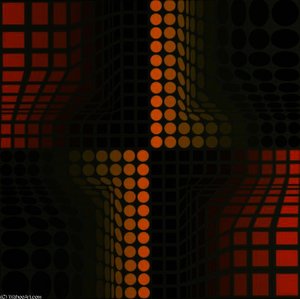
Victor Vasarely’s “Quadrature ”X” stands as a cornerstone of Op Art, an artistic movement that emerged in the mid-1960s and captivated audiences with its mastery of optical illusions. More than just aesthetically pleasing, this painting embodies a profound exploration into how our eyes perceive space and color—a quest rooted in the intellectual currents of postwar Europe.
Born Károly Vaszary in 1906 in Pécs, Croatia (then Austria-Hungary), Vasarely’s artistic trajectory began with an unexpected detour from medicine. Influenced by the Bauhaus principles of functional design and geometric abstraction, he swiftly transitioned to painting at the Podolini-Volkmann Academy in Budapest, where he honed his skills under Sándor Bortnyik.
“Quadrature ”X” exemplifies Vasarely’s signature style—a deliberate manipulation of visual perception. The artwork presents four circles meticulously arranged within a square frame. Each circle is rendered in a distinct hue – vibrant red, emerald green, sapphire blue, and sunny yellow – creating an immediate impression of dynamism and complexity.
Technically speaking, Vasarely employed a method known as “trompe l’œil,” or “fool the eye.” He achieved this illusion by applying paint in layers that subtly shift color depending on the viewer's angle. This technique isn’t merely about creating visual trickery; it’s a conceptual statement about the subjective experience of seeing, reflecting the broader philosophical debates surrounding perception and consciousness prevalent during Vasarely’s time.
Beyond its technical prowess, “Quadrature ”X” carries symbolic weight. The square represents stability and order—a counterpoint to the swirling circles that convey movement and energy. This juxtaposition speaks to a fascination with reconciling opposing forces – harmony alongside disruption – mirroring the anxieties and aspirations of the era.
“Quadrature ”X” continues to resonate today, inspiring interior designers seeking bold geometric patterns and captivating visual effects. Its enduring appeal lies in its ability to transcend time, reminding us that art can engage not only our senses but also our intellect, prompting contemplation on the very nature of reality itself.
"Kvadrat ''X''" eserinin Sakin duygusu, Geometric Abstraction üslubuyla birleşiyor.
"Kvadrat ''X''", yaratıcısının doğum yeri üzerinden Geometric Abstraction akımını Hırvatistan ile ilişkilendiriyor.
"Kvadrat ''X''", Sakin bir duyguyla ilişkilendirilir. Duygusal ton, eserin uyandırdığı izlenimi tanımlar.

1906 - 1997 , Hırvatistan

Explore the profound evolution of Neo-Abstract art. Discover how bold geometric forms, vibrant chromatic depth, and tactile textures redefine modern expression for the discerning collector seeking sophisticated, high-impact masterpieces for contemporary interiors.
Explore the mesmerizing world of Victor Vasarely. Discover how his Bauhaus-inspired Op Art masters the science of perception through geometric abstraction and vibrant color. A sophisticated guide for discerning art collectors seeking to understand the legacy of optical illusion.

Embark on a visual journey through the mesmerizing world of Op Art. Discover the masters of optical illusion, explore geometric abstraction, and learn how to curate high-impact kinetic works for your private collection with expert guidance from art professionals.

Explore the profound spiritual depth of geometric abstraction. From Malevich's Suprematism to modern masters, our expert guide reveals how pure form and color command presence in fine art collections.

Discover the profound beauty of abstract art. Our expert guide explores geometric abstraction, Op Art, and Expressionism, offering connoisseurs deep insights into collecting and curating powerful, non-representational masterpieces for sophisticated interiors.
 Gerçek Boyutta Önizle
 Paylaş
 Paylaş
 Detayları Gör
 Rehber

 İndir
İndir
 Benzer ürünler
 X-Işını
 Slayt Gösterisi
 Soru & Cevap
 İstatistikler
 Tümünü Gör









 Cam seçeneği yalnızca 110 cm altındaki boyutlar için mevcuttur.