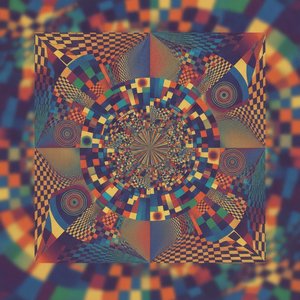
Koentoesh: A Geometric Dance of Color
Victor Vasarely’s “Koentoosh,” created in 1974, stands as a cornerstone of Op Art—Optical Art—a movement that revolutionized visual perception during the mid-20th century. More than just a painting; it's an invitation to experience color and form in ways previously unimaginable, challenging our ingrained assumptions about how we see the world. Executed on aluminum using BASF Luran paint, this monumental piece – measuring 37 ½ x 37 ½ inches – embodies Vasarely’s signature approach: meticulous geometric abstraction designed to induce a mesmerizing illusion of movement.
- The Composition: At first glance, “Koentoosh” appears as a simple square divided into countless smaller squares. However, this apparent simplicity belies an astonishing complexity. Each individual square is filled with vibrant hues—red, green, blue, yellow, and purple—arranged in patterns that subtly shift and shimmer under observation.
- Vasarely’s Method: Vasarely's technique was revolutionary for its time. He painstakingly created these geometric forms using a process known as “laser etching,” transferring precise designs onto aluminum sheets before applying BASF Luran paint. This method ensured unparalleled accuracy and consistency, guaranteeing that each square would maintain the same mesmerizing optical effect.
- Historical Context: Op Art emerged in the wake of World War II, fueled by advancements in physics and psychology. Artists like Vasarely sought to explore how our eyes perceive visual stimuli—specifically, how they create illusions of depth and movement when confronted with static images. It was a reaction against representational art’s perceived limitations and an embrace of pure abstraction as a vehicle for conveying emotion and stimulating the senses.
Symbolism & Emotion: Vasarely deliberately avoided figurative imagery, believing that geometric forms could communicate ideas more powerfully than recognizable subjects. The repetition of squares—a fundamental element in mathematics and visual harmony—represents order and stability amidst apparent chaos. Simultaneously, the shifting colors evoke a feeling of dynamism and excitement, mirroring the perceptual experience itself. “Koentoosh” isn’t merely about seeing; it's about *feeling* the illusion of movement and embracing the beauty of mathematical precision.
Provenance & Significance: Produced in 1974 as part of an edition of eight prints, “Koentoosh” holds considerable artistic prestige. Its inclusion in prominent galleries like Galería RGR underscores its enduring influence on contemporary art and design. It serves as a testament to Vasarely’s pioneering vision—a vision that continues to inspire artists and collectors alike.
- Material: BASF Luran paint was chosen specifically for its ability to produce an iridescent sheen, enhancing the visual illusion created by the geometric patterns.
- Size: The expansive dimensions of “Koentoosh” contribute to its immersive quality, enveloping the viewer in a sea of color and form.
- Edition Size: Limited to eight prints ensures that this masterpiece remains rare and highly sought after by discerning collectors.
The artwork’s enduring appeal lies not only in its aesthetic beauty but also in its intellectual challenge—a reminder that perception is subjective and that art can transcend mere representation, captivating us with its ability to manipulate our senses and provoke profound emotional responses. “Koentoosh” remains a vibrant emblem of Op Art's legacy, cementing Victor Vasarely’s place as one of the most influential artists of the 20th century.
Soru ve Cevaplar
"Koentoeş" adlı eser, Victor Vasarely kariyerinin hangi dönemine ait?
"Koentoeş", Victor Vasarely kariyerinin Mature Period dönemine aittir. Bu sınıflandırma, eseri sanatçının gelişim süreciyle ilişkilendirir.
"Koentoeş" adlı eser, Victor Vasarely’in temaları ve üslubuyla nasıl bir bütünlük sağlıyor?
"Koentoeş", temaları arasında geometric abstraction, bauhaus movement impact, visual perception exploration, optical illusion mastery, iconic op art exemplar yer alan Victor Vasarely'in Op Art dönemine ait bir eserdir."
Victor Vasarely imzalı "Koentoeş" eserinin formatına hangi yerleşim uygundur?
Victor Vasarely imzalı "Koentoeş" eserinin Kare formatı, Oturma Odası için önerilmektedir. Format ve alanın birleşimi, bir reprodüksiyonun yerleşimi konusunda yol göstericidir.



 Önizle
 El Yapımı Tablo Satın Al
 Gönder
 Paylaş
 Detaylar
 Rehber

 Dosyayı İndir
 Benzerleri
 X-Işını
 Slayt Gösterisi
 İstatistikler
 Devamını Oku






































 Cam seçeneği yalnızca 110 cm altındaki boyutlar için mevcuttur.