Victor Vasarely: Geometric Harmony – Exploring Abstract Composition 22
Victor Vasarely (1906-1997), a Hungarian-born artist, stands as one of the most influential figures in Op Art—Optical Art—a movement that revolutionized visual perception during the mid-20th century. His groundbreaking approach to painting wasn’t merely about depicting reality; it was about manipulating how the eye perceives color and form, creating illusions of movement and depth within static images.
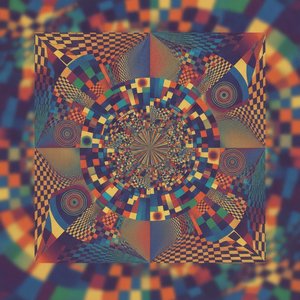
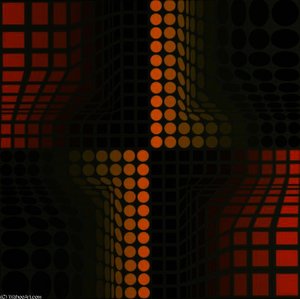
“Abstract Composition 22,” produced around 1968, exemplifies Vasarely's signature style. This artwork immediately captivates with its bold simplicity: a predominantly yellow background punctuated by fourteen meticulously arranged circles of varying sizes. These circles aren’t randomly scattered; they adhere to a rigorously geometric system developed by Vasarely himself—a system rooted in mathematical principles and designed to generate mesmerizing visual effects.
Vasarely's method involved creating “plasmatic” drawings, utilizing a technique he termed “geometric abstraction.” He began with a grid, applying colored squares to it according to specific rules. These squares were then transformed into circles through a process of repeated subdivision and recombination—a method that ensured consistency across all his artworks.
The historical context surrounding “Abstract Composition 22” is crucial to understanding its significance. Op Art emerged during the Cold War era, reflecting anxieties about technological advancement and challenging viewers’ assumptions about visual experience. Vasarely sought to liberate art from representational constraints, arguing that it could communicate ideas and emotions more powerfully through abstraction.
Beyond its technical brilliance, “Abstract Composition 22” possesses a profound emotional impact. The repetition of circles generates a hypnotic rhythm, inviting contemplation and stimulating the viewer’s subconscious mind. The yellow hue contributes to an aura of optimism and vibrancy—a deliberate choice by Vasarely to convey feelings of energy and dynamism.
Fondation Vasarely in Aix en Provence showcases numerous masterpieces of Vasarely's oeuvre, allowing visitors to immerse themselves in the artist’s visionary aesthetic. Reproductions of “Abstract Composition 22” are available at Fondation Vasarely and offer a chance to experience this iconic artwork firsthand.
For interior designers seeking inspiration, Vasarely’s geometric abstractions can infuse spaces with visual interest and sophistication. Consider incorporating circular motifs into wall coverings or furniture designs—a subtle nod to the artist's enduring legacy.



 Önizleme yap
 El yapımı tablo satın al
 Paylaş
 Paylaş
 Detayları Gör

 İndir
İndir
 Benzerlerini gör
 X-Işını
 Slayt Gösterisi
 Stats
Stats
 Tümünü Gör






































 Cam seçeneği yalnızca 110 cm altındaki boyutlar için mevcuttur.