Victor Vasarely's "Caopeo": A Dance of Perception
Victor Vasarely’s “Caopeo” isn’t merely a painting; it’s an invitation, a carefully constructed illusion designed to challenge and delight the viewer. Created in 1962, this seminal work exemplifies the core tenets of Op Art – Optical Art – a movement that sought to evoke sensory experiences through purely visual means. Born Károly Vaszary in 1906 in Pécs, Croatia (then part of Austria-Hungary), Vasarely’s artistic trajectory began unexpectedly with medical studies before he decisively embraced the world of art in 1927. His journey, fueled by a fascination with geometry and perception, led him to develop a revolutionary style that continues to resonate today.
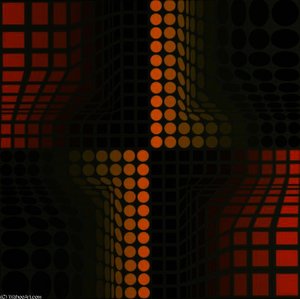
- Geometric Abstraction: At its heart, “Caopeo” is a testament to geometric abstraction. The artwork’s power lies in its meticulously arranged grid of black and white circles.
- Op Art Principles: Vasarely masterfully employs the principles of Op Art, manipulating visual perception through precise repetition and systematic variation.
The Illusion of Movement
The composition of “Caopeo” is deceptively simple. A square canvas explodes with a dynamic arrangement of circles – varying in size from prominent to subtle – all contained within a rigorously structured grid. This isn’t haphazard; each circle contributes to the overall illusion, creating an intense sense of movement and depth. The strategic use of scale—larger circles receding into the background while smaller ones appear closer—is a key technique employed by Vasarely to trick the eye and generate this captivating effect. It's a deliberate manipulation of visual cues, forcing the viewer to actively engage with the artwork rather than passively observing it.
A Historical Context: The Bauhaus Legacy
Understanding “Caopeo” requires acknowledging its roots in the intellectual currents of the early 20th century. Vasarely’s artistic development was profoundly shaped by his time at Sándor Bortnyik’s Műhely workshop, a school deeply influenced by the Bauhaus movement. The Bauhaus emphasized functional design and geometric abstraction – principles that directly informed Vasarely's approach to art. This connection to the Bauhaus legacy is crucial; it highlights “Caopeo” as part of a broader artistic dialogue concerned with exploring the relationship between form, space, and perception.
Symbolism and Emotional Impact
While undeniably abstract, "Caopeo" invites contemplation about the nature of visual experience. The stark black and white palette intensifies the geometric impact, emphasizing the artwork's focus on perception and illusion. Vasarely wasn’t interested in depicting recognizable objects; instead, he sought to create a purely visual language that could evoke emotional responses through its manipulation of form and space. The work’s enduring appeal lies in its ability to stimulate the viewer’s senses and provoke a sense of wonder – a reminder that reality itself is often an illusion.
Materials and Technique
The artwork's impact is achieved through Vasarely’s precise technique, utilizing oil paints on canvas. The smooth application of paint creates a surface texture that enhances the optical effect, while the limited color palette – black and white – maximizes the visual intensity. This meticulous approach, combined with Vasarely’s innovative use of geometric abstraction, cemented his place as one of the most influential figures in Op Art.



 Önizleme yap
 El yapımı tablo satın al
 Paylaş
 Paylaş
 Detayları Gör
 Rehber

 İndir
İndir
 Benzerlerini gör
 X-Işını
 Slayt Gösterisi
 İstatistikler

 Tümünü Gör






































 Cam seçeneği yalnızca 110 cm altındaki boyutlar için mevcuttur.