The Geometric Rhythm of Thomas Downing
In the vibrant tapestry of mid-century American abstraction, few threads are as precise and mesmerizing as those woven by Thomas Downing. A pivotal figure within the Washington Color Field movement, Downing possessed a singular ability to transform the canvas into a rhythmic playground of geometry and light. Born in Suffolk, Virginia, his journey toward becoming a master of the "spot painting" was marked by a rigorous pursuit of formal excellence. After earning his degree from Randolph-Macon College in 1948, he sought the creative pulse of New York, studying at the prestigious Pratt Institute. This period of intense academic honing prepared him for a transformative voyage through Europe, funded by a grant from the Virginia Museum of Fine Arts. His time at the Académie Julian in Paris allowed him to absorb the nuances of European tradition, providing a classical foundation upon which he would later build his radical, modern abstractions.
Upon returning to the United States following his service in the U.S. Army, Downing settled in Washington, D.C., a city that would become the epicenter of his artistic evolution. It was here that his path intersected with the giants of the era. Seeking to refine his vision within the burgeoning abstract landscape, he studied under Kenneth Noland at Catholic University. This mentorship was more than mere instruction; it was a profound intellectual exchange that helped shape Downing’s place within the Washington Color School. Alongside contemporaries like Howard Mehring and Sam Gilliam, Downing contributed to a movement that moved away from the gestural turbulence of Abstract Expressionism toward a cleaner, more cerebral exploration of color and form. His work became a study in balance, where the weight of a single circle could shift the entire equilibrium of a composition.
The Architecture of Color and Form
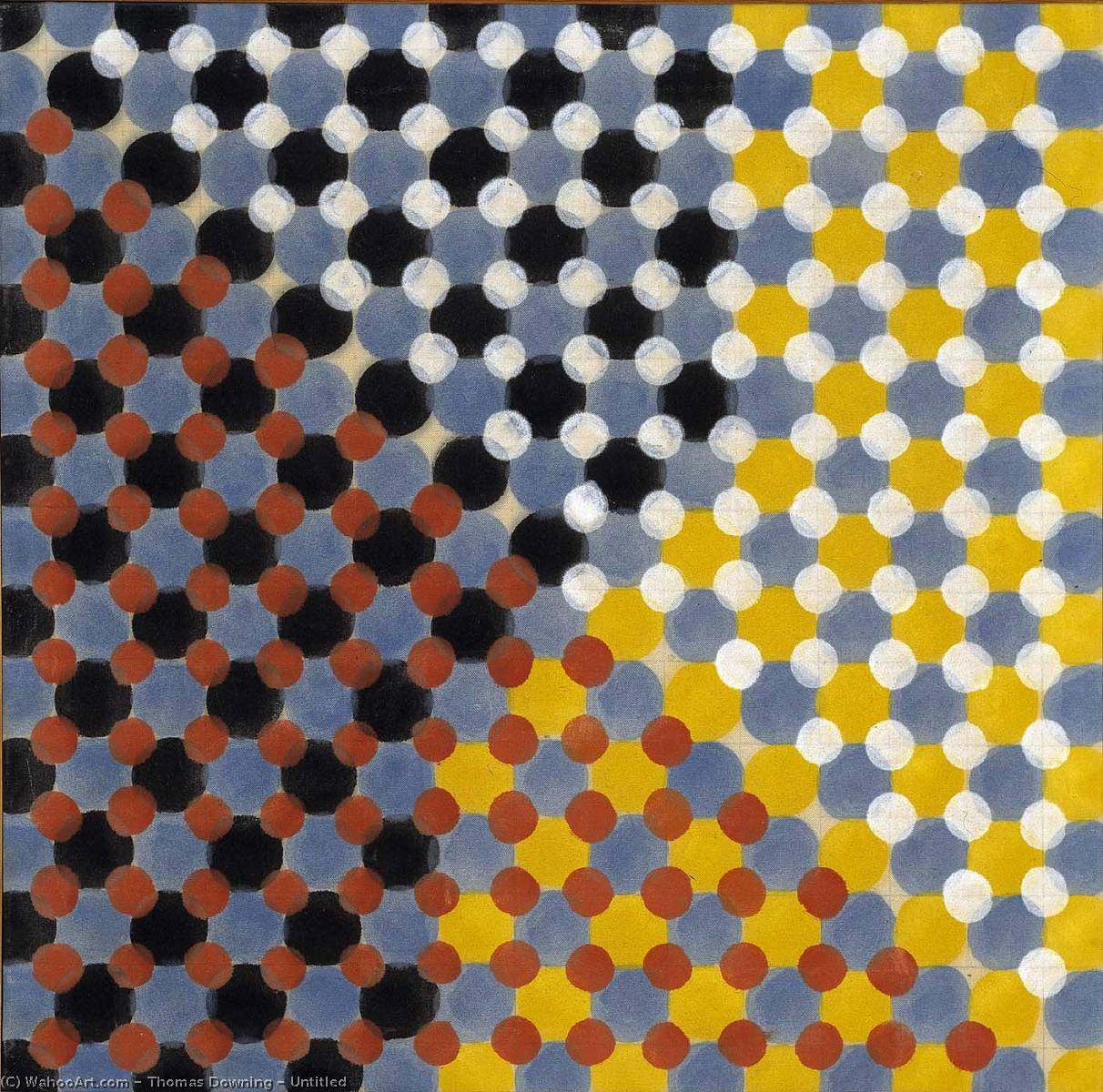
Downing’s most enduring legacy lies in his mastery of the Spot Paintings—works characterized by an exquisite arrangement of circles, arcs, and dots. Unlike the chaotic energy of his predecessors, Downing’s compositions felt orchestrated, almost mathematical, yet they pulsed with a life of their and organic vitality. He utilized color not merely as a decorative element but as a structural force. Through the use of symmetry and carefully calculated spacing, he created a sense of depth and movement that drew the viewer into a meditative state. His canvases often featured a complex interplay of primary hues—reds, yellows, and blues—set against stark whites or deep blacks, creating a visual tension that felt both modern and timeless.
The technical brilliance of his work can be seen in pieces such as Red Span and his various Untitled works from the early 1960s. In these paintings, the artist explored:
- Geometric Precision: The use of perfect circles and arcs to create a sense of cosmic order.
- Chromatic Harmony: A sophisticated understanding of how adjacent colors interact to produce optical vibrations.
- Spatial Dynamics: The manipulation of negative space to allow each geometric element to "breathe" on the canvas.
A Legacy Etched in Abstraction
The historical significance of Thomas Downing extends far beyond his personal catalog of works. In 1964, his inclusion in Clement Greenberg’s seminal exhibition, Post-painterly Abstraction, cemented his status as a leading voice in contemporary art. As an educator at the Corcoran College of Art and Design, he also acted as a vital conduit for new ideas, influencing a subsequent generation of artists who sought to find beauty in clarity and structure. His teaching helped foster an environment where the exploration of pure form could flourish.
Though his life ended prematurely and somewhat mysteriously in Provincetown, Massachusetts, in 1985, the impact of his vision remains undiminished. Downing’s work stands as a testament to the power of restraint. He proved that within the confines of a circle or the edge of an arc, there exists an infinite universe of emotion and complexity. Today, his paintings continue to resonate as essential landmarks of American modernism, reminding us that true innovation often lies in the perfect calibration of simplicity.


 Önizle
 El Yapımı Tablo Satın Al
 Gönder
 Paylaş
 Detaylar
 Rehber

 Dosyayı İndir
 Benzerleri
 X-Işını
 Slayt Gösterisi
 İstatistikler

 Devamını Oku






































 Cam seçeneği yalnızca 110 cm altındaki boyutlar için mevcuttur.


