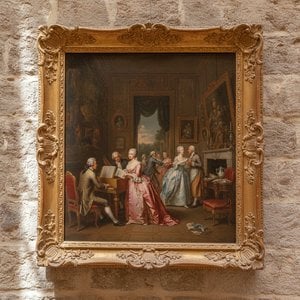
A Tapestry of Village Life: Capturing the Spirit of Pitlessie Fair
To gaze upon this depiction of the Pitlessie Fair is to step directly into the vibrant heart of early nineteenth-century rural England. It is more than just a painting; it is a meticulously preserved moment in time, an olfactory memory of hay smoke, laughter, and the earthy scent of livestock mingling in a bustling town square. Sir David Wilkie, through this masterful oil on canvas from 1804, achieved something rare: he captured not merely a scene, but the very pulse of community life. The composition is alive, teeming with humanity and animal energy, inviting the viewer to lose themselves within its joyful chaos.
Wilkie's Mastery of Everyday Moments
Sir David Wilkie earned his reputation as "The People’s Painter," a title that speaks volumes about his dedication to elevating the mundane into the realm of high art. His technique, characterized by an almost luminous handling of paint and an unparalleled attention to detail, allows every figure and every beast to feel utterly real. Observe the interplay between the numerous individuals; some are engaged in intimate whispers, others are caught mid-gesture in a dance or transaction. The inclusion of horses and cows is not mere filler; they anchor the scene in tangible reality, grounding the gaiety of the fair in the rhythms of agricultural life. Wilkie possessed an extraordinary gift for tonal gradation, allowing light to seem as if it were filtering naturally through the open air onto the canvas.
Historical Resonance and Social Portraiture
The early 1800s represented a period of significant social flux in Britain, a time when traditional village structures remained potent yet were subtly shifting under the weight of burgeoning industrial change. This fair serves as a beautiful historical document, offering an unvarnished glimpse into the social fabric before the sweeping transformations of later decades. It speaks to a pre-Victorian sense of communal celebration—a necessary release valve for the close-knit community. For collectors and designers alike, owning a reproduction of this work is acquiring a piece of tangible British history, imbued with the warmth of its era.
Emotional Echoes for the Modern Home
The emotional impact of this painting is one of pure, unadulterated conviviality. It radiates warmth—the kind that settles over a room and makes it feel instantly lived-in and cherished. For an interior setting, this piece acts as a magnificent focal point, injecting narrative depth and spirited energy into any space. Whether placed above a mantelpiece or within a gallery grouping, the scene invites contemplation on connection, celebration, and the enduring power of human gathering. It is art that does not merely hang on a wall; it breathes life back into a room.



 Önizleme yap
 Baskı Moduna Geç
 Paylaş
 Paylaş
 Detayları Gör

 İndir
İndir
 Benzerlerini gör
 X-Işını
 Slayt Gösterisi
 İstatistikler


 Tümünü Gör






































 Cam seçeneği yalnızca 110 cm altındaki boyutlar için mevcuttur.