A Testament to Faith and Courtly Grace: Simone Martini’s “Crucifix” (1321)
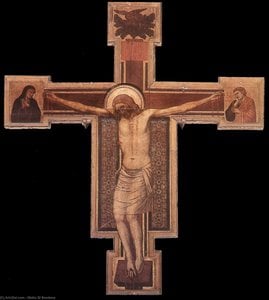
This arresting depiction of the crucifixion, attributed to the masterful hand of Simone Martini, transcends mere religious iconography; it is a profound meditation on faith, suffering, and the enduring power of grace. Painted in 1321, during the apex of his career, this work exemplifies Martini’s signature style – a breathtaking synthesis of Sienese artistic tradition with an unparalleled sensitivity to color and form. Measuring 164 x 147 cm, the scale of the painting immediately draws the viewer into the heart of the scene, fostering a deeply personal connection with the figures depicted.
- Subject Matter: The composition centers on Jesus Christ crucified, presented with an almost agonizing realism that was revolutionary for its time. His posture, rendered with meticulous detail, conveys both physical pain and spiritual anguish.
- The Presence of Mary Magdalene: Standing beside the cross is Mary Magdalene, a figure often associated with repentance and devotion. Her presence underscores the themes of redemption and forgiveness central to Christian belief.
- Angelic Intervention: Above the cross, three angels are depicted in various positions, adding an ethereal dimension to the scene and suggesting divine intervention – a common motif in medieval religious art.
Technique and Artistic Innovation
Simone Martini’s technical prowess is immediately apparent in every brushstroke. Executed in tempera on panel, a technique favored by Sienese artists of the period, the painting boasts an astonishing level of detail and luminosity. The use of vibrant colors – rich blues, reds, and golds – creates a visual feast that was considered groundbreaking for its time. Martini’s mastery of line is particularly noteworthy; each contour is precisely rendered, contributing to the overall sense of realism and emotional intensity. The influence of Giotto, though debated, is undeniable in his approach to depicting human form, albeit filtered through his own distinctive aesthetic.
- Tempera on Panel: The use of tempera paint, known for its slow drying time and ability to build up layers of color, allowed Martini to achieve the remarkable detail and depth characteristic of his work.
- Line as Form: Martini’s meticulous attention to line is a defining feature of his style, creating a sense of solidity and weight in the figures and architectural elements.
Symbolism and Historical Context
Created during a period of intense religious fervor and artistic innovation, “Crucifix” reflects the profound spiritual concerns of 14th-century Siena. The painting’s symbolism is layered and complex, drawing upon both biblical narratives and medieval theological beliefs. The inclusion of the book in the lower left corner likely represents the Gospels, while the cup may symbolize the Eucharist – a central element of Christian worship. Siena itself was a powerful city-state, deeply invested in religious patronage, and Martini’s work served as a testament to its faith and artistic prestige. This piece is considered one of the most important examples of Sienese Gothic art, bridging the gap between the late medieval and early Renaissance periods.
Emotional Impact and Artistic Legacy
More than just a religious depiction, “Cruifix” evokes a powerful emotional response in the viewer. The raw intensity of Jesus’s suffering, combined with the serene presence of Mary Magdalene and the ethereal quality of the angels, creates a scene of profound pathos. Simone Martini's "Crucifix" remains a testament to his artistic genius and a poignant reminder of humanity's enduring struggle with faith, mortality, and redemption. A hand-painted reproduction offers an unparalleled opportunity to experience the beauty and emotional depth of this iconic masterpiece in your own space.
Soru ve Cevaplar
"Crucifix" eserinin ön izlemesini nerede görebilirim?
"Crucifix" eserinin Önizleme sayfası, sipariş vermeden önce eseri önizlemenize olanak tanır.
Simone Martini imzalı "Crucifix" eserinin röntgen görüntüsünü görebilir miyim?
Simone Martini imzalı "Crucifix" eserinin X-Ray görünümü, eserin X-Işını sayfasında yer almaktadır: on bir optik katman aracılığıyla görüntünün interaktif bir incelemesi.
"Crucifix" eserinin üslubu, yaratıcısının dönemle nasıl bir ilişki içindedir?
Simone Martini imzalı "Crucifix", yaratıcısının Geç Orta Çağ döneminde, International Gothic akımı içerisinde yer almaktadır.



 Önizle
 El Yapımı Tablo Satın Al
 Gönder
 Paylaş
 Detaylar
 Rehber

 Dosyayı İndir
 Benzerleri
 X-Işını
 Slayt Gösterisi
 İstatistikler


 Devamını Oku






































 Cam seçeneği yalnızca 110 cm altındaki boyutlar için mevcuttur.