Gertrude Käsebier: Pioneer of Pictorialism – A Portrait of Native American Dignity
Gertrude Käsebier (1852-1934) stands as an undeniable cornerstone in the formative years of American photography, a figure whose artistic vision profoundly shaped the aesthetic landscape of her time. Her journey to recognition wasn’t merely one of talent; it was fueled by unwavering determination—a refusal to accept societal limitations imposed upon women artists during the late Victorian and Edwardian eras.
Born Gertrude Stanton in Des Moines, Iowa, Käsebier's early life instilled within her a resilience that would become synonymous with her artistic endeavors. The shadow of her father’s sudden demise and subsequent relocation to Brooklyn served as formative experiences, shaping her perspective on independence and forging the spirit of innovation that characterized her career.
Her mother’s courageous stance in establishing a boarding house demonstrated an admirable fortitude—a quality undoubtedly influencing Käsebier's own resolve. Despite facing considerable obstacles, she pursued her passion for photography with unwavering dedication, ultimately achieving international acclaim.
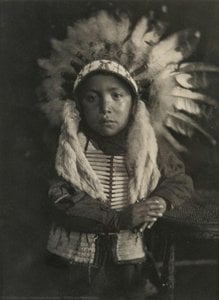
The Willie-Spotted Horse Portrait: Capturing Essence Through Light and Texture
“Willie-Spotted Horse,” created in 1898, represents Käsebier’s most celebrated achievement—a masterpiece of Pictorialism that transcends mere documentation to embody a profound exploration of human emotion and cultural heritage. This striking black and white portrait captures the solemn gaze of a young Sioux Indian boy, meticulously rendered with remarkable attention to detail.
The photograph's composition is centered around the subject’s face, emphasizing his dignified posture and conveying an aura of quiet contemplation. Käsebier skillfully employs dramatic lighting—deep shadows juxtaposed against highlights—to sculpt the boy’s features and accentuate the textures of his clothing and headdress. The artist’s deliberate choice to remove ceremonial articles from the sitter underscores her commitment to portraying individual identity rather than adhering to conventional ethnographic representations.
The technique employed is photographic printing, utilizing silver gelatin processes – a method favored by Käsebier for its ability to achieve tonal richness and textural nuance. Layers of varnish were applied to create a glossy surface that enhanced the visual impact of the image.
Pictorialism: A Movement Defined by Artistic Vision
Käsebier’s work aligns seamlessly with Pictorialism, an artistic movement that championed photography as a medium for artistic expression. Rejecting the purely descriptive aims of earlier photographic practices, Pictorialists sought to elevate photography to the status of fine art—analogous to painting and sculpture.
Influenced by Impressionist painters like Claude Monet and Edgar Degas, Pictorialists prioritized capturing fleeting moments of beauty and emotion through subtle tonal gradations and textured surfaces. Käsebier embraced this ethos wholeheartedly, prioritizing artistic vision over technical accuracy – a hallmark of her distinctive style.
Symbolism and Emotional Resonance
"Willie-Spotted Horse" transcends its visual elements to convey a powerful message about cultural respect and human dignity. The boy’s unwavering gaze embodies resilience and introspection—qualities emblematic of Native American culture during the late 19th century. Käsebier's meticulous attention to detail, combined with her masterful use of light and texture, elevates the portrait beyond mere likeness, transforming it into a timeless symbol of identity and heritage.
The photograph’s enduring appeal lies in its ability to evoke empathy and admiration—a testament to Käsebier’s artistic genius and her unwavering commitment to portraying humanity with compassion and nuance. It remains an inspiring example of how photography can serve as a conduit for conveying profound emotional truths.



 Önizleme yap
 Baskı Moduna Geç
 Paylaş
 Paylaş
 Detayları Gör
 Rehber

 İndir
İndir
 Benzerlerini gör
 X-Işını
 Slayt Gösterisi
 İstatistikler


 Tümünü Gör






































 Cam seçeneği yalnızca 110 cm altındaki boyutlar için mevcuttur.