The Genesis of a Myth: William Tell in the Realm of Dreams
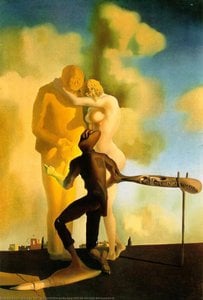
Salvador Dalí’s “William Tell,” painted in 1930, isn't merely a depiction of the Swiss folk hero; it’s an immersion into the artist’s intensely personal and profoundly unsettling subconscious. This work transcends simple narrative, becoming a swirling vortex of symbolism, fractured forms, and dreamlike logic—a quintessential example of Dalí’s mature surrealist style. The painting immediately confronts the viewer with a chaotic tableau: a man on horseback, not in triumphant victory, but radiating an almost palpable anguish; a bull-headed crossbow, a jarring juxtaposition that speaks to primal fears and anxieties; and figures scattered across the landscape like fragments of a shattered memory. It’s crucial to understand Dalí's own biography at this time – his complex relationship with Gala Éluard, his burgeoning artistic independence, and his increasingly critical stance towards established artistic conventions—to fully grasp the emotional weight embedded within this scene.
- The Mythic Core: Dalí doesn’t simply illustrate the legend of William Tell; he distorts it, amplifying its inherent drama and injecting a potent dose of psychological turmoil. The act of tyrannicide, central to the story, is presented not as an heroic deed but as a violent confrontation with authority.
- Symbolic Distortion: Notice the disproportionate figures – the elongated limbs, the floating objects—a hallmark of Dalí’s technique designed to destabilize perception and evoke a sense of unease. The horse itself seems trapped in a perpetual state of motion, mirroring the protagonist's internal struggle.
- A Personal Reflection: Many art historians believe this painting reflects Dalí’s own anxieties about control, power dynamics, and his evolving relationship with Gala, who represented both a muse and a formidable force in his life.
The Language of Surrealism: Technique and Composition
Dalí's mastery lies not just in the imagery but also in its execution. “William Tell” is a rich tapestry woven from various techniques, reflecting the artist’s eclectic approach. The painting incorporates elements of collage—fragments of reality seemingly pasted onto an imagined world—alongside traditional oil paint. The use of vibrant, almost hallucinatory colors – deep reds, blues, and yellows – contributes to the overall sense of disorientation. The composition is deliberately unbalanced, with a strong diagonal thrust created by the horse and figures, pulling the viewer’s eye through the chaotic scene. The meticulous detail in rendering each element—the texture of the horse's coat, the glint of the crossbow—contrasts sharply with the dreamlike atmosphere, further enhancing the painting’s unsettling effect.
Key Techniques:
Collage elements: Juxtaposition of disparate objects and textures.
Oil Paint: Rich color palette and meticulous rendering.
Distorted Perspective: Creates a sense of unease and disorientation.
Decoding the Dreamscape: Symbolism and Interpretation
Beyond the immediate visual impact, “William Tell” is laden with symbolism. The bull-headed crossbow immediately evokes primal fears – the bull representing aggression and the crossbow, a tool of violence. The clock, subtly placed on the right side of the canvas, introduces an element of time and perhaps suggests the relentless passage of judgment or the inescapable nature of fate. The figures surrounding Tell—some standing close together, others distant—represent the complex web of relationships and power dynamics at play. Notably, the figure of a woman, often interpreted as Gala, is present, adding another layer of personal significance to the scene. It’s important to note that Dalí himself offered various interpretations, often deliberately ambiguous, encouraging viewers to project their own meanings onto the work.
A Legacy of Surrealism: Dalí's Enduring Influence
“William Tell” stands as a pivotal work in Salvador Dalí’s oeuvre and a cornerstone of the surrealist movement. It exemplifies the genre’s fascination with the unconscious, its rejection of rational thought, and its exploration of hidden desires and anxieties. Dalí's ability to transform a familiar myth into a profoundly personal and unsettling vision cemented his place as one of the 20th century’s most influential artists. Reproductions of this captivating painting continue to resonate with audiences today, offering a glimpse into the extraordinary mind of a visionary artist—a testament to the power of dreams and the enduring allure of surrealism.



 Önizleme yap
 El yapımı tablo satın al
 Paylaş
 Paylaş
 Detayları Gör

 İndir
İndir
 Benzerlerini gör
 X-Işını
 Slayt Gösterisi
 İstatistikler

 Tümünü Gör






































 Cam seçeneği yalnızca 110 cm altındaki boyutlar için mevcuttur.