The Genesis of a Dreamscape
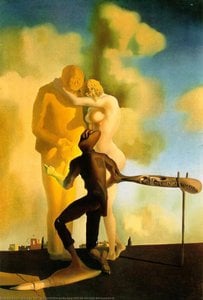
Salvador Dalí’s “LaTour,” painted in 1934, isn't merely a depiction of a landscape; it’s an immersion into the artist’s meticulously constructed dream world. Emerging from the swirling depths of a cobalt blue abyss – reminiscent of both turbulent water and ethereal clouds – rise two nude male figures, their postures simultaneously defiant and vulnerable. This initial encounter immediately establishes a profound tension: a struggle for stability amidst chaos, a yearning for connection within an isolating expanse. The composition itself is deliberately unsettling, utilizing sharp diagonals created by the figures’ limbs and the undulating forms of the background to draw the viewer into this disconcerting space. It's a scene that feels both intensely personal – a reflection of Dalí’s own anxieties and obsessions – and universally resonant, tapping into primal fears of isolation and the unknown.
A Masterclass in Surrealist Technique
Dalí’s signature style is fully realized within “LaTour.” The painting is executed with an almost obsessive attention to detail, a hallmark of his meticulous approach. Thick impasto – layers of paint built up dramatically across the canvas – creates a tactile surface that invites close inspection. Notice how the blue forms aren't smoothly blended; instead, they’re fractured and layered, suggesting movement and instability. The use of light is equally deliberate, diffusing rather than highlighting, contributing to the overall atmosphere of dreamlike ambiguity. The rectangular structure dominating the center isn’t simply a building; it functions as a portal, an invitation – or perhaps a warning – into another dimension. This architectural element, rendered with sharp precision, contrasts starkly with the fluidity and organic shapes that surround it, further amplifying the sense of disorientation.
Echoes of History and Symbolism
To fully appreciate “LaTour,” one must consider its historical context within the Surrealist movement. Dalí’s work was deeply influenced by Sigmund Freud's theories on the unconscious mind, exploring themes of sexuality, anxiety, and repressed desires. The figures themselves are laden with symbolism. Their nudity represents vulnerability and exposure, while their gestures – one reaching out, the other seemingly frozen in contemplation – suggest a complex interplay of desire, struggle, and perhaps even regret. Interestingly, research reveals that this painting was inspired by a photograph taken during a visit to the French architect Arsène Lacarrière-Latour’s studio, whose work featured evocative watercolors of the Americas. This connection adds another layer of intrigue, hinting at a fascination with structure, perspective, and the representation of space – elements that Dalí masterfully incorporates into his own surreal vision. Furthermore, the recurring motif of towers in Dalí's oeuvre often symbolizes aspiration, ambition, or even imprisonment, adding to the painting’s multi-layered meaning.
Beyond Reproduction: Capturing the Essence
Reproductions, however meticulously crafted, can never fully replicate the visceral impact of the original. “LaTour” is a painting that demands engagement; it invites viewers to lose themselves in its unsettling beauty and contemplate its profound themes. The emotional resonance of this piece lies not just in its striking imagery but also in Dalí’s masterful manipulation of space, light, and symbolism. When considering a high-quality reproduction, prioritize one that accurately captures the texture of the impasto, the depth of the blue hues, and the overall sense of disorientation – elements crucial to understanding the painting's power.



 Önizleme yap
 El yapımı tablo satın al
 Paylaş
 Paylaş
 Detayları Gör

 İndir
İndir
 Benzerlerini gör
 X-Işını
 Slayt Gösterisi
 İstatistikler

 Tümünü Gör






































 Cam seçeneği yalnızca 110 cm altındaki boyutlar için mevcuttur.