OilWallArtSurrealist Dreamscape
 1936Modern
 50.0 x 60.0 cm
Sanatçılarımız tarafından sipariş üzerine hazırlanan; istediğiniz boyut ve çerçevede, tuval üzerine el boyaması yağlı boya. ( Baskı satın al Görsel satın al)





























Eserin orijinal oranlarıyla uyumlu, önceden belirlenmiş boyutlarımız arasından seçim yapın.

Belirli bir çerçeveye veya alana uyması için kendi boyutlarınızı girebilirsiniz. Seçtiğiniz boyut orijinal görüntünün oranlarıyla eşleşmiyorsa, sanat eserini kırparak veya ek el boyaması öğelerle resmi uzatarak ayarlayacağız. Üretim başlamadan önce onayınız için dijital bir taslak gönderilecektir.
Lütfen ekrandaki önizlemenin gerçek kırpmayı veya uzatmayı yansıtmadığını unutmayın. Nihai kompozisyonu yalnızca hazırlanan taslak doğru şekilde gösterecektir.
Özel boyutlar mevcut olsa da, orijinal oranları korumak adına önceden tanımlanmış listeden bir boyut seçmenizi öneririz.
Dünya Çapında Teslimat (); standart 5 hafta yerine 3/4 haftada. (7 Eylül). Kaliteden ödün verilmez.


Philosopher's lamp
Reproduksiyon Boyutu
In the quiet, unsettling realm of 1936, René Magritte birthed a masterpiece that continues to haunt the corridors of the modern imagination. “Philosopher’s Lamp” is far more than a mere portrait of a man lost in thought; it is an arresting meditation on the very nature of perception and the elusive boundaries of truth. At first glance, the viewer encounters a scene of deceptive simplicity: a solitary figure seated at a table, a lit candle casting its glow, and the unmistakable presence of a man enjoying a cigar. Yet, beneath this mundane surface lies the profound tension characteristic of the Surrealist movement, where the familiar is stripped of its certainty and reassembled into something deeply mysterious.
Magritte’s technique in this work exemplifies his unique ability to marry meticulous realism with dreamlike irrationality. He renders the man's features—the prominent nose, the subtle texture of the mustache, and the tangible weight of the cigar—with a precision that suggests an almost photographic reality. However, this groundedness is violently interrupted by the background. Instead of a room or a study, we are confronted with a vast, bright blue sky dotted with soft clouds. This jarring juxtaposition creates a palpable sense of displacement, pulling the viewer out of the physical world and into a psychological landscape where gravity and logic no longer apply.
Every element within Philosopher’s Lamp serves as a vessel for deeper meaning, inviting collectors and scholars alike to peel back the layers of Magritte's visual language. The candle, perched precariously atop the table, acts as the central protagonist of this symbolic drama. Traditionally, the flame represents enlightenment, reason, and the light of knowledge—the "lamp" of the title. Yet, in a classic Magrittean twist, this very light casts an ambiguous shadow that partially obscures the man's face. This creates a poignant paradox: the pursuit of truth often leaves us more obscured than before, highlighting the difficulty of accessing the true essence of the self or the hidden realities of the universe.
The blue sky, serving as a surreal backdrop, acts as an infinite canvas for contemplation. It mirrors the boundless nature of the subconscious mind, a central preoccupation for Magritte and his contemporaries who were deeply influenced by the psychoanalytic theories of Sigmund Freud. The interplay between the heavy, terrestrial presence of the man and the weightless, ethereal sky creates an emotional resonance that is both tranquil and profoundly unsettling. It is this very duality—the comfort of the familiar meeting the terror of the unknown—that makes the painting such a captivating subject for interior curation.
For the discerning art lover or interior designer, a high-quality reproduction of “Philosopher’s Lamp” offers more than just aesthetic beauty; it provides a conversational centerpiece that challenges and inspires. The painting's ability to evoke curiosity makes it an ideal choice for spaces designed for reflection, such as private libraries, studies, or avant-garde living areas. Its palette of deep shadows and bright, airy blues allows it to integrate seamlessly into both modern minimalist settings and more traditional, classic environments.
Owning a piece that captures the essence of Magritte’s 1930s experimentation is an opportunity to possess a fragment of art history. This work stands as a testament to a period when artists sought to liberate the mind from the constraints of rationality. By bringing this masterpiece into a home or gallery, one does not merely decorate a wall; one invites the profound, beautiful mystery of the Surrealist spirit to reside within the space, ensuring that every glance at the canvas becomes an opportunity for a new discovery.

René Magritte, born René François Ghislain Magritte on November 21, 1898, in Lessines, Belgium, emerged into a world that would profoundly shape his enigmatic artistic vision. His early years were marked by an unsettling event – the suicide of his mother when he was just thirteen. The image of her body being recovered from the River Sambre, with her dress obscuring her face, became a haunting motif that would subtly permeate his later work, manifesting in veiled figures and a persistent exploration of hidden realities. This early trauma instilled within him a fascination with mystery, loss, and the unsettling power of what remains unseen. While details of his childhood remain somewhat elusive, it’s clear this formative experience laid the groundwork for his lifelong questioning of perception and representation. He began drawing lessons at age ten, revealing an innate inclination towards visual expression, but initially explored Impressionism before embarking on a path that would lead him to become one of the most significant figures in Surrealist art.
Magritte’s artistic journey was not immediate or straightforward. He studied at the Académie Royale des Beaux-Arts in Brussels, yet found its traditional methods stifling. His early work experimented with Futurism and Cubism, absorbing elements of these avant-garde movements but ultimately rejecting their purely formal concerns. It wasn't until encountering Giorgio de Chirico’s painting *The Song of Love* in 1922 that Magritte discovered a resonance that would irrevocably alter his artistic course. De Chirico’s dreamlike landscapes and unsettling juxtapositions unlocked within Magritte a new way of seeing – a world where the familiar could be rendered strange, and the ordinary imbued with profound mystery. This encounter sparked his commitment to Surrealism, though he often maintained a unique distance from its more overtly psychological or automatic approaches. He preferred a meticulous, almost clinical precision in his painting, using realistic techniques to depict illogical scenarios.
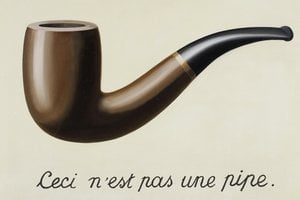
By 1926, Magritte had fully embraced the tenets of Surrealism, producing *Le Jockey Perdu (The Lost Jockey)*, widely considered his first truly surrealist work. However, his brand of Surrealism was distinct. He wasn’t interested in exploring the subconscious through free association or dream imagery in the manner of some of his contemporaries. Instead, Magritte sought to challenge viewers' perceptions of reality by presenting ordinary objects in unexpected contexts, forcing them to question their assumptions about the world around them. Iconic works like *The Treachery of Images (This is not a pipe)* (1929) brilliantly deconstructs the relationship between image and object, reminding us that a representation is never the thing itself. *Les Amants (The Lovers)* (1927-1928), with its shrouded figures, echoes the trauma of his mother’s death while simultaneously exploring themes of concealment and intimacy. *Time Transfixed* (1938) presents a locomotive bursting through a brick wall, disrupting our sense of space and time. And *The Human Condition* (1933), a canvas within a canvas, blurs the boundaries between representation and reality, prompting us to consider how we perceive and interpret the world.
Despite initial struggles for recognition, Magritte’s work gradually gained prominence, particularly in the United States with exhibitions in 1936 and later retrospective shows at the Museum of Modern Art (1965) and the Metropolitan Museum of Art (1992). He continued to refine his signature style, exploring themes of repetition, illusion, and the power of language in paintings that are both intellectually stimulating and visually arresting. Magritte died on August 15, 1967, leaving behind a body of work that continues to captivate and challenge audiences worldwide. His influence extends far beyond the realm of painting, impacting pop art, minimalist art, conceptual art, and even advertising and film. Today, his paintings are held in major museum collections around the globe, including the Musées royaux des beaux-arts de Belgique in Brussels, which houses the Magritte Museum – dedicated entirely to his work and boasting the world’s largest collection of his creations.
Magritte's enduring legacy lies in his ability to make us see the familiar anew, to question our assumptions about reality, and to appreciate the power of art to provoke thought and inspire wonder. He wasn’t simply painting images; he was crafting visual paradoxes that continue to resonate with viewers decades after their creation, solidifying his position as a true master of Surrealism and a pivotal figure in 20th-century art.

1898 - 1967 , Belçika

Discover the profound allure of oil on canvas. Explore the mastery of impasto textures, the science of pigment longevity, and expert guides to selecting museum-quality reproductions that elevate your collection with timeless elegance and tactile depth.

Delve into the profound mysteries of René Magritte’s Surrealism. Explore an expert analysis of 'The Treachery of Images,' decoding the philosophical paradoxes and visual subversions that redefined modern art history for collectors and connoisseurs alike.

Discover the enduring allure of oil on canvas. Explore how master techniques like impasto and glazing create the depth, texture, and emotional resonance found in the world's greatest masterpieces. An essential guide for fine art enthusiasts and discerning collectors.

 Önizleme yap
 Paylaş
 Paylaş
 Detayları Gör

 İndir
İndir
 Benzerlerini gör
 X-Işını
 Slayt Gösterisi
 Tümünü Gör







 Cam seçeneği yalnızca 110 cm altındaki boyutlar için mevcuttur.