A Moment Frozen in Provence: Paul Cézanne’s “Village Road”
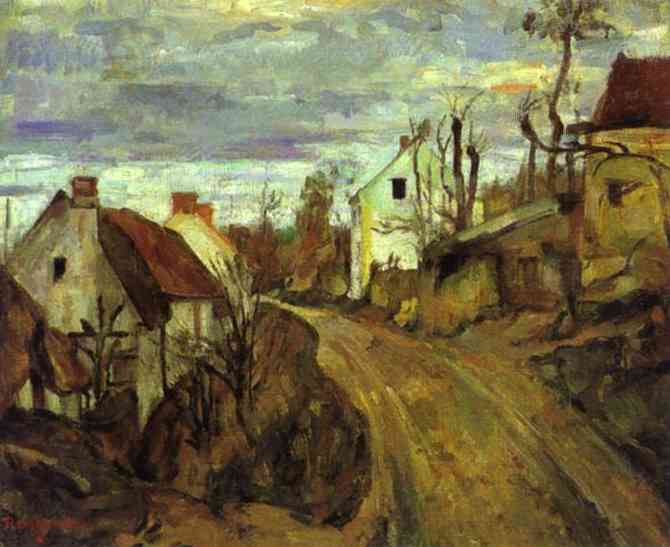
Paul Cézanne's "Village Road, auvers" isn’t merely a depiction of a Provençal scene; it’s an invitation into the artist’s intensely personal and revolutionary approach to seeing. Painted between 1872 and 1873, during his time working alongside Camille Pissarro in Pontoise, this canvas represents a pivotal shift in Cézanne's artistic trajectory – a move away from the fleeting impressions of Impressionism towards a more structured, geometric representation of reality. The painting captures a quiet moment along a dirt road winding through a small village, yet it’s far from a simple landscape study. Instead, it’s a carefully constructed exploration of form and space, anticipating the radical innovations of Cubism that would follow.
The scene itself is deceptively straightforward: a modest collection of houses clustered beneath a hazy sky, anchored by the prominent dirt road that dominates the composition. Two figures – likely villagers engaged in everyday tasks – are subtly integrated into the landscape, adding a touch of human presence without disrupting the overall sense of stillness. Three birds, one soaring high above and two perched lower down, punctuate the scene with delicate details, hinting at the natural rhythms of rural life. However, it’s Cézanne's masterful manipulation of light, color, and perspective that truly elevates this work. He employs thick, visible brushstrokes – a hallmark of his style – to build up planes of color and create a sense of solidity and depth. The colors are muted and earthy, reflecting the ochre tones of the soil and the hazy atmosphere of Provence.
The Architectonics of Perception
Cézanne’s approach to painting was profoundly influenced by his interest in architecture and mathematics. He believed that all natural forms could be reduced to a series of geometric shapes – pyramids, cylinders, and cones – and he sought to represent these underlying structures within his paintings. “Village Road” exemplifies this principle perfectly. The houses are not rendered as soft, atmospheric blurs but rather as sharply defined volumes, their edges delineated with precise brushstrokes. The road itself is treated as a linear element, guiding the viewer’s eye through the composition and creating a sense of spatial recession. This deliberate simplification of form was revolutionary at the time, challenging the traditional conventions of academic painting that prioritized illusionistic realism.
Interestingly, this work predates Cézanne's most famous explorations of Mont Sainte-Victoire, the mountain range near Aix-en-Provence. Yet, it demonstrates a similar preoccupation with capturing the essence of nature through geometric abstraction. The artist wasn’t simply recording what he saw; he was actively constructing an image based on his own understanding of how things looked and felt. This process reflects Cézanne's lifelong quest to find a new language for painting – one that would capture not just the appearance of objects but also their underlying structure and essential qualities.
Symbolism and Emotional Resonance
While seemingly tranquil, “Village Road” is imbued with a subtle sense of melancholy. The muted colors, the hazy atmosphere, and the solitary figures all contribute to an overall feeling of quiet contemplation. Some art historians interpret the painting as a reflection of Cézanne’s own emotional state during this period – a time of personal uncertainty and artistic struggle. The road itself can be seen as a metaphor for life's journey, winding through an uncertain landscape towards an unknown destination.
Furthermore, the inclusion of birds adds another layer of symbolic meaning. Birds are often associated with freedom, spirituality, and connection to nature – themes that resonate deeply within Cézanne’s work. Their presence in “Village Road” suggests a longing for escape from the constraints of everyday life and a desire to connect with something larger than oneself.
A Legacy of Innovation
“Village Road, auvers” is more than just a beautiful painting; it's a foundational work that profoundly influenced the course of modern art. Cézanne’s innovative approach to form, color, and perspective paved the way for the development of Cubism and other abstract movements of the 20th century. His emphasis on the underlying structure of objects and his willingness to challenge traditional conventions inspired generations of artists to explore new ways of seeing and representing the world. Reproducing this artwork allows one to experience a pivotal moment in art history, appreciating Cézanne’s genius and understanding his lasting impact on the visual arts.



 Önizleme yap
 El yapımı tablo satın al
 Paylaş
 Paylaş
 Detayları Gör

 İndir
İndir
 Benzerlerini gör
 X-Işını
 Slayt Gösterisi

 Tümünü Gör






































 Cam seçeneği yalnızca 110 cm altındaki boyutlar için mevcuttur.





