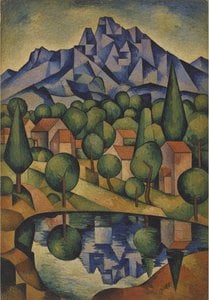
Chateau Noir (Washington) by Paul Cézanne: A Post-Impressionist Masterpiece
Paul Cézanne, a pioneering French artist, is renowned for his pivotal role in transitioning from 19th-century Impressionism to 20th-century Cubism. His painting, Chateau Noir (Washington), exemplifies the essence of Post-Impressionism and showcases his unique style.
Background and Artistic Style
Post-Impressionism emerged as a reaction against the naturalistic depiction of light and color by Impressionists. Cézanne, influenced by Romanticism and Realism in his early works, later developed a new pictorial language through intense examination of Impressionist forms of expression. He emphasized the underlying structure of objects in a composition and the formal qualities of art. Unlike the fleeting moments captured by the Impressionists, Cézanne sought to represent enduring forms and spatial relationships. His approach involved breaking down objects into geometric shapes – cylinders, spheres, and cones – and reassembling them on the canvas, creating a sense of solidity and depth that defied traditional perspective.
The Scene: Chateau Noir in its Surroundings
The painting Chateau Noir (Washington) depicts a large house with a distinctive black roof nestled amongst trees, evoking an atmosphere of age and rustic charm. The detailed architecture and natural elements are captured vividly, creating a sense of depth and atmosphere. Cézanne’s use of color is deliberate; he doesn't simply replicate the colors he sees but uses them to create form and volume. Notice how the greens of the foliage aren't uniform but layered with blues and browns, contributing to the painting's overall solidity. The presence of figures in the scene adds a touch of human activity within this tranquil landscape.
Historical Context and Cézanne’s Legacy
Cézanne's work was initially met with incomprehension and ridicule in contemporary art criticism. However, fellow artists like Camille Pissarro and the art dealer Ambroise Vollard recognized his genius. In 1895, Vollard opened the first solo exhibition of Cézanne's work in Paris, leading to a broader examination of his paintings. Cézanne’s influence on modern art is profound. Both Henri Matisse and Pablo Picasso acknowledged him as "the father of us all." His innovative approach to representation paved the way for avant-garde movements like Cubism, which revolutionized painting and visual arts in the early 20th century. He challenged conventional notions of perspective and representation, laying the groundwork for abstract art.
Emotional Impact and Enduring Appeal
Chateau Noir (Washington) is more than just a landscape painting; it's an exploration of form, space, and perception. The painting’s quiet grandeur invites contemplation, while its innovative style sparks curiosity. It embodies Cézanne’s desire to create something enduring and timeless – a testament to the beauty of the natural world rendered through a uniquely modern lens. Today, this piece continues to inspire artists and art enthusiasts alike, solidifying Cézanne's place as one of the most influential figures in Western art history.



 Önizleme yap
 Baskı Moduna Geç
 Paylaş
 Paylaş
 Detayları Gör

 İndir
İndir
 Benzerlerini gör
 X-Işını
 Slayt Gösterisi
 İstatistikler

 Tümünü Gör






































 Cam seçeneği yalnızca 110 cm altındaki boyutlar için mevcuttur.