Poplars: A Symphony of Light and Form
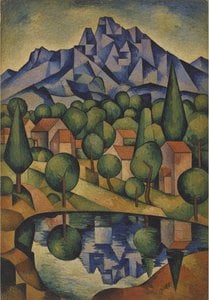
Paul Cézanne’s “Poplars,” completed in 1880, stands as a cornerstone of Impressionism’s transition into the revolutionary vanguard of Post-Impressionism. Currently residing within the hallowed halls of Musée d’Orsay in Paris, France—a testament to its enduring artistic significance—this oil on canvas masterpiece transcends mere depiction; it embodies Cézanne’s groundbreaking approach to capturing the essence of nature and reshaping the very language of painting. Measuring 62 x 78 cm, the artwork invites contemplation and rewards close observation with layers of subtle nuances that reveal the artist's profound understanding of visual perception.
The Painting's Composition: Harmony Amidst Dynamism
At first glance, “Poplars” presents a tranquil landscape dominated by towering trees laden with verdant foliage. However, beneath this serene surface lies an intricate orchestration of compositional elements designed to convey a sense of movement and energy—characteristics that would become hallmarks of Cézanne’s oeuvre. The artist skillfully arranges several trees in the foreground, their trunks rendered with thick, overlapping brushstrokes that emphasize solidity and texture. Simultaneously, distant trees contribute depth and perspective, creating a harmonious balance between stillness and dynamism. A building subtly positioned in the background anchors the scene while simultaneously enriching its visual complexity. Cézanne’s deliberate choices underscore his conviction that art should strive to represent not just what is seen but also how it feels—a principle that distinguishes him from earlier Impressionist painters who prioritized capturing fleeting atmospheric effects.
Artistic Style: Breaking Boundaries
Cézanne's artistic style represents a decisive departure from the conventions of Impressionism, marking a pivotal moment in art history. Rejecting the optical blending championed by Monet and others, Cézanne embraced a more expressive technique characterized by bold brushstrokes and vibrant colors—though tempered with muted tones—that prioritized form over mere color fidelity. This approach profoundly influenced subsequent generations of artists, paving the way for movements like Cubism and Surrealism. The artist’s meticulous attention to detail is evident in the rendering of bark textures and leaf surfaces, demonstrating a commitment to capturing the materiality of his subjects. Cézanne's method involved constructing forms from geometric shapes—cylinders, cones, cubes—a technique that anticipates the radical simplification championed by Picasso and Braque.
Historical Context: Bridging Two Movements
“Poplars” emerged during a period of transformative change within the art world, as Impressionism yielded to Post-Impressionism. Artists like Cézanne, Gauguin, and Seurat challenged the prevailing aesthetic sensibilities of their time, questioning the primacy of optical observation and advocating for subjective interpretation. Cézanne’s work served as a crucial bridge between these two movements, synthesizing Impressionist color palettes with Cubist structural principles. This innovative fusion reflected a broader intellectual climate marked by interest in scientific discoveries—particularly Darwin's theory of evolution—which encouraged artists to reconsider their understanding of the natural world and human perception. The painting’s creation coincided with a growing fascination for Cézanne's exploration of form, influencing artists who sought to move beyond mere representation toward conveying deeper emotional and psychological states.
Relevance to WahooArt: Authenticity and Artistic Legacy
WahooArt recognizes the enduring power of Cézanne’s vision—a conviction that resonates deeply with collectors and art enthusiasts alike. Our skilled artisans meticulously recreate “Poplars” using traditional oil painting techniques, ensuring that every brushstroke faithfully captures the original artwork's nuances. For those desiring to experience the beauty of Cézanne’s masterpiece firsthand, WahooArt offers high-quality reproductions—a tangible connection to a pivotal moment in art history. Explore our collection at
WahooArt and bring home a piece of artistic brilliance.
Soru ve Cevaplar
Paul Cézanne, 1880 yılında "Akaslar" eserini oluşturduğunda kaç yaşındaydı?
"Akaslar" adlı eser 1880 yılında yaratıldığında, 1839 yılında doğan Paul Cézanne, 41 yaşındaydı.
Paul Cézanne imzalı "Akaslar" tanınmış bir sanat eseri mi?
"Akaslar", Tanınmış olarak sınıflandırılmaktadır.
Paul Cézanne imzalı "Akaslar" hangi yılda yapıldı?
"Akaslar", 1880 yılına tarihlenmektedir. Bu tarih, eseri Paul Cézanne kariyerinin ve dönemin içerisine yerleştirmektedir.
"Akaslar" eserindeki renkler birbiriyle nasıl bir uyum içinde?
Paul Cézanne imzalı "Akaslar" eserinin renkleri Güçlü Renk Uyumu bir uyum sergiliyor. Uyum, renklerin birbirleriyle olan ilişkisini tanımlar.
Paul Cézanne imzalı "Akaslar" eserinin renkleri, barındırdığı duyguyla nasıl bir ilişki içinde?
Paul Cézanne imzalı "Akaslar" eserinin Toprak tonları paleti, Huzurlu duygusal tonuyla bir bütünlük sergiliyor. Renk, bir eserin duyguyu aktarma yollarından biridir.
Paul Cézanne imzalı "Akaslar" hangi ruh halini ve duyguyu ifade ediyor?
"Akaslar" eserinde, Huzurlu bir ruh hali Huzurlu bir duyguya eşlik ediyor.
"Akaslar" eserinin arkasındaki sanatçı kim?
"Akaslar", Paul Cézanne tarafından yaratılmıştır. Bu sayfadaki bilgiler Paul Cézanne imzalı orijinal esere aittir.



 Önizle
 El Yapımı Tablo Satın Al
 Gönder
 Paylaş
 Detaylar
 Rehber

 Dosyayı İndir
 Benzerleri
 X-Işını
 Slayt Gösterisi
 İstatistikler


 Devamını Oku






































 Cam seçeneği yalnızca 110 cm altındaki boyutlar için mevcuttur.