The Enigmatic Figure of Picasso’s Seated Woman
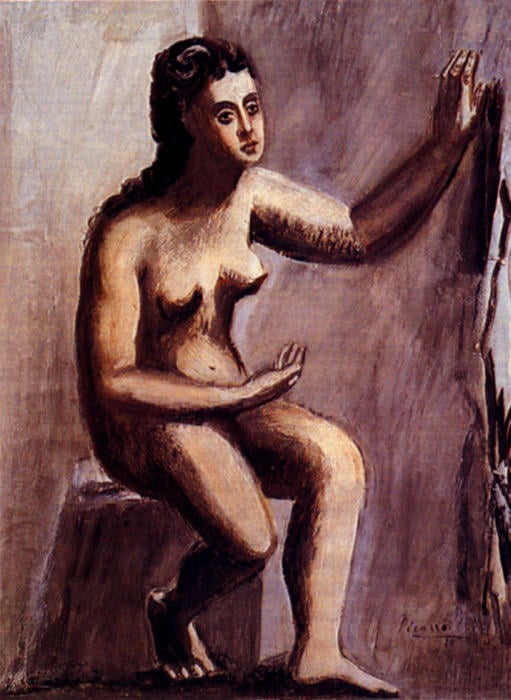
Pablo Picasso's Seated Woman, painted in 1920, isn’t merely a portrait; it’s a carefully constructed tableau brimming with layers of meaning. Measuring just 55 x 41 centimeters, this gouache painting immediately draws the viewer into a world where simplicity and profound symbolism intertwine. The subject, a woman seated on a chair with her hands resting against the wall, appears to gaze out from an unseen doorway or window – a gesture simultaneously vulnerable and contemplative. The choice of a nude figure within a domestic setting was radical for its time, reflecting Picasso’s deliberate exploration of Naive Art principles and his desire to strip away conventional artistic conventions.
Picasso's decision to employ gouache, a paint known for its opacity and ability to create rich, flat colors, contributes significantly to the painting’s immediate impact. The palette is restrained – primarily blues, browns, and ochres – lending the scene an almost timeless quality. The figures in the background, subtly rendered, hint at a narrative beyond the immediate image, suggesting a story unfolding just out of frame, inviting speculation about the woman's thoughts and experiences. This deliberate ambiguity is characteristic of Picasso’s approach to storytelling, prioritizing emotional resonance over literal representation.
Delving into the World of Naive Art
The painting firmly places itself within the realm of Naive Art, also known as Primitivism. This artistic movement, which gained prominence in the early 20th century, sought to emulate the style and spirit of non-Western art – particularly African masks and Oceanic sculpture. Picasso’s foray into this style wasn't a simple imitation; rather, he adopted its core tenets—directness, lack of illusionism, and an emphasis on essential forms—to create a powerfully emotive work. Notice how the woman’s features are simplified, her body rendered with bold, unmodulated strokes, mirroring the stylistic choices found in Primitivist art.
- Directness of Line: The strong outlines and lack of shading contribute to a sense of immediacy and raw emotion.
- Simplified Forms: Picasso reduces the figure to its essential components, eliminating unnecessary detail.
- Emotional Intensity: The painting’s power lies in its ability to evoke feelings of loneliness, introspection, and perhaps even melancholy, rather than providing a realistic depiction.
Symbolism and Narrative Fragments
Beyond the immediate visual impact, Seated Woman is rich with symbolic potential. The presence of two figures in the background—one on the left and another to the right—suggests a story or relationship that extends beyond the central figure. These shadowy presences could represent lovers, family members, or perhaps even strangers, adding depth and complexity to the scene. The woman’s posture – seated with her hands resting against the wall – is particularly evocative, conveying a sense of isolation and contemplation. It's as if she's caught in a moment of quiet reflection, grappling with unspoken thoughts and emotions.
Furthermore, the painting aligns itself with Symbolist principles, which emphasized the expression of ideas and emotions through visual elements rather than strict adherence to realism. Picasso’s use of color, composition, and symbolic figures all contribute to this expressive intent, inviting viewers to interpret the scene on a deeper, more intuitive level.
A Legacy of Innovation
Seated Woman stands as a pivotal work in Picasso's artistic development and within the broader context of 20th-century art. It represents a conscious departure from traditional academic painting, embracing a new approach to form, color, and narrative. Picasso’s experimentation with Naive Art techniques paved the way for subsequent movements like Surrealism and Expressionism, demonstrating his profound influence on the course of modern art.
WahooArt offers meticulously crafted, hand-painted reproductions of this iconic masterpiece, ensuring that the essence of Picasso's vision is preserved in stunning detail. Each reproduction captures the painting’s raw emotion and symbolic depth, allowing you to bring this captivating work into your home or office – a testament to Picasso’s enduring legacy.


 Önizleme yap
 El yapımı tablo satın al
 Paylaş
 Paylaş
 Detayları Gör

 İndir
İndir
 Benzerlerini gör
 X-Işını
 Slayt Gösterisi
 İstatistikler


 Tümünü Gör






































 Cam seçeneği yalnızca 110 cm altındaki boyutlar için mevcuttur.





