Pablo Picasso’s “Great Profile”: A Fragmented Portrait of Emotion
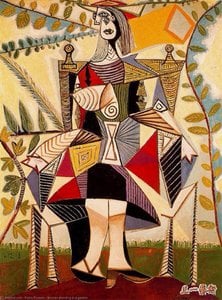
Pablo Picasso's "Great Profile," a captivating work often associated with his explorations during the 1940s, isn’t merely a portrait; it’s a carefully constructed puzzle of fragmented forms and vibrant color. This piece, though shrouded in some mystery regarding its precise creation date – estimates place it between 1938-1942 – embodies the artist's signature Cubist sensibilities while simultaneously hinting at a deeply personal emotional landscape. The painting presents a woman’s face, not as a unified whole, but rather as an assemblage of distinct planes and angles, each element contributing to a complex and ultimately arresting visual experience. The deliberate distortion of features—a sharp nose juxtaposed with a softly rounded mouth, eyes that seem both distant and intensely focused—creates a sense of unease and psychological depth rarely found in traditional portraiture.
A Symphony of Color and Technique
Picasso’s masterful use of color is immediately striking. The palette explodes with a dynamic interplay of reds, yellows, greens, blues, and blacks – colors that aren't simply decorative but actively contribute to the painting’s emotional resonance. The fiery reds and oranges dominate the upper regions of the face, suggesting passion or perhaps even agitation, while cooler blues and greens are employed in the lower areas, evoking a sense of melancholy or introspection. Notice how he utilizes thick impasto—a technique where paint is applied thickly—particularly around the edges of the fragmented planes, adding texture and volume to the image. This tactile quality invites closer inspection, encouraging the viewer to trace the contours of each individual element within the portrait.
Symbolism and the Echoes of Personal Experience
While Picasso rarely offered explicit interpretations of his work, art historians have proposed several readings of “Great Profile.” The fragmented nature of the face can be seen as a metaphor for the complexities of identity—the way we present ourselves to the world versus the internal realities we grapple with. The necklace worn by the subject is particularly intriguing; it could represent adornment, perhaps a symbol of status or even a subtle nod to Picasso’s own relationships and affections during this period. Considering Picasso's personal life at the time – marked by both creative flourishing and emotional turmoil, including his complex relationship with Dora Maar – one can speculate that the portrait reflects a deeper exploration of love, loss, and the elusive nature of beauty. The painting resonates with themes explored in other works from this era, such as “Jacqueline’s Portrait (Profile) 2,” demonstrating a consistent investigation into the human psyche.
A Legacy of Innovation and Emotional Intensity
“Great Profile” stands as a testament to Picasso's enduring legacy as one of the most revolutionary artists of the 20th century. It exemplifies his willingness to challenge conventional notions of representation, pushing the boundaries of form and color to create images that are both visually arresting and emotionally profound. Reproductions of this work offer an exceptional opportunity to experience the intensity of Picasso’s vision firsthand, bringing a vibrant and thought-provoking piece of art into any space. WahooArt's hand-painted reproductions meticulously capture the nuances of the original, ensuring that you can appreciate every brushstroke and color variation – a true celebration of artistic genius. Consider this artwork not just as decoration, but as an invitation to contemplate the complexities of human experience through the eyes of one of history’s greatest masters.
- Key Techniques: Cubism, Impasto, Fragmented Forms
- Color Palette: Vibrant and Contrasting – Reds, Yellows, Greens, Blues, Blacks
- Historical Context: 1938-1942, Reflecting Picasso’s Personal Life and the tumultuous era of World War II.