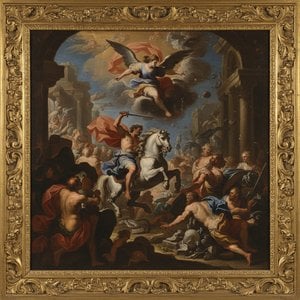
A Moment of Revelation: Poussin’s “The Exposition of Moses”
Nicolas Poussin's "The Exposition of Moses," painted in 1650 and currently residing within the hallowed halls of the Ashmolean Museum in Oxford, is more than simply a depiction of a biblical scene; it’s an exquisitely rendered meditation on faith, lineage, and the very essence of human connection. The painting captures a pivotal moment – the presentation of Moses to Pharaoh – yet transcends mere historical illustration, achieving a timeless quality that continues to resonate with viewers centuries later. Poussin, a master of classical composition and light, elevates this narrative through his meticulous attention to detail and profound understanding of color theory, creating an image brimming with both serenity and underlying significance.
Composition and Technique: A Symphony of Light and Form
Measuring 105 x 204 cm, the canvas is dominated by a carefully orchestrated arrangement of figures bathed in a soft, diffused light. Poussin’s technique—a hallmark of his mature style—is characterized by layered brushstrokes, subtly building up form and texture to create an illusion of depth and volume. Notice how he employs *chiaroscuro*, the dramatic contrast between light and shadow, not merely for aesthetic effect but to draw our eye across the scene, guiding us through the complex interplay of characters. The figures are arranged in a pyramidal composition, lending stability and grandeur to the tableau. The use of atmospheric perspective—distant objects appearing paler and less distinct—further enhances the sense of space and distance, transporting the viewer into this intimate moment.
Symbolism and Narrative: Echoes of Antiquity
“The Exposition of Moses” is rich in symbolic meaning, drawing heavily on classical precedents. The scene itself references the biblical account from Exodus 4, where Pharaoh reluctantly agrees to let the Israelites leave Egypt. However, Poussin subtly shifts the focus beyond a simple recounting of events. Observe the central figure – a baby, clearly representing Moses – cradled by a woman whose features evoke both maternal tenderness and an almost regal bearing. This figure is not merely a child; she embodies the lineage of Abraham, linking the Israelites to their ancient patriarch. The presence of the dog, often interpreted as a symbol of loyalty and fidelity, reinforces this connection to ancestral roots. The figures surrounding the infant are diverse in age and attire, representing the various tribes of Israel, united in reverence before Moses’s birth.
Historical Context and Artistic Legacy
Poussin's creation emerged during a period of significant artistic transition in France. While influenced by the Venetian Renaissance, he sought to synthesize classical ideals with contemporary sensibilities. The Ashmolean Museum, founded by Elias Ashmole in 1683, provides a fitting backdrop for this masterpiece, reflecting a commitment to preserving and showcasing both historical artifacts and artistic treasures. Poussin’s work profoundly impacted subsequent generations of artists, particularly those associated with the Rococo movement, who admired his mastery of light, color, and composition. His influence can be seen in the works of Rembrandt, Claude Lorrain, and even later Impressionists. The painting stands as a testament to Poussin's ability to imbue biblical narratives with universal themes of faith, family, and the enduring power of human connection.
For those seeking to experience the profound beauty and intellectual depth of “The Exposition of Moses,” WahooArt offers meticulously crafted, hand-painted reproductions that faithfully capture the essence of this iconic artwork. Each reproduction is a testament to our commitment to preserving artistic heritage and bringing the masterpieces of the past into your home or studio.



 Önizleme yap
 El yapımı tablo satın al
 Paylaş
 Paylaş
 Detayları Gör
 Rehber

 İndir
İndir
 Benzerlerini gör
 X-Işını
 Slayt Gösterisi
 İstatistikler


 Tümünü Gör






































 Cam seçeneği yalnızca 110 cm altındaki boyutlar için mevcuttur.