Sanatçı Özgeçmişi
A Life Etched in the American West
Maynard Dixon, born Lafayette Maynard Dixon on January 24, 1875, in Fresno, California, was more than just a painter of the American West; he *was* a chronicler of its spirit. His story is one deeply interwoven with the landscape and people that defined a nation’s evolving identity. Descended from Confederate aristocracy who sought new beginnings after the Civil War, Dixon inherited a complex heritage – a Southern sensibility transplanted to the burgeoning frontier. This duality would subtly inform his artistic vision, imbuing it with both romanticism and a stark realism. His mother, Constance Maynard, nurtured his early inclinations toward art and literature, fostering a creative spirit that would blossom amidst the rugged beauty of California and beyond. Though briefly enrolled at the California School of Design in San Francisco, Dixon’s true education came from direct observation – sketching the landscapes, the laborers, the Native Americans who populated the West. He quickly found work as an illustrator, honing his skills while absorbing the visual language of a rapidly changing world.
From Illustration to Independent Vision
Dixon's early career was firmly rooted in illustration, contributing to publications like *Overland Monthly* and various San Francisco newspapers. This period provided him with invaluable experience, but also ignited a desire for artistic freedom. A pivotal journey to Arizona and New Mexico in 1900 sparked a lifelong passion for the Southwest – its vastness, its light, its ancient cultures. He wasn’t interested in simply replicating what he saw; he sought to capture the *essence* of the West, moving beyond romanticized depictions toward something more authentic and emotionally resonant. This quest led him on horseback expeditions with fellow artist Edward Borein, immersing himself in the landscapes that would become his muse. His illustrations for Clarence Mulford’s Hopalong Cassidy stories brought him wider recognition, but also a growing dissatisfaction with commercial constraints. Dixon yearned to create “honest art of the West,” unburdened by the expectations of publishers and popular taste. This desire propelled him toward an independent path, one defined by personal expression and artistic integrity.
Modernism Forged in Landscape and Love
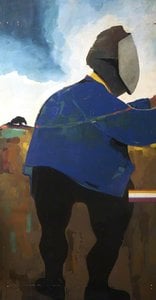
The years following his return from New York – a brief sojourn with his first wife and daughter – marked a turning point in Dixon’s style. He settled in San Francisco, becoming a colorful figure known for his cowboy attire and unwavering commitment to Western aesthetics. The 1915 Panama-Pacific International Exposition exposed him to new artistic currents, prompting a shift away from Impressionism toward a simpler, more modern approach. However, it was his marriage to photographer Dorothea Lange in 1920 that proved truly transformative. Lange’s keen eye for social realism and her mastery of composition profoundly influenced Dixon's work. By 1925, his style had dramatically evolved, characterized by bold compositions, striking color palettes, and a powerful emphasis on design. Low horizons, marching cloud formations, and simplified forms became hallmarks of his mature style – simultaneously evocative and mysterious. This period saw the emergence of a true modernist, one who distilled the essence of the West into its most potent visual elements.
Social Commentary and Enduring Legacy
The Great Depression brought with it a new dimension to Dixon’s art. He turned his attention to social realism, depicting the struggles of maritime workers, displaced laborers, and those affected by economic hardship. Simultaneously, Lange documented the plight of migrant workers in California's Central Valley, creating iconic images that captured the human cost of the era. Their artistic partnership, though ultimately ending in divorce in 1935, was a testament to their shared commitment to social justice and their belief in the power of art as a vehicle for change. Following his separation from Lange, Dixon married muralist Edith Hamlin, and together they sought refuge in Southern Utah, near Mount Carmel. There, amidst the red rock canyons and cottonwood trees, he found renewed inspiration, continuing to refine his minimalist style and explore the spiritual dimensions of the landscape. He died in Tucson, Arizona, in 1946, leaving behind a body of work that continues to resonate with audiences today. His ashes were scattered on a bluff overlooking his Mount Carmel studio, a fitting tribute to a life dedicated to capturing the soul of the American West. Dixon’s legacy extends beyond his paintings; he was a poet, a storyteller, and a visionary artist who helped define a uniquely American aesthetic.



 Önizleme yap
 Baskı Moduna Geç
 Paylaş
 Paylaş
 Detayları Gör
 Rehber

 İndir
İndir
 Benzerlerini gör
 X-Işını
 Slayt Gösterisi
 İstatistikler


 Tümünü Gör






































 Cam seçeneği yalnızca 110 cm altındaki boyutlar için mevcuttur.