Önizleme yapÖnizleme yap AR ile önizleAR ile önizle El yapımı tablo satın al El yapımı tablo satın alDijital Görsele Geç Dijital Görsele Geç PaylaşPaylaş
Detayları GörDetayları Gör Favorilere ekle Favorilere ekle İndirİndir Benzerlerini görBenzerlerini gör X-IşınıX-Işını Slayt GösterisiSlayt Gösterisi İstatistiklerİstatistikler

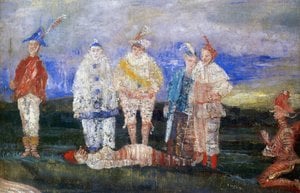
Masques regardant un negre batteleur

James Ensor's 'Masques regardant un negre batteleur' (1879) is a haunting black-and-white painting exploring themes of disguise, ritual, and social commentary through unsettling figures and masks. A masterpiece of Symbolism.

James Ensor (1860-1949), İkinci Dünya Savaşı sırasında Ostend’de yaşamasına rağmen Bomba saldırılarından kaçınan Belçika sanatçısıdır. Les XX sanat grubunun üyelerinden biriydi. Ayrıca Ekspresyonizm ve Surrealizm hareketlerine önemli bir etkisi olan ve Rembrandt, Goya ve Whistler gibi sanatçılardan etkilenen Bir İngiliz babası ve Bir Belçika annesi tarafından dünyaya gelen İskoçya doğumlu bir eser

Giclée / Sanat Baskısı

Hızlı üretim ve esnek bitiş seçenekleriyle müze kalitesinde giclée veya kanvas baskı. (El yapımı tablo satın al El yapımı tablo satın alDijital Görsele Geç Dijital Görsele Geç)

P118B $10
P118H $10
P118W $10
P438Z $10
P508JH $12
P508YH $12
P805H $10
P805Z $10
P919BZ $10
P919G $10
P919XJ $10
P959ZH $10
P968JZ $12
W106C $8
W218G $10
W218JH $8
W218Y $10
W307PJ $10
W316G $10
W316PJ $8
W316Y $10
W398PJ $8
W4111J $10
W500HY $15
W500JH $15
W692G $12
W849H $8
W940BG $15
W953PJ $8

Standart
kişiye özel
CM
INCH

Eserin orijinal oranlarıyla uyumlu, önceden belirlenmiş boyutlarımız arasından seçim yapın.

genişlik
yükseklik

Belirli bir çerçeveye veya alana uyması için kendi ölçülerinizi girebilirsiniz. Seçtiğiniz boyut orijinal görüntünün oranlarıyla eşleşmiyorsa, sanat eserini kırpacağız veya görüntüyü aynalanmış ya da düz dolgulu bir kenarlıkla genişleteceğiz. Üretim başlamadan önce onayınız için bir dijital taslak gönderilecektir.
Lütfen ekrandaki önizlemenin gerçek kırpma veya genişletmeyi yansıtmadığını unutmayın. Nihai kompozisyonu yalnızca taslak doğru bir şekilde gösterecektir.
Özel boyutlar mevcut olsa da, orijinal oranları korumak için önceden tanımlanmış listeden bir boyut seçmenizi öneririz.

Dünya Çapında Teslimat (); standart 4/5 hafta yerine 2 haftada. (13 Eylül)

why_choose_icon
Dünya Çapında Ücretsiz Ekspres Kargo
why_choose_icon
Yüksek Kaliteli Keten Tuval
why_choose_icon
Tam Kapsamlı Nakliye Sigortası
why_choose_icon
Gümrük Vergisi İade Garantisi
why_choose_icon
Gerçek Renk Uyumu Garantisi
why_choose_icon
100 Günlük İade Politikası (Sadece Kusurlu Ürünler İçin)
why_choose_icon
%100 Para İade Garantisi
why_choose_icon
Toplu Alım İndirimi

Toplam Fiyat

$ 68

reproduction

Masques regardant un negre batteleur

Giclée / Sanat Baskısı

Reproduksiyon Boyutu

-

Toplam Tutar

$ 68

Hızlı Bilgiler

  • Year: 1878/79
  • Artist: James Ensor
  • Influences:
    • masks
    • carnivals
  • Notable elements: Masks, black figure
  • Medium: Oil on canvas
  • Artistic style: Surrealist, grotesque
  • Location: Private collection

Sanat Bilgisi Testi

Her soru için yalnızca bir doğru cevap bulunmaktadır.

Soru 1:
What is the primary subject depicted in James Ensor’s ‘Masques regardant un negre batteleur’?
Soru 2:
James Ensor frequently utilized masks in his artwork. What is the likely inspiration for this practice?
Soru 3:
The image description mentions a turtle near the bottom left corner. What might this detail suggest about the overall scene?
Soru 4:
James Ensor is often associated with which artistic movement?
Soru 5:
Which of the following best describes James Ensor’s style?

James Ensor’s Unsettling Tableau: “Masques regardant un negre batteleur”

James Ensor's "Masques regardant un negre batteleur" (Masks Watching a Black Fighter), painted around 1879, is not merely a depiction of a scene; it’s an immersion into a world steeped in theatricality, anxiety, and the unsettling gaze of observation. This powerful black-and-white artwork, currently housed within private collections but readily available through WahooArt's exquisite hand-painted reproductions, immediately confronts the viewer with a chaotic gathering – a tableau vivant brimming with figures engaged in an unseen struggle. The central focus is a man, starkly nude and positioned before a figure wielding a stick and holding a bird, suggesting a ritualistic or violent encounter. The scene unfolds within a densely populated space, filled with individuals performing various actions: some seated, others standing, all contributing to the overall sense of heightened drama and unspoken tension.

Ensor’s artistic journey was profoundly shaped by his upbringing in Ostend, a vibrant seaside resort town known for its annual carnival. His parents operated a souvenir shop overflowing with masks, costumes, and exotic objects – a veritable treasure trove that ignited his imagination and became a recurring motif throughout his oeuvre. This fascination with disguise and the theatrical is palpable here; the masks themselves are not merely decorative elements but symbols of hidden identities and concealed emotions. The very title, “Masques,” immediately establishes this core theme, hinting at a world where appearances are deliberately misleading and reality is obscured.

A Study in Contrast: Technique and Composition

The painting’s stark monochrome palette – predominantly black and white – amplifies the dramatic effect, lending it an almost photographic quality while simultaneously evoking the atmosphere of a theatrical stage. Ensor masterfully employs hatching and cross-hatching to create texture and volume, particularly evident in the figures' clothing and the bird held aloft. The composition is deliberately crowded and claustrophobic, drawing the viewer into the scene and preventing any sense of easy escape. The placement of the turtle near the bottom left corner adds an unexpected element of quiet observation, a grounding presence amidst the surrounding chaos.

Ensor’s technique reveals a deliberate rejection of academic realism in favor of expressive distortion. Figures are elongated, faces are exaggerated, and gestures are imbued with intense emotion. This stylistic choice aligns perfectly with the burgeoning Expressionist movement that would later emerge from his work, prioritizing emotional impact over strict representation. The use of negative space is also crucial; it allows the eye to wander across the scene, absorbing the details and contributing to the overall sense of unease.

Symbolism and Interpretation

“Masques regardant un negre batteleur” is rich in symbolic potential, inviting multiple interpretations. The “negre batteleur,” or black fighter, immediately raises questions about race, power dynamics, and perhaps even colonial representation – a sensitive topic that was increasingly relevant during Ensor’s time. The masks themselves can be seen as representing societal roles, hidden identities, and the performative nature of human interaction. The bird held by the fighter could symbolize freedom, captivity, or even a sacrificial offering.

Furthermore, the scene suggests a ritualistic combat, possibly a staged performance or a symbolic representation of internal struggles. The onlookers, engaged in various activities, may represent different facets of society – judgment, amusement, indifference—all contributing to the overall sense of ambiguity and unsettling observation. The painting’s power lies not in providing clear answers but in prompting viewers to confront their own interpretations and anxieties.

Emotional Resonance and Artistic Legacy

James Ensor's "Masques regardant un negre batteleur" is a profoundly disturbing yet captivating work of art. It transcends mere representation, offering instead a glimpse into the artist’s complex psychological landscape and his exploration of themes such as identity, power, and social anxiety. Reproductions by WahooArt capture the painting's intensity and detail with remarkable fidelity, allowing viewers to experience Ensor’s unsettling vision in stunning clarity. This artwork remains a cornerstone of Belgian art history and continues to resonate with audiences today, prompting reflection on the masks we wear and the hidden battles we wage within ourselves.


Sanatçı Özgeçmişi

James Ensor: A Pioneer of Expressionism and Surrealism

James Sidney Edouard Ensor (Ostend, 13 April 1860-19 November 1949) was a Belgian painter and printmaker, an important influence on expressionism and surrealism who lived in Ostend for almost his entire life. He was associated with the artistic group Les XX.

Early Life and Artistic Training

Ensor’s father, James Frederic Ensor, born in Brussels to English parents, was a cultivated man who studied engineering in England and Germany. Ensor’s mother, Maria Catharina Haegheman, was Belgian. Ensor himself lacked interest in academic study and left school at the age of fifteen to begin his artistic training with two local painters. From 1877 to 1880 he attended the Académie Royale des Beaux-Arts in Brussels, where one of his fellow students was Fernand Khnopff. Ensor first exhibited his work in 1881.

The Emergence of Expressionist Style

During the late 19th century much of Ensor’s work was rejected as scandalous, particularly his painting Christ’s Entry Into Brussels (1888–89). The Belgium art critic Octave Maus famously summed up the response from contemporaneous art critics to Ensor's innovative (and often scathingly political) work: “Ensor is the leader of a clan. Ensor is the limelight. Ensor sums up and concentrates certain principles which are considered to be anarchistic. In short, Ensor is a dangerous person who has great changes. ... He is consequently marked for blows. It is at him that all the harquebuses are aimed. It is on his head that are dumped the most aromatic containers of the so-called serious critics.” Some of Ensor's contemporaneous work reveals his defiant response to this criticism.

Key Works and Recurring Themes

Ensor’s artistic style evolved dramatically over time, reflecting a profound engagement with psychological exploration and social critique. Initially influenced by Rembrandt, Redon, Goya, Japanese woodcuts, Brueghelian images and contemporary spoofs, Ensor developed a highly personal iconography and design. He rejected French Impressionism and Symbolism and lent himself to the expressive qualities of light, line, colour and the grotesque and macabre motifs such as carnival masks and skeletons, which he rendered in massive tableaux such as *The Aureoles of Christ* (1885–86) and *Skeletons Fighting over a Hanged Man* (1891). These grotesque metamorphoses culminate in Ensor’s most well-known and monumental mask tableau: *Christ’s Entry Into Brussels* (1888–89, oil on canvas, Los Angeles, J. Paul Getty Museum).

Legacy and Influence

Ensor is now widely recognized as a pivotal figure in the transition from 19th-century Symbolism to early 20th-century Expressionism and Surrealism—a true pioneer of modern art. His fearless exploration of the subconscious, his embrace of grotesque imagery, and his rejection of academic conventions paved the way for future generations of artists who dared to challenge artistic norms. Despite facing initial resistance, Ensor eventually gained recognition in his later years, being named a Baron by King Albert I in 1929 and awarded the Légion d’honneur in 1933. He died in Ostend in 1949, leaving behind a body of work that continues to captivate, disturb, and inspire.

James Ensor

James Ensor

1860 - 1949 , Belçika

Kısa Bilgiler

  • Artistic Movement Or Style: Expressionism, Surrealism
  • Artists Who Influenced This Artist:
    • Bruegel the Elder
    • Francisco Goya
    • Whistler
  • Date Of Birth: April 13, 1860
  • Date Of Death: November 19, 1949
  • Full Name: James Sidney Edouard Ensor
  • Nationality: Belgian
  • Notable Artworks:
    • The Scandalized Masks
    • Skeletons Fighting...
    • Christ's Entry into Brussels
  • Place Of Birth: Ostend, Belgium
Temalara, stillere ve özelliklere göre düzenlenmiş sanat eserlerini keşfedin.