A Satirical Masterpiece: Decoding Daumier’s Vision
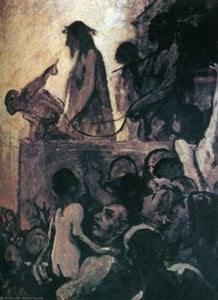
In the realm of French Realism, few works capture the biting wit and social scrutiny of Honoré Daumier quite like "The Hypochondriac" (Le Malade imaginaire). Executed around 1870, this evocative drawing serves as a profound visual distillation of Molière’s legendary satirical play. Daumier does not merely illustrate a theatrical moment; he breathes life into the very essence of human folly and the absurdity of medical pretension. The scene presents a dramatic tableau where the boundaries between stagecraft and reality blur, inviting the viewer to witness the tension between the delusional patient, Argan, and the self-important physician, Purgon. It is a work that transcends its 19th-century origins, offering a timeless commentary on how easily authority can be used to mask incompetence.
The composition is anchored by a palpable sense of atmosphere, achieved through Daumier’s masterful command of light and shadow. The room feels intimate yet claustrophobic, mirroring the psychological entrapment of the hypochondriac himself. Through his use of chiaroscuro-like effects, Daumier directs our gaze across the figures—from the bearded doctor engaged in intense dialogue to the whimsical presence of a jester holding a bottle. This interplay of light does more than define form; it sculpts the emotional weight of the scene, highlighting the dramatic friction between the characters and creating a sense of theatrical depth that pulls the observer into the heart of the drama.
Technique and the Art of Observation
To behold "The Hypochondriac" is to appreciate the technical brilliance of Daumier’s dry etching process. By applying acid to a zinc plate coated with bitumen, the artist achieved a remarkable level of detail that allows for incredible textural nuance. Every line carries intention, contributing to a sense of movement and life that is rare in works of this period. The tonal modulations are particularly striking; they provide a velvety richness to the shadows and a sharp clarity to the highlights, lending the black and white medium a near-painterly quality. This meticulous draftsmanship allows the viewer to feel the heavy fabrics of the costumes and the somber stillness of the room.
For the discerning collector or interior designer, this piece offers a sophisticated aesthetic that balances historical gravity with expressive energy. The monochromatic palette makes it an exceptionally versatile choice for high-end decor, capable of anchoring a gallery wall or serving as a focal point in a study lined with books. It possesses that rare quality of "living art"—a work that does not merely sit on a wall but actively engages the room, sparking conversation and inviting deep contemplation of the human condition.
A Legacy of Social Commentary
Beyond its technical merits, the emotional impact of Daumier’s work lies in its unapologetic honesty. As a chronicler of the tumultuous currents of 19th-century France, Daumier used his art as a weapon against hypocrisy. In "The Hypochondriac," he captures the precise moment where medical authority meets theatrical farce. The symbolism is subtle yet pervasive: the bottles, the costumes, and the exaggerated gestures all serve to lampoon the inflated egos of those who claim expertise over life and death. It is an invitation to look beneath the surface of societal roles and recognize the comedy—and the tragedy—inherent in our shared delusions.
Owning a high-quality reproduction of this masterpiece allows one to preserve a fragment of art history’s most sharp-witted era. Whether you are drawn to its connection to Molière, its exquisite Realist technique, or its ability to add a layer of intellectual depth to a modern space, "The Hypochondriac" remains an enduring icon of artistic bravery and observational genius.



 Önizleme yap
 El yapımı tablo satın al
 Paylaş
 Paylaş
 Detayları Gör

 İndir
İndir
 Benzerlerini gör
 X-Işını
 Slayt Gösterisi
 İstatistikler


 Tümünü Gör






































 Cam seçeneği yalnızca 110 cm altındaki boyutlar için mevcuttur.