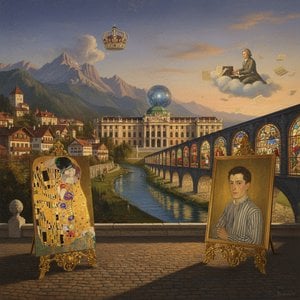
Opera – A Symphony of Gold and Shadow by Gustav Klimt
Gustav Klimt’s “Opera,” completed in 1902, stands as a cornerstone of Viennese Secession art—a movement that boldly rejected academic conventions and championed artistic freedom. Painted during Klimt's prolific golden phase, this monumental oil on canvas captures not merely a theatrical performance but embodies an exploration of duality: masculine strength juxtaposed with feminine grace, earthly materiality illuminated by divine inspiration. The artwork’s genesis lies in Klimt’s fascination with Beethoven’s Ninth Symphony, specifically its Ode to Joy—a musical expression of universal brotherhood and optimism that profoundly influenced his artistic vision.
- Subject Matter: The scene depicts a formal opera performance within the venerable Burgtheater of Vienna. Klimt meticulously portrays figures engaged in observing the spectacle – a woman adorned in opulent attire, gazing intently at a statue or painting representing Beethoven himself. Surrounding them are additional attendees, subtly rendered to contribute to the overall atmosphere of grandeur.
- Style and Technique: Klimt’s signature Secession style is immediately recognizable through its lavish application of gold leaf—a technique borrowed from Byzantine mosaics and symbolizing spiritual enlightenment. The painting utilizes a rich textural surface achieved by layering oil paint with meticulous detail, creating an illusionistic depth that draws the viewer into the theatrical space.
The composition itself is deliberately asymmetrical, mirroring the complexities inherent in human relationships and artistic interpretation. Klimt employs flattened perspectives and stylized figures—characteristic of Secession’s rejection of realism—to prioritize expressive qualities over accurate representation. The woman's gaze directs our attention towards Beethoven’s statue, suggesting a contemplation of beauty, harmony, and transcendence – themes central to the symphony and subsequently reflected in Klimt’s artistic endeavor.
Historical Context: Vienna at the turn of the century was experiencing significant cultural ferment—the rise of psychoanalysis, burgeoning avant-garde movements like Futurism and Cubism, and a renewed interest in mythology and symbolism. Klimt's “Opera” reflects this intellectual climate, aligning with Secession’s desire to forge new artistic paths while honoring tradition through masterful craftsmanship. It represents a deliberate departure from the conservative aesthetic of the Austro-Hungarian Empire, asserting Klimt’s commitment to artistic innovation.
Symbolism: Beyond its depiction of opera and Beethoven, “Opera” is laden with symbolic imagery. The gold leaf itself symbolizes divine illumination and spiritual aspiration—a direct reference to Beethoven's Ode to Joy. Furthermore, the statue of Beethoven embodies intellectual contemplation and artistic genius. Klimt’s masterful use of color – predominantly gold contrasted against deep blues and reds – amplifies these thematic concerns, conveying a sense of solemn beauty and profound emotion.
- Emotional Impact: “Opera” evokes feelings of awe and reverence—a testament to Klimt's ability to capture the sublime. The painting’s opulent materiality invites contemplation on themes of wealth, power, and artistic legacy. It serves as a reminder that art can transcend mere visual representation, communicating complex ideas about human experience and spiritual aspiration.
A reproduction of “Opera” would undoubtedly elevate any interior space—bringing forth the radiant glow of gold leaf and capturing the essence of Klimt’s Secession aesthetic. Its enduring appeal lies in its ability to inspire viewers with a vision of beauty, harmony, and intellectual engagement—a legacy worthy of preserving through exceptional artistic reproductions.
Soru ve Cevaplar
Gustav Klimt, "Opera" eserini kaç yaşında yaptı?
Gustav Klimt, "Opera" adlı eserini 21 yaşındayken yaptı. Sanatçı 1862 yılında doğmuştur ve eser 1883 tarihine aittir.
Gustav Klimt imzalı "Opera" eserinin parlaklık değeri nedir?
Gustav Klimt imzalı "Opera", Işıltılı düzeyinde bir parlaklığa sahiptir. Parlaklık, renklerin ne kadar ışık yansıtıyor gibi göründüğünü tanımlar.
"Opera" ne zaman yapıldı?
"Opera", 1883 yılına tarihlenmektedir. Bu tarih, eseri Gustav Klimt kariyerinin ve dönemin içerisine yerleştirmektedir.
"Opera" adlı eserin orijinali hangi müzede bulunuyor?
Gustav Klimt imzalı "Opera", Wien Museum, Viyana, Avusturya bünyesinde sergilenmektedir. Müze listelemesi reprodüksiyonları değil, eserin orijinalini ifade eder.
"Opera" eserinin arkasındaki sanatçı kim?
"Opera" eserinin arkasındaki sanatçı Gustav Klimt'tir. Eser, Gustav Klimt adına kataloglanmıştır.
"Opera" adlı eser bir sanat baskısı olarak mevcut mu?
Gustav Klimt imzalı "Opera" eserinin bir baskası doğrudan bu sayfa üzerinden sipariş edilebilir: pamuklu kanvas veya arşivlik kanvas kağıt üzerine yüksek kaliteli sanat baskısı.
Gustav Klimt imzalı "Opera" hangi duyguyu uyandırıyor?
"Opera" eserinde, Zarif bir ruh hali Romantik ve samimi bir duyguya eşlik ediyor.



 Önizle
 Baskı Satışına Geç
 Gönder
 Paylaş
 Detaylar
 Rehber

 Dosyayı İndir
 Benzerleri
 X-Işını
 Slayt Gösterisi
 İstatistikler


 Devamını Oku






































 Cam seçeneği yalnızca 110 cm altındaki boyutlar için mevcuttur.