Giorgio de Chirico’s “Self Portrait (8)” – A Dreamscape of Isolation
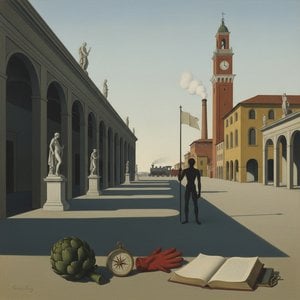
Giorgio de Chirico's "Self Portrait (8)," painted in 1967, isn’t merely a depiction of an artist; it’s a meticulously constructed fragment of the subconscious, a distilled essence of the anxieties and intellectual currents that defined his entire oeuvre. This particular iteration, created later in his career, leans heavily into the neo-baroque style he embraced during this period, offering a glimpse into a mind grappling with memory, alienation, and the unsettling beauty of the familiar transformed. The painting immediately draws the viewer in with its stark simplicity – a solitary figure, rendered in muted tones against a backdrop that simultaneously evokes classical Roman architecture and an unnerving sense of emptiness. It’s a portrait not just of a man, but of a state of being.
The Anatomy of Disquiet: Style and Technique
De Chirico's technique in this self-portrait is deliberately restrained, almost austere. The brushwork is visible, lending the painting a tactile quality that contrasts sharply with the dreamlike atmosphere. He employs a flattened perspective, reminiscent of Byzantine icons, creating an illusion of depth that simultaneously draws the eye inward and reinforces the feeling of confinement. Notice the careful attention to detail in the figure’s face – the slightly furrowed brow, the intense gaze directed squarely at the viewer—a direct challenge to the observer's presence within this carefully constructed space. The use of dark clothing against a lighter background further emphasizes the figure’s isolation and creates a dramatic interplay of light and shadow that contributes significantly to the painting’s overall mood.
Philosophical Echoes: Schopenhauer, Nietzsche, and the Uncanny
To understand “Self Portrait (8),” one must delve into the philosophical landscape that profoundly shaped de Chirico's artistic vision. Heavily influenced by Arthur Schopenhauer’s philosophy of pessimism and Friedrich Nietzsche’s exploration of nihilism and the will to power, de Chirico sought to capture the unsettling feeling of reality as a deceptive illusion—a “veil” concealing an underlying chaos. The painting embodies this concept perfectly. The Roman-inspired background, with its echoing arches and distant water, is not a genuine place but rather a construct of memory and imagination, imbued with a sense of longing and loss. The mannequins, often present in his earlier works, subtly hint at the artificiality of human relationships and the inherent loneliness of existence—a recurring motif reflecting his engagement with Schopenhauer’s ideas about the will as a relentless striving for satisfaction ultimately leading to suffering.
Symbolism and Emotional Resonance: Birds, Perspective, and the Viewer
Beyond the philosophical influences, several symbolic elements contribute to the painting's layered meaning. The two birds—one perched near the top left corner, another in the lower right—represent fleeting moments of beauty or perhaps even a sense of escape within an otherwise desolate landscape. The illogical perspective, a hallmark of de Chirico’s metaphysical style, further destabilizes our perception and creates a feeling of disorientation. Most importantly, the direct gaze of the self-portrait is profoundly unsettling. It forces the viewer to confront their own reflection in this strange, dreamlike world—a silent acknowledgment of shared isolation and the inherent mystery of human consciousness. “Self Portrait (8)” isn’t simply a portrait; it's an invitation to contemplate the complexities of the inner life and the enduring power of art to capture the elusive nature of reality.
A Reproduction for the Soul: Bringing De Chirico Home
WahooArt offers meticulously hand-painted reproductions of “Self Portrait (8),” allowing you to bring this iconic work into your own space. Our artists recreate de Chirico’s distinctive style and evocative atmosphere with exceptional skill, ensuring that every detail—from the subtle brushstrokes to the nuanced color palette—is faithfully reproduced. This is more than just a print; it's an authentic artistic experience, a window into the mind of one of the 20th century’s most enigmatic artists. Consider this reproduction not as a mere decoration, but as a conversation starter, a meditation on themes of isolation, memory, and the enduring power of art to illuminate the human condition.



 Önizleme yap
 El yapımı tablo satın al
 Paylaş
 Paylaş
 Detayları Gör

 İndir
İndir
 Benzerlerini gör
 X-Işını
 Slayt Gösterisi
 İstatistikler

 Tümünü Gör






































 Cam seçeneği yalnızca 110 cm altındaki boyutlar için mevcuttur.