A Study in Contrasting Hues: Gerhard Richter’s “Blau”
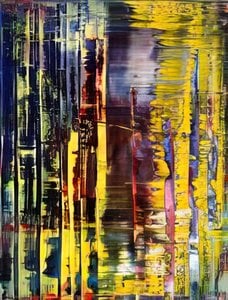
Gerhard Richter's "Blau," a deceptively simple painting of a blue door, is far more than a mere depiction of an everyday object. It’s a meditation on perception, memory, and the elusive nature of reality – hallmarks of the artist’s distinctive approach to abstraction. Created during a period when Richter was deeply engaged with exploring photographic sources and pushing the boundaries of his artistic practice, this work exemplifies his signature style: a blend of controlled precision and subtle ambiguity that invites endless interpretation.
The painting itself is remarkably understated in its execution. The door, rendered in a vibrant, almost saturated blue – a color Richter frequently employed to evoke feelings of melancholy and introspection – dominates the composition. A deliberate patch of yellow paint disrupts this cool intensity, creating an immediate visual tension. This juxtaposition isn’t merely decorative; it suggests a layering of experiences, perhaps representing fragments of memory or the collision of different perspectives. The open doorway hints at a hidden interior, inviting the viewer to project their own narratives onto the scene.
The Richter Legacy: Abstraction and Photographic Influence
To understand “Blau,” one must consider Gerhard Richter’s broader artistic trajectory. Beginning in the late 1960s, Richter began incorporating photographs into his work, initially as a basis for abstract paintings. He would meticulously reproduce photographic images – often of landscapes or cityscapes – and then apply layers of paint to them, blurring the lines between reality and representation. This process, known as ‘photo-relativism,’ became central to his oeuvre, challenging traditional notions of authorship and artistic creation.
“Blau” can be seen as a distillation of this approach. The door itself is an abstracted form, reminiscent of a photographic image – a fleeting glimpse captured in time. Richter’s technique—often employing squeegees to apply paint in broad, even strokes—creates a surface that feels both smooth and textured, mirroring the qualities of photographic prints. The deliberate lack of detail forces the viewer to engage with the painting on an emotional level, relying on color and form to convey meaning rather than precise representation.
Color as Emotion: Richter’s Palette
Richter's use of color is consistently profound and deeply personal. The blue in “Blau” isn’t simply a visual element; it carries significant emotional weight. He frequently used blue to evoke feelings of loneliness, sadness, or contemplation – emotions that resonate strongly within his work. The addition of yellow introduces an unexpected counterpoint, suggesting hope, warmth, or perhaps even a sense of unease. It's this careful orchestration of color that elevates the painting beyond a simple depiction of a door.
Interestingly, Richter’s systematic exploration of color charts – meticulously documented in his 1968 work “Color Charts” – reveals a deep fascination with the properties and effects of different hues. These charts served as a visual vocabulary for his paintings, allowing him to experiment with subtle variations in tone and saturation. “Blau” demonstrates this meticulous approach, showcasing Richter’s mastery of color theory and his ability to use it to create powerful emotional responses.
Collecting “Blau”: A Window into Richter's World
A hand-painted reproduction of Gerhard Richter’s “Blau” offers a remarkable opportunity to bring this iconic work into your home or office. WahooArt meticulously recreates the painting’s subtle nuances and atmospheric qualities, capturing the essence of Richter’s artistic vision. The reproduction allows you to experience the painting's contemplative mood and its complex interplay of color and form – elements that are often lost in reproductions of other media.
Beyond its aesthetic appeal, owning a “Blau” reproduction connects you to one of Germany’s most significant contemporary artists. It’s an investment in art history, a testament to Richter's enduring influence, and a beautiful addition to any collection. Explore the full artwork details and high-resolution images on our website to discover how this captivating painting can enrich your space.