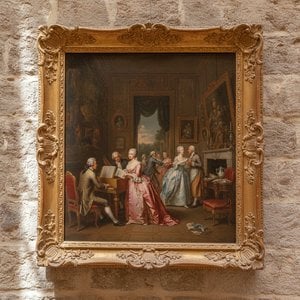
Florinda: An Ode to Aristocratic Beauty Amidst Nature’s Embrace
Franz Xaver Winterhalter's “Florinda,” completed in 1853, transcends mere portraiture; it embodies the spirit of Romanticism at its zenith – a fascination with emotion, imagination, and the sublime beauty of the natural world intertwined with refined aristocratic sensibilities. This monumental oil painting (178 x 246 cm) commissioned by Queen Victoria herself isn’t simply a depiction of women reclining in a tranquil pool; it's an elaborate tapestry woven from artistic innovation, historical significance, and profound symbolic resonance.
A Masterclass in Composition and Technique
Winterhalter’s genius lies not only in capturing likeness but also in orchestrating visual harmony. The central grouping of nude women is positioned within a carefully constructed circular arrangement, mirroring the idealized forms prevalent in Renaissance art while simultaneously reflecting the influence of Baroque dynamism. Fluid lines dominate the canvas—defining the graceful curves of the figures' bodies and tracing the undulating contours of the foliage—creating an illusion of movement that draws the viewer’s gaze inwards. The artist meticulously builds up texture through layering paint, achieving remarkable detail in skin tones and drapery, demonstrating unparalleled technical skill.
Warm Earth Tones: Palette and Light – A Symphony of Color
The painting's palette is dominated by warm earth tones—ochres, browns, reds, and golds—creating a comforting visual experience reminiscent of Tuscan landscapes. However, Winterhalter skillfully juxtaposes these hues with cooler blues and greens in the distant hills and trees, establishing depth and enhancing the dramatic interplay of light and shadow. The strong illumination from above casts highlights on the figures’ skin, emphasizing their form and conveying an aura of serenity and elegance.
Royal Patronage and Artistic Innovation: Contextualizing Florinda
Franz Xaver Winterhalter was arguably the most celebrated portraitist of his era, securing commissions from monarchs across Europe. Yet “Florinda” distinguishes itself through Winterhalter’s masterful blending of realism with Romantic idealism—a technique that earned him considerable acclaim. The painting reflects the artist's ability to infuse his subjects with flattering embellishments while maintaining a palpable sense of truthfulness – a hallmark of Winterhalter’s oeuvre and indicative of his profound understanding of artistic conventions.
Symbolism Beyond Surface Beauty: Layers of Meaning
"Florinda" speaks volumes about themes of femininity, leisure, and the connection between humanity and nature. The tranquil pool symbolizes purity and contemplation, mirroring classical ideals of beauty and harmony. The distant castle represents civilization yet simultaneously serves as a reminder of grandeur and tradition—elements that resonate deeply within the painting’s emotional core. Ultimately, Winterhalter's masterpiece invites viewers to contemplate not only visual splendor but also the enduring power of art to evoke profound feelings of joy, serenity, and admiration.
Detailed Analysis: Artistic Style & Material Considerations
Winterhalter’s style exemplifies the Romantic aesthetic—characterized by expressive brushwork, dramatic chiaroscuro (the interplay of light and shadow), and a preoccupation with capturing fleeting emotions. He skillfully employs glazing techniques to achieve luminous color effects and imbues his canvases with an ethereal quality. The painting is executed on canvas stretched over wooden frame using oil paints – a medium known for its durability and ability to reproduce nuanced tonal variations.
Historical Significance: A Reflection of Victorian Era Values
"Florinda" stands as a testament to the artistic achievements of the Victorian period—a time marked by social conservatism, moral earnestness, and an unwavering belief in the transformative power of art. Winterhalter’s portrait captures the essence of aristocratic culture—emphasizing grace, refinement, and intellectual curiosity – reflecting the values cherished by Queen Victoria and her court.
Recommended Reproduction: Bringing Florinda Home
A museum-quality reproduction of “Florinda” offers an unparalleled opportunity to experience Winterhalter’s artistic vision firsthand. WahooArt.com provides stunning prints on archival canvas—preserving the painting's vibrancy for generations to come—allowing you to adorn your home with a masterpiece that radiates beauty and inspiration.



 Önizleme yap
 Baskı satın al
 Paylaş
 Paylaş
 Detayları Gör

 İndir
İndir
 Benzerlerini gör
 X-Işını
 Slayt Gösterisi


 Tümünü Gör






































 Cam seçeneği yalnızca 110 cm altındaki boyutlar için mevcuttur.