A Symphony of Geometry and Modernity
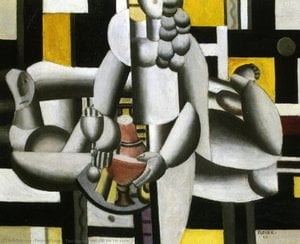
In the vast landscape of twentieth-century modernism, few works capture the rhythmic pulse of the machine age as poignantly as Fernand Léger’s "Untitled (4692)." Created during the transformative years between 1930 and 1935, this masterpiece serves as a crystallized moment of artistic rebellion. Rather than retreating into pure abstraction, Léger invites the viewer into a carefully orchestrated tableau where the boundaries between the human form and the inanimate object begin to blur. The painting presents a solitary, bearded figure seated in a state of quiet contemplation, cradling two delicate figurines within his hands. Yet, this is no traditional portrait; it is a sophisticated exploration of how life, time, and structure intersect within the modern urban experience.
The composition is a masterclass in Tubism—a term often applied to Léger’s unique evolution of Cubism. He moves away from the fractured, multi-perspective fragmentation of Picasso and Braque, opting instead for a singular, powerful viewpoint defined by interlocking planes and cylindrical forms. Through his brush, the man, the clocks, the bowl, and the vase are unified by a shared geometric language. The repetition of angular lines and simplified, robust shapes mimics the precision of industrial design, reflecting the artist's fascination with the beauty found in factory production and mechanical rhythm. For the discerning collector, this piece offers a profound sense of structural balance that brings both intellectual depth and a striking visual order to any interior space.
The Pulse of Time and the Machine Age
Beyond its aesthetic brilliance, "Untitled (4692)" is steeped in the historical anxieties and technological optimism of the interwar period. Léger was deeply moved by the legacy of Italian Futurism, absorbing their glorification of speed and dynamism while tempering it with a more grounded, humanistic approach. The presence of clocks within the composition acts as a poignant symbol of the relentless march of time—a constant, ticking reminder of the accelerating pace of modern society. These temporal elements, paired with the heavy, sculptural quality of the objects surrounding the figure, create a tension between the permanence of form and the fleeting nature of the moment.
To possess a reproduction of this work is to invite a piece of art history into one's home that speaks of resilience and evolution. The emotional impact of the painting lies in its ability to find harmony within chaos; it takes the disparate, often jarring elements of modern life—the mechanical, the domestic, and the human—and weaves them into a cohesive, beautiful whole. For interior designers seeking to anchor a room with a conversation piece that embodies strength and sophistication, Léger’s work provides an unparalleled sense of architectural elegance and avant-garde spirit.
Soru ve Cevaplar
Fernand Léger imzalı "untitled (4692)" bir yağlı boya tablo mu, çizim mi yoksa baskı mı?
Katalogda, Fernand Léger imzalı "untitled (4692)" eseri WallArt olarak sınıflandırılmıştır. Bu kategori, benzer eserlerin bulunmasına yardımcı olur.
Fernand Léger imzalı "untitled (4692)" hangi duyguyu yansıtıyor?
Fernand Léger imzalı "untitled (4692)", Reflective bir duygusal ton yansıtıyor.
Fernand Léger imzalı "untitled (4692)" eserini odamda görmek için artırılmış gerçekliği kullanabilir miyim?
Uyumlu bir cihazda artırılmış gerçekliği kullanarak, eserin AR Önizleme sayfası aracılığıyla Fernand Léger imzalı "untitled (4692)" adlı çalışmayı kendi duvarınızda önizleyebilirsiniz.



 Önizle
 Baskı Satışına Geç
 Gönder
 Paylaş
 Detaylar
 Rehber

 Dosyayı İndir
 Benzerleri
 X-Işını
 Slayt Gösterisi
 İstatistikler

 Devamını Oku






































 Cam seçeneği yalnızca 110 cm altındaki boyutlar için mevcuttur.