Fernand Léger’s “The Men in the City”: A Symphony of Form and Urban Life
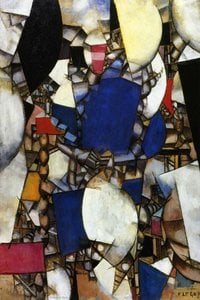
Fernand Léger's "The Men in the City," painted around 1916, is more than just a depiction of two figures; it’s a vibrant declaration of modernity itself. Emerging from the fertile artistic landscape of early 20th-century Paris, Léger was a key figure in bridging the gap between representational art and the burgeoning abstract movements. This work exemplifies his unique approach – a bold synthesis of Cubist fragmentation with an undeniable fascination for industrial forms and the dynamism of urban life. The painting immediately draws the eye to its geometric composition: the figures are rendered as blocky, almost machine-like shapes, their bodies simplified into angular planes that echo the structures surrounding them. This deliberate distortion wasn’t a rejection of realism but rather a new way of perceiving and representing the world – one shaped by the rise of industry and the increasingly dominant role of technology.
A Cubist Vision Rooted in Rural Experience
Léger's artistic journey began with a profound connection to his rural upbringing near Argentan, Normandy. This early exposure to the physicality of agricultural labor – the rhythms of the land, the textures of wood and stone – profoundly influenced his later work. He initially studied architecture, a discipline that instilled in him an appreciation for structure and form. However, it was his encounter with Post-Impressionist painters like Cézanne and Gauguin, coupled with the revolutionary ideas circulating within the Cubist movement, that truly ignited his artistic vision. Cubism, championed by Picasso and Braque, offered a radical new way of seeing – breaking down objects into their constituent parts and reassembling them in abstract compositions. Léger adopted this technique but infused it with his own distinctive vocabulary, prioritizing the visual impact of geometric shapes over strict representational accuracy.
Symbolism Within the Geometric Landscape
Beyond its formal qualities, “The Men in the City” is rich in symbolic meaning. The two figures, rendered as almost identical blocks, could be interpreted as representing humanity itself – reduced to essential forms within the overwhelming context of the modern city. The umbrella held by one man becomes a poignant detail, suggesting protection and perhaps a yearning for refuge amidst the chaos of urban life. The inclusion of the bird adds an unexpected layer of symbolism; often associated with freedom and spirituality, it subtly contrasts with the rigid geometry of the scene, hinting at a desire for transcendence within a mechanized world. The overall atmosphere is one of quiet observation, inviting the viewer to contemplate their own place in this rapidly changing landscape.
Technique and Color: A Bold Palette
Léger’s technique involved applying paint in thick, layered strokes, creating a tactile surface that emphasizes the three-dimensional quality of his forms. His color palette is deliberately restrained – primarily consisting of earthy tones like ochre, brown, and gray, punctuated by occasional bursts of vibrant blue and red. These bold colors aren't used for decorative effect but rather to accentuate the geometric shapes and create visual impact. The artist’s meticulous attention to detail—the precise rendering of each plane and angle—demonstrates a remarkable command of his medium and a deep understanding of the principles of Cubist composition. The result is a powerfully expressive work that captures both the beauty and the alienation of modern urban life.



 Önizleme yap
 Baskı Moduna Geç
 Paylaş
 Paylaş
 Detayları Gör
 Rehber

 İndir
İndir
 Benzerlerini gör
 X-Işını
 Slayt Gösterisi
 İstatistikler

 Tümünü Gör