A Portrait of Anxiety: Examining Edvard Munch’s Untitled (6167)
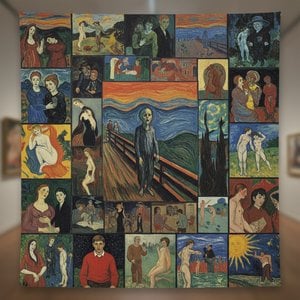
Edvard Munch's *Untitled (6167)*, a stark monochrome depiction of a woman gazing intently at something unseen beyond the horizon, transcends mere visual representation; it embodies the profound anxieties and psychological complexities characteristic of Expressionism. Created around 1893, this painting stands as one of Munch’s most arresting explorations into the human condition—a testament to his unwavering commitment to conveying inner turmoil rather than simply documenting external reality. The photograph captures a woman standing alone in a field, her back turned towards the viewer, creating an immediate sense of vulnerability and isolation. Her posture exudes contemplation, yet beneath the surface lies palpable unease.
- Style: Munch’s style aligns perfectly with Expressionism, prioritizing emotional intensity over objective observation. He eschewed academic conventions in favor of a visceral approach that sought to capture subjective experience—fear, grief, and longing—with uncompromising honesty.
- Technique: Executed primarily in oil paint on canvas, *Untitled (6167)* utilizes thick brushstrokes and textured surfaces to convey the artist’s emotional state. Munch's deliberate manipulation of pigment creates a palpable sense of movement and instability, mirroring the turbulent inner landscape he portrays.
- Historical Context: The painting emerged during a period marked by significant intellectual ferment—the burgeoning Symbolist movement alongside the rise of psychoanalysis—influencing Munch’s artistic vision. It reflects anxieties prevalent in European society at the time concerning mortality, illness, and the fragility of human psyche.
Symbolism & Emotion: The woman's gaze directs our attention outwards, yet her preoccupation suggests a deeper internal struggle. The desolate field serves as a visual metaphor for loneliness and isolation—themes recurrent in Munch’s oeuvre. The absence of discernible detail amplifies the painting’s emotional impact, inviting viewers to contemplate their own fears and vulnerabilities. Munch deliberately avoids portraying explicit emotion; instead, he communicates it through subtle gestures and tonal variations, fostering contemplation and prompting introspection.
The Landscape as Reflection
Beyond its psychological depth, *Untitled (6167)*’s landscape contributes significantly to its overall narrative. The two houses in the background—one distant, one closer—represent stability and familiarity juxtaposed against the woman's solitary presence. This compositional choice underscores Munch’s preoccupation with confronting existential dread—the confrontation between individual consciousness and the indifferent cosmos. The muted palette reinforces this mood of melancholy and uncertainty, mirroring the emotional core of the artwork.
Munch Museum: Experiencing Genius
A visit to Oslo's MUNCH Museum offers an unparalleled opportunity to immerse oneself in Munch’s artistic legacy. Located in Bjørvika, a revitalized waterfront district, the museum houses the largest collection of Munch’s paintings and prints globally—a breathtaking panorama of his iconic works like *The Scream*, alongside insightful exhibitions exploring his artistic evolution and psychological influences. Designed by Juan Herreros, its architectural grandeur complements Munch's expressive vision, creating an unforgettable experience for art enthusiasts worldwide.
Soru ve Cevaplar
"untitled (6167)" ne hakkında ve nasıl bir atmosfere sahip?
"untitled (6167)", landscape, woman figure, psychological depth, melancholy mood, rural scene, symbolism, emotional expression, twilight atmosphere konularını sergilemekte olup, yansıttığı duygu Dramatic şeklindedir.
Edvard Munch imzalı "untitled (6167)", Expressionist Anxiety akımını sanatçının ana vatanıyla nasıl ilişkilendiriyor?
"untitled (6167)", yaratıcısının doğum yeri aracılığıyla Expressionist Anxiety akımını İsveç ile ilişkilendiriyor.
"untitled (6167)" ışık ve karanlığı nasıl dengeliyor?
"untitled (6167)" genel olarak shadow düzeyindedir ve parlaklığı Soft Shadow'dir.



 Önizle
 El Yapımı Tablo Satın Al
 Gönder
 Paylaş
 Detaylar
 Rehber

 Dosyayı İndir
 Benzerleri
 X-Işını
 Slayt Gösterisi
 İstatistikler
 Devamını Oku






































 Cam seçeneği yalnızca 110 cm altındaki boyutlar için mevcuttur.