A Portrait of Anxiety Under a Bleak Sky
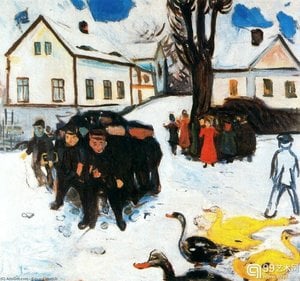
Edvard Munch's “The Snow Shovelers,” completed in 1913, stands as a cornerstone of Norwegian Expressionism and a haunting testament to the psychological landscape of its time. More than just a depiction of manual labor amidst snowfall, it’s an intensely felt portrayal of human vulnerability confronted by overwhelming forces – both internal and external.
Created during Munch's prolific period of artistic exploration, “The Snow Shovelers” embodies the movement’s core tenets: prioritizing emotional expression over objective representation. Unlike Impressionists who sought to capture fleeting moments of light and color, Munch aimed to distill the anxieties and melancholic undertones simmering beneath the surface of everyday life.
Expressionism's Bold Aesthetic
The painting utilizes a stark monochrome palette – predominantly black and white – amplifying its dramatic impact. Munch’s distinctive style is characterized by distorted forms, exaggerated contours, and vibrant, unsettling colors (though absent in this particular print). These stylistic choices aren’t arbitrary; they serve to convey psychological states directly, bypassing rational thought.
Consider the figures themselves: two men shoveling snow on a desolate street. Their postures are rigid, conveying exhaustion and perhaps resignation. Munch skillfully renders their faces with subtle shading, hinting at inner turmoil – eyes wide with apprehension, mouths slightly downturned. The looming dark sky dominates the composition, symbolizing impending doom and mirroring the characters’ emotional distress.
Symbolism and Emotional Resonance
Beyond its formal elements, “The Snow Shovelers” is laden with symbolic significance. The snow itself represents isolation and oppression, while the umbrella positioned in the upper left corner offers a fragile shield against the encroaching darkness – a futile attempt to ward off despair.
Munch’s masterful use of line and texture contributes to the painting's visceral quality. Thick brushstrokes create a sense of movement and unease, mirroring the relentless effort required to combat the bleakness of winter. The artwork resonates deeply with viewers because it captures the universal experience of confronting fear and uncertainty.
Discovering Munch’s Legacy
“The Snow Shovelers” exemplifies Munch's unwavering commitment to portraying human emotion with unflinching honesty. Its enduring power lies in its ability to evoke a profound sense of melancholy and anxiety – feelings that continue to resonate powerfully today. Explore the beauty and complexity of this masterpiece through a high-quality reproduction at WahooArt.com.
Learn more about Edvard Munch’s artistic journey and his contribution to Expressionism on Wikipedia: Wikipedia
For a deeper understanding of Munch's influence, visit the Munch Museum in Oslo, Norway: The Munch Museum



 Önizleme yap
 Baskı Moduna Geç
 Paylaş
 Paylaş
 Detayları Gör

 İndir
İndir
 Benzerlerini gör
 X-Işını
 Slayt Gösterisi
 İstatistikler

 Tümünü Gör






































 Cam seçeneği yalnızca 110 cm altındaki boyutlar için mevcuttur.