Çevrimiçi önizlemeden çok daha üstün, yüksek çözünürlüklü ve iyileştirilmiş bir dijital görüntü satın alın.
Her dosya, uzman ekibimiz tarafından gelişmiş araçlar ve titiz manuel rötuş teknikleri kullanılarak özenle hazırlanır. Her görüntünün olağanüstü netliğe, kusursuz renk doğruluğuna ve ince ayrıntılara sahip olduğundan emin oluruz.
Son dosya; profesyonel, editoryal ve baskı süreçlerinde anında kullanıma uygun şekilde optimize edilerek 72 saat içinde e-posta yoluyla teslim edilir. Bu, seçkin tasarım stüdyoları, yayıncılar ve galerilerin güvendiği aynı kalite standartlarındadır.
Kişisel sergileme, baskı ve yaratıcı projeleriniz için yüksek çözünürlüklü bir dosya indirin. ( Baskı satın al El yapımı tablo satın al)
WahooArt.com seçtiğinizde, sadece bir görsel edinmekle kalmaz; titizlikle hazırlanmış, profesyonelce iyileştirilmiş dijital bir sanat eserine sahip olur ve memnuniyet garantisiyle güvence altına alınırsınız. Siparişinizle birlikte otomatik olarak sunulan her şey şunlardır:

Yüksek çözünürlüklü dijital görüntü dosyanız, siparişinizin üzerinden en geç 72 saat geçmeden e-posta ile size gönderilecektir; hemen kullanıma hazırdır.

Sanat eseriniz; maksimum detay, netlik ve renk doğruluğu sağlamak amacıyla gelişmiş yapay zeka araçları ve manuel düzenleme kullanılarak profesyonelce optimize edilmektedir.

Dosyanızı yanlışlıkla mı sildiniz yoksa kayıp mı oldu? Endişelenmeyin; dosyanızı dilediğiniz zaman size ücretsiz olarak tekrar göndereceğiz.

Sanat eserinizin tadını gümrük vergisi, harç veya teslimat ücreti ödemeden anında çıkarın; dijital indirmeler her zaman vergiden muaftır.

Profesyonel araçlar ve renk yönetimi kullanarak dijital görselinizin orijinal renklere mümkün olduğunca yakın yansıtılmasını sağlıyoruz.

If you're not satisfied with your digital image, we'll revise it or refund 100% within 100 days - no questions asked.

Memnun kalmadınız mı? Dijital dosyanızı teslim aldıktan sonraki 100 gün içinde, hiçbir soru sorulmaksızın tam para iadesi alabilirsiniz.

Buy 3 images, save 10% - Buy 5, save 15% - Buy 10+, save 20%. Great for creative projects, galleries, and agencies.

In the vibrant, shifting landscape of the late Italian Renaissance, few artists captured the tension between classical order and Mannerist artifice as delicately as Carlo Urbino. Born in the Lombard town of Crema around 1525, Urbino emerged from a period of profound intellectual ferment, where the rigid structures of the High Renaissance were beginning to dissolve into the more expressive, elongated, and dramatic forms of Mannerism. His journey was one of both artistic refinement and scientific inquiry, a path that saw him move through the influential circles of Venice and Milan, leaving behind a trail of frescoes and drawings that bridge the gap between the grace of the 16 th century and the burgeoning energy of the Baroque.
Urbino’s early development was deeply rooted in the aesthetic currents of the Veneto. Training amidst the luminous traditions of Venice, he absorbed a mastery of light and color that would later define his approach to composition. However, it was his connection to the Campi family—specifically the masters Antonio, Bernardino, and Giulio Cambi—that provided the stylistic scaffolding for his career. This lineage instilled in him a penchant for complex, often crowded arrangements and a fascination with the human form in motion. His work does not merely depict a scene; it orchestrates a visual drama, utilizing sfumato and dynamic gestures to guide the viewer’s eye through intricate religious narratives.
What truly distinguishes Carlo Urbino from his contemporaries was his profound intellectual curiosity, which extended far beyond the boundaries of the canvas. He was a true Renaissance man, possessing a mind that sought to find the underlying geometry in all things. This passion for structure led to a remarkable collaboration with the mathematician and engineer Camillo Agrippa. Together, they worked on the Codex Huygens, a monumental endeavor that explored the intersection of art, proportion, and the science of armaments. Through this work, Urbino demonstrated that his interest in perspective was not merely a tool for illusion, but a way to understand the very mechanics of the physical world.
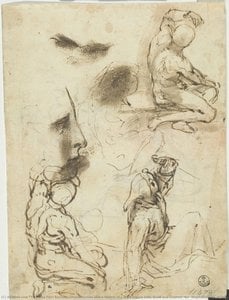
This scientific rigor is often visible in his preparatory drawings and sketches. Whether working with ink, sanguine, or pen, Urbino possessed an ability to distill complex anatomical truths into elegant lines. His studies for religious compositions were not merely blueprints but explorations of weight, balance, and tension. This duality—the ability to be both a dreamer of divine visions and a student of mathematical precision—allowed him to create works that felt both spiritually transcendent and physically grounded.
As his reputation grew, Urbino’s career found its most significant momentum in Milan, where he secured prestigious commissions from the era's most influential patrons. His work for Vespasiano Gonzaga and Alessandro Sforza placed him at the heart of Lombard political and religious life. In the sacred spaces of Milan, such as the Church of Santa Maria della Passione, his frescoes breathed life into the walls, showcasing a command of perspective that could transform a flat surface into an expansive, heavenly realm. His contributions to the St. Joseph’s Chapel remain a testament to his ability to handle large-scale religious iconography with both solemnity and grace.
The breadth of his artistic output can be seen in several key areas of his career:
By the time of his death in 1585, Carlo Urbino had helped establish a stylistic bridge that would support the weight of the coming Baroque era. He left behind an oeuvre that serves as a vital link in the history of Italian art—a legacy defined by the seamless integration of the eye's beauty and the mind's logic. His ability to navigate the transition from the balanced ideals of the Renaissance to the emotive complexity of Mannerism ensures his place as a pivotal figure in the evolution of European painting.

1525 - 1585 , Italy

 Önizleme yap
 Paylaş
 Paylaş
 Detayları Gör

 İndir
İndir
 Benzerlerini gör
 X-Işını
 Slayt Gösterisi
 Tümünü Gör