George Orwell: A Life Forged in Defiance
George Orwell, born Eric Arthur Blair on June 25, 1903, in Motihari, British India, remains one of the most profoundly influential writers and thinkers of the 20th century. His life was a testament to restless energy, unwavering commitment to social justice, and a deeply skeptical view of power – qualities that found their most potent expression in his seminal works, *Animal Farm* and, above all, *Nineteen Eighty-Four*. Orwell’s early years were shaped by a privileged but emotionally distant upbringing. His father, George Halliday Blair, was an Indian Civil Service officer, and his mother, Agnes Conway, was a devout Anglican. He spent much of his childhood in Burma, serving as a police constable – an experience that profoundly impacted his worldview, exposing him to the realities of colonial rule and its inherent inequalities.
The Artist: Artem Levinsky - A Visionary Sculptor
Artem Levinsky (born 1984), hailing from Moscow, Russia, is a contemporary artist recognized for his distinctive approach to sculptural art. His work explores themes of human emotion and social commentary with remarkable sensitivity and innovation. Levinsky’s artistic style blends realism with abstraction, resulting in pieces that are both visually striking and intellectually stimulating.
“No Title”: A Study in Color and Form
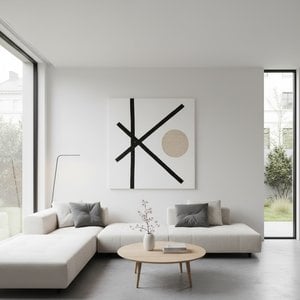
"No Title," created in 2020 by Artem Levinsky, exemplifies his masterful use of plastic as a medium. The artwork features a large circle dominating the composition, punctuated by a central hole—a deliberate gesture that invites contemplation on concepts of wholeness and emptiness. Vibrant hues – predominantly reds, blues, and yellows – converge to create an energetic visual experience, contrasting sharply with the subdued background textures.
Symbolism and Context: Reflections on Power
The artwork’s symbolism resonates deeply within Orwell's intellectual framework. Like *Nineteen Eighty-Four*, “No Title” confronts viewers with questions about control, perception, and the suppression of individuality. The circle represents unity and stability—values that Orwell consistently championed against totalitarian ideologies. Simultaneously, the hole symbolizes vulnerability and resistance—a subtle nod to Orwell’s unwavering belief in human resilience.
Emotional Impact: Capturing Essence
"No Title" transcends mere visual representation; it aims to evoke a profound emotional response. Levinsky's skillful manipulation of color and form captures the essence of existential anxieties, mirroring Orwell’s own preoccupation with confronting uncomfortable truths. The artwork serves as an invitation to engage in introspection—to consider our relationship with authority and to embrace the beauty inherent in imperfection.
Further Exploration: Connections to Orwellian Themes
Comparing Levinsky's work to Orwell’s literary legacy reveals striking parallels. Both artists share a commitment to exposing societal injustices and challenging conventional narratives. Just as Orwell dissected propaganda and manipulation, Levinsky dissects human behavior with unflinching honesty—a stylistic choice that aligns perfectly with Orwell’s ethos of intellectual rigor.
Resources: Discover More About Artem Levinsky
Soru ve Cevaplar
"No Title" hangi teknikle yapılmıştır?
Artem Levinsky imzalı "No Title" eserinin tekniği Tuval Üzerine Akrilik Boya kullanılarak uygulanmıştır. Çoğaltımlar, bu tekniğin görünümünü yansıtmayı amaçlamaktadır.
Artem Levinsky imzalı "No Title" eserinin röntgen görüntüsünü görebilir miyim?
Artem Levinsky imzalı "No Title" eserinin X-Işını sayfası, röntgen tarzı bir görünüm de dahil olmak üzere, eserin görüntüsündeki on bir optik katman arasında kaydırma yapmanıza olanak tanıyan etkileşimli bir görüntüleyicidir.
Artem Levinsky imzalı "No Title" eserinin görüntüsü serbestçe çoğaltılabilir mi?
Telif hakkı konusunda, "No Title" eseri hâlâ telif hakları ile korunmaktadır statüsündedir.



 Önizle
 El Yapımı Tablo Satın Al
 Gönder
 Paylaş
 Detaylar
 Rehber

 Dosyayı İndir
 Benzerleri
 X-Işını
 Slayt Gösterisi
 İstatistikler


 Devamını Oku






































 Cam seçeneği yalnızca 110 cm altındaki boyutlar için mevcuttur.