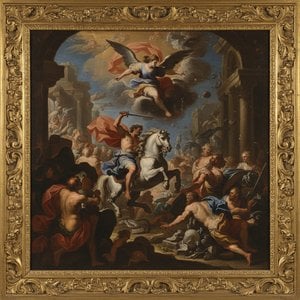
Abraham Janssens I (1575–1632): A Baroque Visionary Bridging Mannerism and Classical Influence
Abraham Janssens I, born around 1575 in Antwerp, Belgium—likely the son of Jan Janssens and Roelofken van Huysen—emerged as a pivotal figure in Flemish Baroque painting during his lifetime. While precise birthdates remain debated, he established himself as the foremost history painter of Flanders before Rubens’ triumphant return from Italy, skillfully blending Mannerist aesthetics with the grandeur of classical ideals. His artistic journey began under the tutelage of Jan Snellinck and culminated in membership of the Antwerp Guild of Saint Luke in 1601-1602, marking a significant step toward professional recognition.
- Early Training & Travels: Janssens’ formative years were spent honing his skills under Snellinck's guidance before embarking on a transformative voyage to Italy between 1597 and 1602. This immersion in the artistic heartland of Rome profoundly impacted his stylistic sensibilities, exposing him to the innovations championed by Caravaggio and Raphael—influences that would permeate his subsequent oeuvre.
- Marriage & Family: In 1602, Janssens married Sara Goetkint, with whom he raised eight children, five surviving into adulthood. This familial life provided a grounding amidst his burgeoning artistic career, fostering an environment conducive to creativity and mentorship.
- Guild Mastership & Patronage: Janssens ascended to the role of Dean of the Antwerp Guild of Saint Luke in 1607, securing invaluable connections with influential patrons—a circumstance that propelled him into producing monumental commissions for provincial clients. Notably, he joined the confrerie of Romanists, a humanist society dedicated to artistic pursuits and papal pilgrimage, furthering his exposure to wealthy benefactors.
Janssens’ artistic output is characterized by dramatic compositions infused with chiaroscuro—the masterful use of light and shadow—a technique directly inherited from Caravaggio. His paintings frequently depict biblical narratives and mythological scenes rendered with meticulous detail and vibrant color palettes, reflecting the humanist spirit of his era. He achieved considerable renown during Rubens' absence from Antwerp, establishing himself as a dominant force in the production of large altarpieces – a testament to his artistic prowess and reputation.
His pupils included his son Abraham Janssens II, Giovanni di Filippo del Campo, Michele Desubleo, Nicolas Régnier, and Gera—individuals who carried forward his stylistic legacy and contributed to the flourishing Antwerp Baroque tradition. Janssens’ enduring contribution to art history lies in his ability to synthesize disparate artistic currents into a cohesive visual language that embodies both Mannerist elegance and classical grandeur. He died peacefully in Antwerp in 1632, leaving behind a remarkable body of work that continues to inspire admiration for its expressive power and technical brilliance.
Notable Works & Artistic Style
Janssens’ artistic style is instantly recognizable by its dramatic use of light and shadow—a hallmark of Caravaggio's technique—which he skillfully employed to heighten emotional impact and create a sense of theatrical grandeur. His paintings often explore themes of religious piety and mythological allegory, showcasing meticulous observation of anatomical detail and masterful rendering of textures. Key masterpieces include “The Dead Christ in the Tomb with Two Angels,” “Jupiter Rebuked,” and “Peace And Plenty Binding Arrows Of War”—each demonstrating Janssens’ unwavering commitment to artistic excellence and his profound engagement with humanist ideals.
Legacy & Historical Significance
Abraham Janssens I stands as a cornerstone of Flemish Baroque painting, representing a pivotal moment in the transition from Mannerism to Classical style. His influence extended beyond Antwerp, shaping artistic sensibilities across Europe and cementing his place among the most celebrated history painters of his time. He is remembered not only for his technical virtuosity but also for his ability to convey profound spiritual contemplation through visual imagery—a legacy that continues to resonate within the annals of art history.


 Önizle
 Gönder
 Paylaş
 Detaylar
 Rehber

 Dosyayı İndir
 Benzerleri
 X-Işını
 Slayt Gösterisi
 Q&A
Q&A İstatistikler
 Devamını Oku
 Baskı Satışına Geç





































 Cam seçeneği yalnızca 110 cm altındaki boyutlar için mevcuttur.