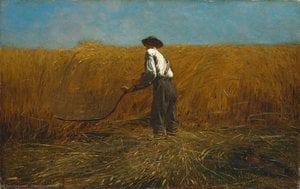
A Moment of Quietude: Winslow Homer’s “The Sand Dune”
Winslow Homer's "The Sand Dune," painted in 1871, isn’t merely a depiction of a woman and her dog on the beach; it’s a profound meditation on the relationship between humanity and nature, rendered with an almost palpable sense of serenity. This oil-on-canvas masterpiece captures a fleeting moment – a quiet afternoon bathed in golden light – that speaks volumes about the American spirit of observation and appreciation for the simple pleasures of rural life. Homer, already establishing himself as one of America’s most significant artists, eschewed the grand narratives favored by European academies, instead choosing to immerse himself in the realities of his native New England, a decision that profoundly shaped his artistic vision.
The painting immediately draws the eye with its expansive landscape. The undulating sand dunes dominate the composition, stretching towards a hazy horizon, creating an illusion of limitless space and inviting the viewer into this intimate scene. Homer’s masterful use of color – warm ochres, sandy yellows, and muted blues – evokes the feeling of sun-drenched heat and the soft texture of the sand beneath one's feet. The woman, dressed in a simple hat that adds a touch of formality to the otherwise casual setting, stands with a relaxed posture, her gaze directed towards an unseen point beyond the frame. Beside her, two dogs – a sturdy terrier and a smaller breed – are engaged in playful interaction, their presence adding a layer of domestic warmth to the scene.
Technique and Composition: Echoes of Homer’s Early Style
Examining the painting's technique reveals a fascinating blend of realism and Impressionistic influence. Homer’s early training as an illustrator is evident in his meticulous attention to detail, particularly in the rendering of the sand dunes and the textures of the dogs’ fur. However, he departs from strict photographic accuracy, employing loose brushstrokes and subtle color variations to capture the atmospheric quality of the light and the sense of movement within the landscape. The composition itself is carefully balanced, with the diagonal lines created by the dunes leading the eye towards the distant horizon, while the figures in the foreground provide a grounding element. Notably, “The Sand Dune” shares stylistic similarities with works like "Country School" and "Girl with Pitchfork," demonstrating Homer’s consistent exploration of rural American life.
The inclusion of the bird on the right side is particularly intriguing. It could be interpreted as a symbol of freedom or perhaps simply an element of the natural world seamlessly integrated into the scene. Homer's ability to imbue even seemingly minor details with significance underscores his deep understanding of the interconnectedness of all things within the landscape.
Historical Context and Artistic Significance
"The Sand Dune" was created during a period of significant social and artistic change in America. Following the Civil War, there was a growing interest in documenting American life and celebrating the nation’s diverse landscapes. Homer's work reflects this trend, offering a nuanced portrayal of rural America that moved beyond romanticized depictions to capture the everyday realities of its people. The painting is currently housed at the Terra Foundation for American Art in Chicago, an institution dedicated to preserving and promoting the understanding of historical American art – a testament to Homer’s enduring legacy.
Owning a Piece of History: Reproductions and Beyond
WahooArt.com offers meticulously crafted, hand-painted reproductions of “The Sand Dune,” allowing art enthusiasts to experience the beauty and emotional resonance of this iconic painting firsthand. These reproductions capture not only the visual details but also the spirit and atmosphere of Homer’s original work. For those seeking further information on Winslow Homer or his artistic journey, we encourage you to explore the resources available at WahooArt.com and the Wikipedia page dedicated to the artist. Explore a high-quality reproduction today: https://WahooArt.com



 Förhandsvisa
 Beställ handmålad reproduktion
 Skicka
 Dela
Dela
 Visa detaljer

 Ladda ner
 Liknande objekt
 Röntgen
 Bildspel
 Stats
Stats

 Visa mer






































 Glasalternativet är endast tillgängligt i storlekar under 110 cm.


![Indian Tobacco Shop Sign [reverse, Indian Facing Right] — Winslow Homer, Contemporary Realism](/media/artworks/images-thumb/74/22/7422432cafc295265ef3b7f7fa62d35d.jpg)