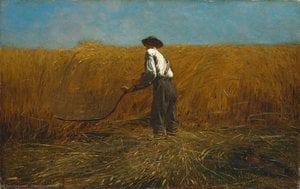
A Moment of Quiet Contemplation
Winslow Homer’s *The Nooning* (1872) presents a captivating slice of rural American life, depicting a young man reclining in a sun-dappled meadow. He appears lost in thought, perhaps searching for something amidst the tall grasses, while a simple farmhouse and mature trees form a tranquil backdrop. The scene isn’t one of strenuous labor, but rather a peaceful interlude – a moment of respite during the heat of the day. This painting is more than just a depiction of a man in a field; it's an evocation of stillness and connection to nature.
Impressionistic Techniques & Artistic Style
Homer masterfully employs oil on canvas, utilizing loose, visible brushstrokes characteristic of the emerging Impressionist style. While not fully embracing all tenets of Impressionism, *The Nooning* demonstrates a shift away from meticulous detail towards capturing the *impression* of light and atmosphere. The color palette is dominated by earthy greens and browns, punctuated by subtle yellows and whites that suggest sunlight filtering through foliage. This technique creates a sense of depth and dimensionality, drawing the viewer into the scene. The flattened perspective further enhances this atmospheric quality, prioritizing mood over strict realism.
Historical Context & The Rise of American Genre Painting
Created in 1872, *The Nooning* reflects a growing interest in depicting everyday American life during the post-Civil War era. Artists like Homer moved away from historical or mythological subjects to focus on scenes of rural existence and the working class. This shift coincided with a burgeoning sense of national identity and a desire to capture uniquely American experiences. Homer’s work, alongside that of artists like Eastman Johnson and Thomas Eakins, helped establish genre painting as a significant force in American art.
Symbolism & Emotional Resonance
The symbolism within *The Nooning* is subtle yet potent. The reclining figure embodies relaxation and contemplation. His search through the grass could represent a yearning for something more, or simply an appreciation of the natural world. The farmhouse symbolizes domesticity and stability, while the trees evoke growth, resilience, and connection to the land.
Collectively, these elements create a sense of peaceful solitude and harmonious coexistence between humanity and nature. The painting’s emotional impact is one of quiet serenity – an invitation to pause, reflect, and appreciate the simple joys of life.
Winslow Homer: A Master of American Realism
Born in Boston in 1836, Winslow Homer initially gained recognition as a commercial illustrator before dedicating himself to fine art. He became renowned for his depictions of marine subjects, landscapes, and scenes of rural America.
His ability to capture the essence of light, atmosphere, and human emotion cemented his place as one of the most important American artists of the 19th century. Other notable works include *Snap the Whip* (1872), *Crossing the Pasture* (1871-72) and *Fishergirls on Shore, Tynemouth* (1880).
Integrating *The Nooning* into Your Space
This painting’s calming palette and evocative subject matter make it an ideal addition to a variety of interior design schemes. It would complement a farmhouse-style living room, adding warmth and authenticity. Its subtle colors also lend themselves well to more contemporary spaces, providing a touch of rustic charm.
- Consider pairing *The Nooning* with natural materials like wood and linen.
- Its earthy tones harmonize beautifully with muted greens, browns, and creams.
- Hang it in a quiet space – a reading nook or bedroom – to enhance its sense of tranquility.
A high-quality reproduction of *The Nooning* allows you to bring the serenity and beauty of Winslow Homer’s masterpiece into your home, offering a timeless source of inspiration and contemplation.



 Förhandsvisa
 Beställ handmålad reproduktion
 Skicka
 Dela
Dela
 Visa detaljer

 Ladda ner
 Liknande objekt
 Röntgen
 Bildspel

 Visa mer






































 Glasalternativet är endast tillgängligt i storlekar under 110 cm.