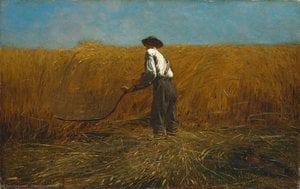
A Moment of Quiet Determination: Winslow Homer's "The Busy Bee"
Winslow Homer’s “The Busy Bee,” painted around the late 19th century, is more than just a depiction of a young boy; it’s a poignant snapshot of American life rendered with the meticulous observation and understated emotional power that defined Homer’s career. The painting captures a fleeting moment – a boy in a straw hat, seemingly absorbed in his task, set against a backdrop of rural New England tranquility. This isn't a grand historical scene or an idealized pastoral; it’s a grounded portrayal of everyday existence, reflecting Homer’s deep connection to the American spirit and his commitment to portraying scenes with remarkable clarity and detail.
- Subject Matter: The central figure, a young boy, immediately draws the viewer's attention. His posture – upright, determined, holding the hat firmly – suggests purpose and perhaps even a quiet struggle or ambition.
- Setting: The grassy field and distant figures establish a rural setting, characteristic of Homer’s frequent depictions of New England life. This context speaks to the burgeoning industrialization of America while simultaneously highlighting the enduring importance of traditional occupations.
- Composition: The composition is deceptively simple, yet expertly balanced. The boy occupies the foreground, drawing us in with his direct gaze, while the background elements – the other people and the potted plant – contribute to a sense of depth and narrative without overwhelming the central subject.
Technique and Style: Homer’s Masterful Realism
Homer's mastery lies in his ability to translate observation into paint with remarkable precision. Executed primarily in black and white, “The Busy Bee” exemplifies his signature style – a blend of realism and tonal subtlety. The use of shading is particularly noteworthy, creating a strong sense of volume and texture within the boy’s clothing and the surrounding environment. This technique, honed during his years as an illustrator for Harper's Weekly, allowed him to capture not just the appearance but also the *feeling* of a scene – the light, the atmosphere, the very essence of the moment. The lack of color intensifies the focus on form and texture, echoing the stark clarity often found in journalistic illustration.
- Tonal Range: Homer expertly manipulates tones to create depth and dimension, emphasizing the boy's physicality and the textures of the grass and hat.
- Line Work: Precise lines define the boy’s form and the surrounding elements, contributing to the painting’s overall clarity and impact.
- Brushwork: The brushstrokes are generally smooth and controlled, reflecting Homer's meticulous approach to rendering detail.
Symbolism and Emotional Resonance
"The Busy Bee" transcends a simple portrait of a boy; it’s imbued with subtle symbolism. The boy’s determined expression suggests ambition, resilience, and perhaps even the burdens of responsibility – qualities often associated with the American character. The presence of the birds adds an element of freedom and aspiration, while the potted plant introduces a touch of domesticity and connection to nature. The painting evokes a sense of quiet contemplation and nostalgia, inviting viewers to reflect on themes of childhood, work, and the passage of time. It’s a testament to Homer's ability to capture not just what he saw, but also what he *felt* about it.
Historical Context and Legacy
Painted during a period of significant social and economic change in America – the late 19th century – “The Busy Bee” reflects Homer’s fascination with depicting the lives of ordinary people. His work, rooted in his experiences as an illustrator and his deep connection to the American landscape, helped solidify his place as one of the most important figures in American art. Reproductions of this evocative piece offer a window into a bygone era, allowing us to appreciate Homer’s artistic vision and his enduring contribution to the nation's cultural heritage.



 Förhandsvisa
 Beställ handmålad reproduktion
 Skicka
 Dela
Dela
 Visa detaljer

 Ladda ner
 Liknande objekt
 Röntgen
 Bildspel
 Statistik

 Visa mer






































 Glasalternativet är endast tillgängligt i storlekar under 110 cm.