Konstnärsbiografi
William-Adolphe Bouguereau: En Skildring av Skönhet och Klassisk Perfektion
William-Adolphe Bouguereau, född 1825 i La Rochelle, Frankrike, var en fransk målare vars liv och verk var djupt rotade i en strävan efter skönhet, klassiska ideal och en otrolig realism. Från sin tidiga barndom, omgiven av vinodlingar och olivlundar, visade Bouguereau en stark konstnärlig känsla som ledde honom till Paris och den prestigefyllda École des Beaux-Arts. Där, under vägledningen av François-Edouard Picquenot, utvecklade han sina färdigheter, absorberade lärdomarna från de gamla mästarna – framför allt Raphael och Titian. Dessa inflytanden var inte bara imitationer; de blev grunden för Bouguereaus unika konstnärliga vision, präglad av minutiös detaljrikedom, ljusa färger och en obeveklig strävan efter att förmedla skönhet i dess mest idealiserade form. Han målade inte bara det han *såg*, utan snarare det han ansåg vara inneboende vackert, med ett mål att uppnå en perfektion som resonerade med den konstnärliga känslan hos sin tid.
Den Arkitekten av Akademisk Perfektion
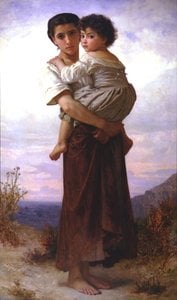
Bouguereaus konstnärliga stil beskrivs ofta som akademisk realism, och det är helt rättvist. Han beseglade en otrolig skicklighet i anatomi, ljus och komposition. Hans målningar bebos av figurer målade med en häpnadsväckande precision – den delikata kurvan på en axel, den subtila rodnaden i huden, djupet i ett öga. Men hans verk sträcker sig bortom ren teknisk skicklighet; de är fyllda med emotion och berättarmakt. Han målade ofta mytologiska scener, omvandlande gamla berättelser till livfulla, känslomässigt resonanta ögonblick. *Födelsen av Venus*, till exempel, är inte bara en bild av gudinnan som stiger ur havet; det är en hyllning till kvinnlig grace och eterisk skönhet. Liknande verk som *Zenobia Funnen av Herdar på Araxes-floden* fångar sårbarhet och patos med otrolig känslighet. Utöver mytologi hittade Bouguereau inspiration i vardagligt liv – herdeungar som sköter sina flockar, unga flickor som leker, mammor som omsluter sina barn. Dessa genre scener, även om de verkar enkla, är fyllda med en känsla av värdighet och ömhet som lyfter dem till konstens nivå. *Faneuse (1869)* illustrerar detta tillvägagångssätt, där den unga kvinnan målad i ett lugnt landskap skapar en otrolig detaljrikedom och atmosfär. Hans engagemang för att fånga oskuld är särskilt framträdande i målningar som *Barn vid badet*, där den delikata renderingen av hud och ljus skapar en verkligen fängslande bild.
Inflytanden och Utveckling
Bouguereaus konstnärliga resa var formad av flera inflytelserika faktorer. Hans tidiga år i La Rochelle, med dess vackra landskap, gav honom en djup förståelse för naturens skönhet. Familjens bakgrund som vin- och olivoljemästare gav honom en praktisk förmåga till observation och detaljfokus. Men det var hans studier vid École des Beaux-Arts i Paris som verkligen formade hans konstnärliga stil. Där lärde han sig de traditionella teknikerna och teorierna om akademisk målning, samtidigt som han utvecklade sin egen unika vision. Han studerade intensivt verk av Raphael och Titian, och försökte att återskapa deras skicklighet i anatomi, ljus och komposition. Han var också starkt påverkad av den franska romantiska konsttraditionen, särskilt av målare som Eugène Delacroix, vars dramatiska färger och känslomässiga uttryck inspirerade honom att skapa verk med djupare emotionell laddning.
Stora Genombrott och Erkännande
Bouguereaus konstnärliga karriär blomstrade under 1870- och 1880-talen, då han blev en av de mest populära målarna i Paris. Hans verk visades regelbundet på Salonen, den prestigefyllda konstutställningen som avgjorde en konstnäres framgång. Han vann flera priser och utmärkelser, vilket bekräftade hans skicklighet och popularitet. Han fick även titeln "befälhavare i Hedersorden" 1875, ett tecken på den stora erkännandet han hade inom det konstnärliga samhället. Hans förmåga att skapa bilder som var både tekniskt briljanta och känslomässigt engagerande gjorde honom till en favorit bland samlare och museer över hela världen. Under sin livstid sålde Bouguereau ett stort antal verk, vilket gav honom ekonomisk trygghet och möjligheten att fortsätta sin konstnärliga utveckling.
En Arv Utmanat och Återupptäckt
Trots sitt stora erkännande under sin tid, föll Bouguereaus verk i glömska efter hans död 1905. Med framväxten av modernismen i början av 1900-talet, som betonade abstraktion och experimentell konst, ansågs Bouguereaus traditionella stil vara gammalmodig och utdaterad. Hans verk marginaliserades i museer och gallerier, och hans namn glömndes bort för många. Men under 1980-talet började en ny våg av intresse för Bouguereau att uppstå. Konsthistoriker och samlare började omvärdera hans konstnärliga skicklighet och hans bidrag till den franska konsttraditionen. Hans verk hyllades nu för sin skönhet, precision och emotionella djup. Denna återupptäckt var inte bara en nostalgisk längtan efter det förflutna; det var ett erkännande av att Bouguereau var en mästare som förtjänar en plats bland de största konstnärerna genom tiderna. Hans inflytande kan ses i samtida figurativ målning, där konstnärer fortsätter att inspireras av hans skicklighet i form och ljus. *Låten från änglarna (1881)* är ett särskilt berömt mästerverk som uttrycker hans förmåga att väcka en känsla av vördnad och andlig transcendens. Bouguereaus konst är mer än bara vackra bilder; det är ett testamente till skicklighet, engagemang och en obeveklig tro på den bestående attraktionen hos klassiska ideal. Han förblir en nyckelperson i 19:e århundradets franska målning, som representerar kulmen av akademisk konst och erbjuder en tidlös vision av skönhet som fortsätter att fängsla publiken idag.



 Förhandsvisa
 Beställ handmålad reproduktion
 Skicka
 Dela
Dela
 Visa detaljer

 Ladda ner
 Liknande objekt
 Röntgen
 Bildspel
 Statistik


 Visa mer






































 Glasalternativet är endast tillgängligt i storlekar under 110 cm.