Konstverket som visas på denna sida skyddas av upphovsrättslagen, vilket innebär att vi inte lagligt kan skapa eller sälja en identisk reproduktion. Detta skydd upprätthålls genom internationella avtal såsom den Bernkonventionen och genom nationella lagar, inklusive de som fastställs av Amerikansk upphovsrättslag – Titel 17. Alla rättigheter förbehållna. Återgivning av konstverk är förbjuden utan skriftligt tillstånd från WahooArt.
Denna metod följer fullt ut upphovsrättsliga regler eftersom den inte innebär kopiering eller duplicering av det skyddade konstverket. Istället är det en kreativ nytolkning – en ny målning som är influerad av originalet men inte identisk med det.
Giclée- eller canvasprint av museumskvalitet med snabb produktion och flexibla ytbehandlingsalternativ. ( Beställ handmålad reproduktion Byt till digital bild)





























Välj bland våra förinställda storlekar som motsvarar konstverkets ursprungliga proportioner.

Ange den bredd och höjd du behöver för att passa din ram eller vägg. Ett tryck kan endast beskäras, aldrig göras större än originalbilden, vilket innebär att ett format med en annan proportion leder till att en del av bilden går förlorad. Vi skickar en digital mockup för godkännande innan vi påbörjar tryckningen. Bilden som visas på denna sida visar inte den faktiska beskärningen — det är endast mockuppen som gör det.
Leverans över hela världen () på 2 veckor istället för standard 4/5 veckor. (9 november)
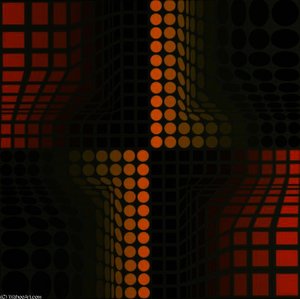
Syry
Storlek på reproduktion
Victor Vasarely's "Syry" is not merely a painting; it’s an invitation – an invitation to question the very nature of visual perception. This vibrant artwork, dominated by a colossal sphere encircled by a constellation of smaller circles, embodies the core tenets of Op Art and represents a pivotal moment in 20th-century art history. Created by a man initially destined for a medical career, Vasarely’s journey reflects a profound fascination with geometry and its ability to manipulate our senses. Born Károly Vaszary in 1906 in Pécs, Croatia – then part of Austria-Hungary – his early life foreshadowed little of the groundbreaking artistic path he would ultimately forge. His initial studies in medicine were abruptly abandoned in favor of a pursuit far more captivating: the exploration of visual form and its impact on human perception.
Vasarely’s artistic evolution was inextricably linked to the intellectual currents of his time. His enrollment at Sándor Bortnyik’s “Műhely” workshop, profoundly influenced by the Bauhaus movement, proved instrumental. This environment fostered a deep understanding of functional design and geometric abstraction – principles that would become the bedrock of his signature style. The Bauhaus emphasis on reducing form to its essential elements—primarily lines, shapes, and colors—directly informed Vasarely’s approach. He wasn't interested in depicting recognizable objects; instead, he sought to create visual experiences that directly stimulated the viewer’s eye and challenged their assumptions about space and depth. “Syry,” with its meticulously arranged circles, is a quintessential example of this pursuit.
The creation of "Syry" exemplifies Vasarely's mastery of Op Art techniques. The large sphere, rendered in bold, contrasting colors – likely utilizing layering and glazing—appears to float within a dynamic field of smaller circles. These circles aren’t simply decorative elements; they are carefully calibrated to create an optical illusion. Through precise placement and color variations, Vasarely generates a sense of movement and depth that seems to defy the two-dimensional surface of the canvas. The technique relies heavily on the viewer's eye actively processing the visual information, creating a dynamic and shifting perception. Vasarely’s meticulous attention to detail ensures that the artwork is not static but rather an active participant in the viewing experience.
"Syry" transcends mere optical illusion; it carries symbolic weight. The sphere itself can be interpreted as representing wholeness, unity, or even the cosmos – a fundamental building block of existence. The surrounding circles evoke a sense of infinite expansion, mirroring the boundless possibilities of perception. Vasarely’s work isn't about creating beautiful images in the traditional sense; it’s about provoking thought and stimulating emotional responses through the manipulation of visual elements. The artwork’s vibrant colors and dynamic composition generate a feeling of excitement, energy, and perhaps even a slight disorientation – a deliberate effect designed to engage the viewer on a visceral level. It's a testament to Vasarely's belief that art could be both intellectually stimulating and emotionally resonant.
"Syry" tillhör Victor Vasarelys Op Art i konstnärskarriären. Denna klassificering relaterar verket till konstnärens utveckling.
Inom Op Art-rörelsen har "Syry" en Iconic popularitetsnivå.
I "Syry" ackompanjeras en Calm känsla av Dark färger.

1906 - 1997 , Kroatien

Explore the profound spiritual depth of geometric abstraction. From Malevich's Suprematism to modern masters, our expert guide reveals how pure form and color command presence in fine art collections.

Explore the profound evolution of Neo-Abstract art. Discover how bold geometric forms, vibrant chromatic depth, and tactile textures redefine modern expression for the discerning collector seeking sophisticated, high-impact masterpieces for contemporary interiors.

Discover the profound beauty of abstract art. Our expert guide explores geometric abstraction, Op Art, and Expressionism, offering connoisseurs deep insights into collecting and curating powerful, non-representational masterpieces for sophisticated interiors.
 Förhandsvisa
 Skicka
 Dela
Dela
 Visa detaljer
 Guide
Guide

 Ladda ner
 Liknande objekt
 Röntgen
 Bildspel
 Frågor och svar
 Statistik

 Visa mer









 Glasalternativet är endast tillgängligt i storlekar under 110 cm.