A Dance of Geometry: Unveiling Victor Vasarely’s Pal-Ket
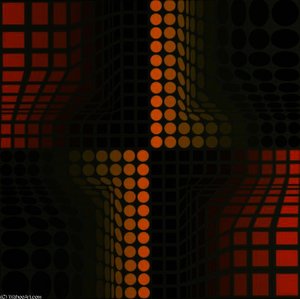
Victor Vasarely's Pal-Ket, painted in 1974, isn’t merely a visual experience; it’s an invitation to reconsider the very nature of perception. This vibrant acrylic on canvas piece, measuring a substantial 224 x 198 cm, embodies the core tenets of Op Art – a movement Vasarely essentially pioneered. Far from static representation, Pal-Ket actively engages with the viewer’s eye, creating an illusion of depth and movement that defies the limitations of a two-dimensional surface. The painting's genesis lies in Vasarely’s lifelong fascination with geometry and its ability to manipulate our visual senses, a pursuit rooted in his early training as a medical student before he decisively embraced the world of art.
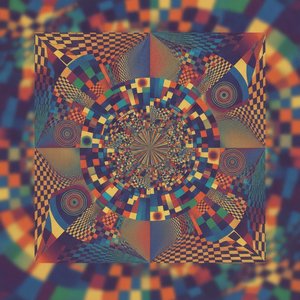
The composition is deceptively simple at first glance: a predominantly circular arrangement dominated by an interplay of blues, greens, and purples. However, closer inspection reveals a meticulously constructed system of overlapping circles, each subtly varying in tone and intensity. This isn’t haphazard layering; Vasarely employed a sophisticated understanding of color theory and optical illusion to generate the impression of volume and spatial depth. The strategic use of gradients – transitioning smoothly from lighter to darker shades – further enhances this effect, mimicking the way light interacts with surfaces in the real world. The careful balance between solid forms and areas of transparency creates a dynamic tension that keeps the eye moving across the canvas, perpetually seeking new points of interest.
The Roots of Op Art: Bauhaus Principles and Beyond
To truly appreciate Pal-Ket, it’s crucial to understand Vasarely's artistic lineage. His early training at Sándor Bortnyik’s Műhely – a school deeply influenced by the principles of the Bauhaus movement – provided him with a foundational understanding of functional design and geometric abstraction. The Bauhaus emphasized clarity, simplicity, and the integration of art into everyday life, values that profoundly shaped Vasarely's approach to painting. He wasn’t interested in replicating reality; instead, he sought to create visual experiences that challenged conventional notions of representation. This pursuit aligns perfectly with the core goals of Op Art – a movement characterized by its use of optical illusions and dynamic patterns to stimulate the viewer’s perception.
Vasarely's work extended beyond mere geometric abstraction. He was deeply interested in exploring the relationship between art, science, and technology. His paintings often evoke the imagery of futuristic cities and technological landscapes – a reflection of his belief that art could be used to shape our understanding of the world around us. The influence of kinetic art is also evident in Pal-Ket; the dynamic arrangement of shapes suggests a sense of movement and energy, as if the painting were constantly shifting and transforming before your eyes.
Symbolism and Emotional Resonance
While Vasarely deliberately avoided overt symbolism in his work, Pal-Ket possesses a subtle emotional resonance. The vibrant colors evoke feelings of joy, optimism, and wonder – qualities that are often associated with the artist’s vision for a more harmonious and technologically advanced future. The circular forms themselves can be interpreted as symbols of unity, wholeness, and infinity. The painting's overall effect is one of playful experimentation and intellectual stimulation, inviting the viewer to engage in a dialogue with the artwork on both a visual and cognitive level.
Pal-Ket stands as a testament to Victor Vasarely’s pioneering spirit and his profound impact on the art world. It's more than just a beautiful painting; it’s an exploration of perception, a celebration of geometry, and a glimpse into a future shaped by technology and imagination. Reproductions of this captivating artwork offer a unique opportunity to bring this dynamic visual experience into your home or office – a vibrant reminder of the power of art to challenge our senses and expand our horizons.
Frågor och svar
Vilket rum rekommenderas för "Pal-Ket" av Victor Vasarely, med tanke på dess färger?
Med tanke på dess Dark färger rekommenderas "Pal-Ket" för ett Hotel Lobby.
Vilken palett och vilken dominerande färg definierar "Pal-Ket"?
"Pal-Ket" definieras av en Dark-palett med Cobalt Violet (#8a92b4) som dominerande färg.
Hur passar "Pal-Ket" in i Victor Vasarelys teman och stil?
"Pal-Ket" tillhör Victor Vasarelys Op Art-period, vars dokumenterade teman inkluderar bauhaus influence, geometric forms, post-war optimism, visual impact, democratizing art, perceptual studies, kinetic art, optical illusions.



 Förhandsvisa
 Byt till tryck
 Skicka
 Dela
Dela
 Visa detaljer
 Guide
Guide

 Ladda ner
 Liknande objekt
 Röntgen
 Bildspel
 Q&A
Q&A Statistik


 Visa mer






































 Glasalternativet är endast tillgängligt i storlekar under 110 cm.